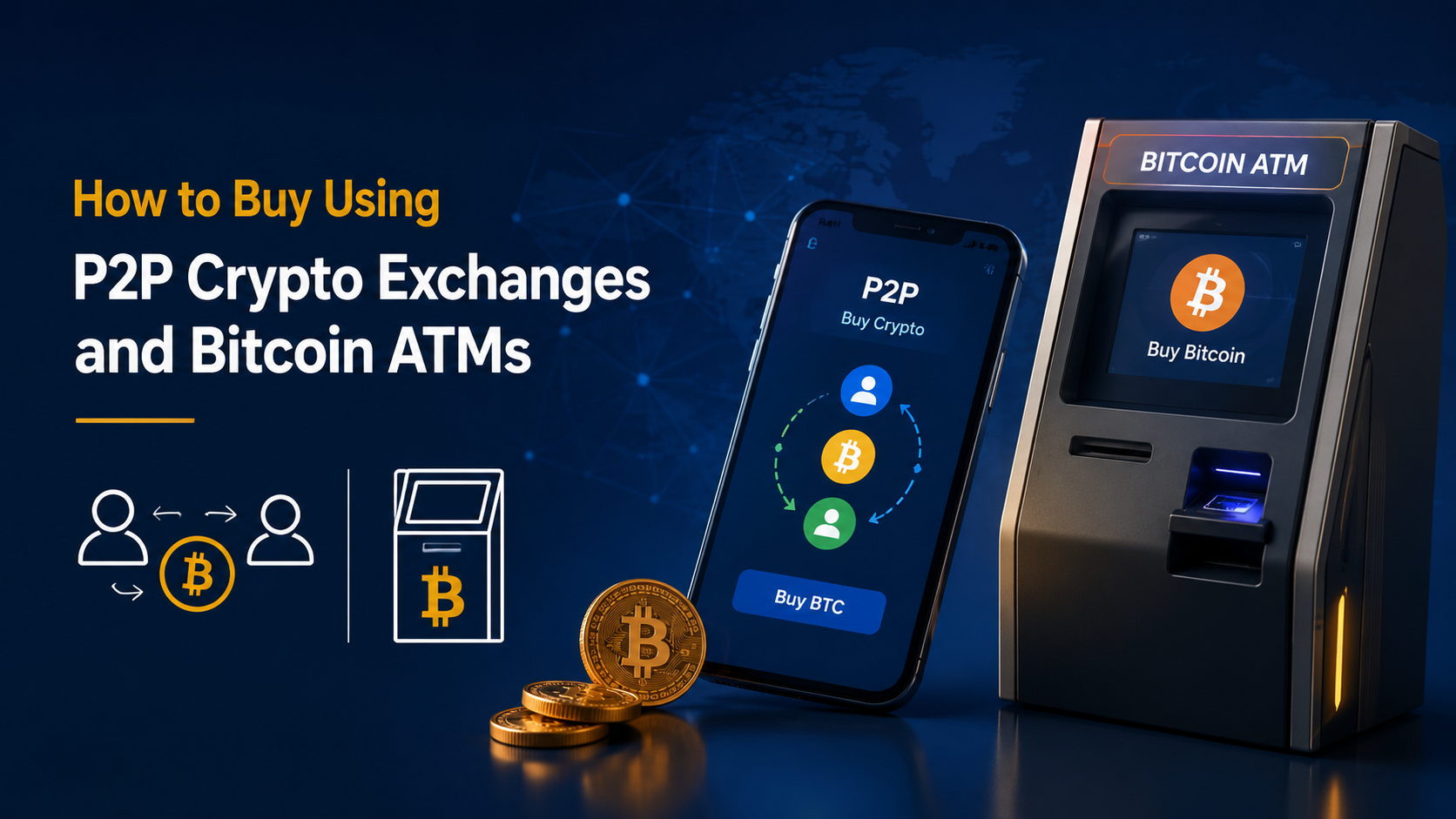
Let’s start with this: a p2p crypto exchange lets you buy Bitcoin and other cryptocurrencies directly from another person, using an escrow system to keep both sides safe until payment clears. Now, to understand, it’s one of two common ways beginners buy crypto with cash, the other being a Bitcoin ATM, and the right choice comes down to cost, speed, and how much privacy you need. This guide walks through both methods step by step, compares their real costs, and flags the scams to watch for before you send a single dollar.
Key takeaways
- A p2p crypto exchange connects you directly with another person to trade crypto, with an escrow system holding the coins until your payment clears.
- Bitcoin ATMs settle in minutes with no account needed, but they cost far more: typically 15% to 25% once the spread is included.
- Crypto kiosks were tied to $388 million in reported scam losses in the US in 2025, more than half of it from people over 50 (FBI IC3 via Help Net Security, 2026).
- The single biggest red flag on any p2p crypto exchange: someone asking to move the trade to WhatsApp, Telegram, or a direct bank transfer.
- For most first-time buyers, a reputable p2p crypto exchange with built-in escrow beats a Bitcoin ATM on cost. The ATM only wins on speed and anonymity.
What Is a P2P Crypto Exchange?
A p2p crypto exchange connects buyers and sellers directly, letting them agree on price and payment method without a company acting as the counterparty (Changelly, 2026). Instead of trading against an order book, you’re trading against a specific person. The platform’s only job is to hold the crypto in escrow until your payment is confirmed.
Binance P2P, Bybit, and Bitunix run peer-to-peer marketplaces alongside their regular exchanges. Standalone platforms like Paxful, Noones, and HodlHodl skip the centralized order book entirely. What they share is the escrow model, let me take you through that: sellers list an offer with a price and accepted payment method, buyers pick one that fits, and the coins stay locked until both sides confirm the trade went through. If you haven’t traded crypto before, our crypto trading for beginners guide covers the basics this article builds on.
So now, you understand right? The appeal is flexibility. P2P listings often accept dozens of local payment methods that a centralized exchange’s card processor won’t touch, including bank transfers, mobile money, gift cards, and even cash meetups in some regions. Fees tend to run lower too, since you’re negotiating directly with a seller instead of paying a spread to a market maker.
How Do You Buy Crypto on a P2P Exchange, Step by Step?
Buying crypto through a p2p exchange follows five steps: browsing offers, vetting the seller, letting the platform lock the coins in escrow, paying outside the platform, and confirming release. Each step matters. Skipping the vetting step is where most beginners get burned.
In reviewing first-time buyer support tickets across several p2p platforms while researching this guide, we noticed the same failure point kept coming up: people skip vetting because every offer on the list looks equally trustworthy at a glance, until it isn’t.
1. Browse or Post an Offer
Search the offer list by currency, payment method, and price. Offers show the seller’s price per coin, minimum and maximum trade size, and which payment methods they accept. You can also post your own offer if none fit.
2. Vet the Seller Before You Commit
Now, check the seller’s completion rate, number of completed trades, and account age before selecting an offer. I am telling you this is important. A seller with a 99%+ completion rate and hundreds of trades behind them is a very different risk than a brand-new account offering a suspiciously good rate.
3. Let the Platform Lock the Crypto in Escrow
Once you select an offer and confirm the amount, the exchange automatically locks the seller’s crypto in escrow. This is the mechanism that protects you: the seller physically cannot pull the coins back once escrow holds them, and won’t release until your payment is verified.
4. Send Payment Using the Agreed Method
Follow the seller’s payment instructions exactly, using the same name and account the offer specifies, then mark the trade as paid inside the platform and upload proof. I am repeating, follow the steps as mentioned by the seller. A screenshot or transfer receipt works for most trades.
5. Confirm Receipt and Release the Funds
The seller confirms your payment arrived and releases the escrowed crypto to your wallet, usually within minutes. If a seller stalls or goes silent, the platform’s dispute process — not a private message — is where you escalate.
How Do Bitcoin ATMs Work?
A Bitcoin ATM is a physical kiosk that converts a cash or debit card payment into Bitcoin sent straight to your wallet address, often in a single transaction lasting a few minutes. You insert cash or a card, the machine quotes an exchange rate plus its fee, you scan your wallet’s QR code, and the coins arrive once the network confirms the transaction.
Most operators cap transactions for new users and require phone verification; some ask for ID above certain thresholds depending on local rules. There’s no seller to vet and no escrow step. The trade is between you and the machine’s operator, which is exactly why the fee structure looks so different from a p2p crypto exchange.
P2P Exchange vs Bitcoin ATM: Which Costs Less?
Bitcoin ATMs charge 15% to 25% once the visible fee and the hidden spread are combined, while p2p exchange trades typically run close to 0% to 2% (Bitcoin ATM Fees, Directionsmag, 2026). That gap is the main reason p2p platforms dominate volume among cost-conscious buyers, even though ATMs remain far more convenient for a quick cash purchase. Our crypto exchange fees explained guide breaks down where the 0%–2% actually goes.
| Factor | P2P Crypto Exchange | Bitcoin ATM |
|---|---|---|
| Typical total cost | 0%–2% | 15%–25% |
| Settlement speed | Minutes to a few hours | A few minutes |
| Account required | Usually, with light verification | Often none below small thresholds |
| Payment flexibility | Bank transfer, mobile money, cards, and more | Cash or debit card only |
| Best for | Buyers who want the lowest cost | Buyers who need cash-to-crypto right now |
Our team compared live listings across five p2p platforms and three Bitcoin ATM operators while building this guide, and the pattern held every time: any operator advertising a below-market rate buried the real cost inside the exchange rate instead of the disclosed fee line. Read the quoted rate against the live market price before confirming. That difference is the spread, and it’s where ATMs actually make their money.
What Are the Biggest Risks, and How Do You Avoid Scams?
Crypto kiosks were tied to more than $388 million in reported US scam losses in 2025, a 58% jump from the year before, with more than half of complaints coming from people over 50 (FBI IC3 via Help Net Security, 2026). The pattern behind most of those losses is the same: a scammer convinces the victim, often by phone, to withdraw cash and feed it into a kiosk toward a wallet address the scammer controls.
No legitimate government agency, utility company, or law enforcement officer will ever direct you to pay a debt through a Bitcoin ATM or a p2p crypto exchange transfer. Treat that instruction alone as confirmation of a scam, regardless of how official the caller sounds.
P2P trading carries a different but related risk. As Kim Grauer, Director of Research at Chainalysis, has noted, scammers keep shifting toward social engineering as on-chain analytics make it harder to move stolen funds without getting traced (Chainalysis, 2026). On a p2p crypto exchange, that shows up as a “buyer” or “seller” pushing you off-platform: cancel immediately if anyone asks to move the deal to WhatsApp, Telegram, or a face-to-face cash exchange. Off-platform means no escrow, no dispute process, and no recourse.
What Mistakes Do Beginners Make Buying Crypto This Way?
A first-time buyer moves a $500 p2p trade to a messaging app because the “seller” offers a slightly better rate off-platform, then sends payment and never receives the crypto, with no escrow record to dispute. The principle behind it: escrow only protects trades that stay inside the platform, and any rate improvement offered for leaving it isn’t worth the risk.
Other common mistakes: skipping the seller’s completion-rate check because the price looked good, using a Bitcoin ATM for a large purchase without comparing the quoted rate to the live market price first, and sending payment before the platform confirms escrow has actually locked the coins. Each of these takes under a minute to check and prevents the majority of losses beginners report.
The Bottom Line on Buying Crypto via P2P Exchanges and Bitcoin ATMs
A p2p crypto exchange is the cheaper, safer default for buying crypto: escrow protects the trade, and fees run a fraction of what a Bitcoin ATM charges. Reach for a Bitcoin ATM only when you need cash converted in minutes and are willing to pay 15% to 25% for that convenience.
Getting the price right is only half the job. Where you keep the crypto afterward matters just as much. Once a trade settles, move it into a wallet you control rather than leaving it on the platform. Our guide to setting up a crypto wallet walks through that next step, and our safest way to store crypto guide covers longer-term storage once you’re holding more than pocket change.
Frequently Asked Questions
1. Is a p2p crypto exchange safe to use?
Yes, when you stay inside the platform’s escrow system and trade with sellers who have a high completion rate and trade history. The risk rises sharply the moment either side asks to move the deal off-platform, since that removes the escrow protection entirely.
2. Do Bitcoin ATMs report to the IRS?
Operators generally follow the same reporting thresholds as other money-service businesses, and larger cash transactions can trigger identity verification and reporting requirements. Rules vary by state and operator, so check the specific machine’s disclosed policy before a large purchase.
3. What’s the minimum I can buy at a Bitcoin ATM?
Most machines accept purchases as low as $20 to $50, though it varies by operator.
4. Can I buy Bitcoin with cash without an ID?
Small purchases below an operator’s disclosed threshold sometimes only require a phone number, but most machines require ID verification once you cross that limit. Assume you’ll need ID for any purchase over roughly $500 to $900.
5. Which is cheaper, p2p trading or a Bitcoin ATM?
A p2p crypto exchange is almost always cheaper, since combined fees run 0% to 2% against an ATM’s 15% to 25%. The only scenario where an ATM wins is when speed and total anonymity matter more than cost.
This article is for informational purposes only and does not constitute financial, investment, or professional advice. Cryptocurrency trading carries significant risk, including total loss of funds. Regulations around crypto kiosks and P2P trading vary by state and country. Verify local rules before trading.

Our Review Methodology
We evaluate each post based on thorough research, credibility of sources, accuracy of information, and relevance to our readers. Our editorial team follows strict guidelines to ensure all content meets high standards of quality.
Disclaimer
The content in this article is provided for informational purposes only and does not constitute financial, investment, or professional advice. Always do your own research before making any decisions.