Every crypto trade carries at least two cost layers — a trading fee (split into maker or taker rates) and a spread embedded in the quoted price. Stack on deposit charges, withdrawal fees, and network costs, and a platform advertising “0.1% fees” can quietly take 2% or more per round trip. The sections below break down every fee type, which ones matter most for your trading style, and where the hidden costs actually live.
What Are Crypto Exchange Fees?
Exchanges charge fees on nearly every action — buying, selling, depositing, and withdrawing. The revenue funds matching infrastructure, customer support, security auditing, and, let’s be honest, shareholder returns. Understanding how these fees stack together is the difference between thinking you made a 5% return and realizing you barely broke even after costs.
There are four core fee types every trader needs to know:
- Trading fees (maker/taker) — charged as a percentage of each transaction
- Spread fees — the markup baked into the quoted price before you ever see it
- Deposit and withdrawal fees — charged when moving money in or out of the platform
- Network fees — paid to blockchain validators, not the exchange itself
Most platforms headline the trading fee and bury the others. Each one gets its own section below, because they work very differently — and they hurt very differently depending on how you trade.
If you’re still figuring out which platform to use, the crypto trading for beginners guide covers the broader picture before fees even enter the picture.
What Is a Maker Fee — and Why Do Exchanges Charge Less for It?
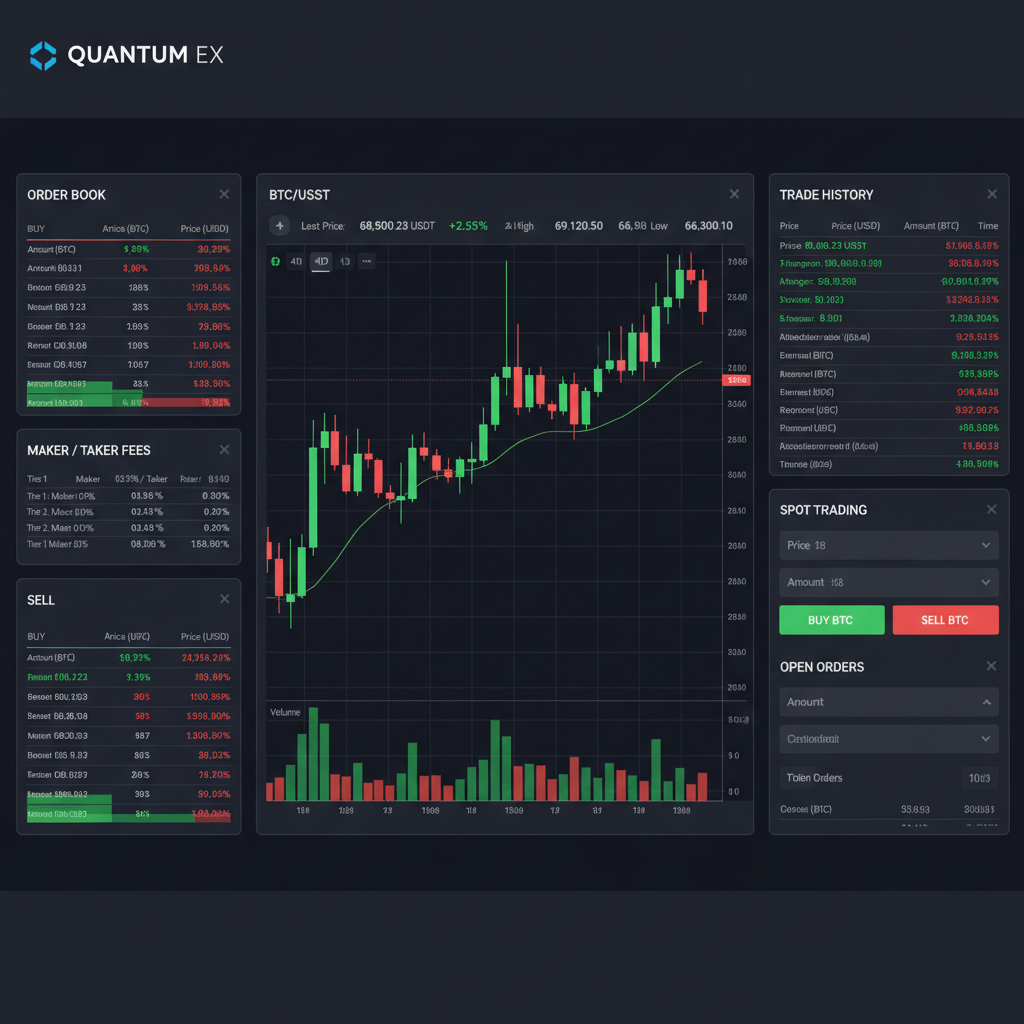
A maker places a limit order that doesn’t execute immediately — say, a bid to buy Bitcoin at $65,000 when the current price is $65,800. That order sits in the order book, waiting. In the meantime, it’s actually useful to the exchange: it gives other traders more options to fill against, which improves market depth and overall liquidity.
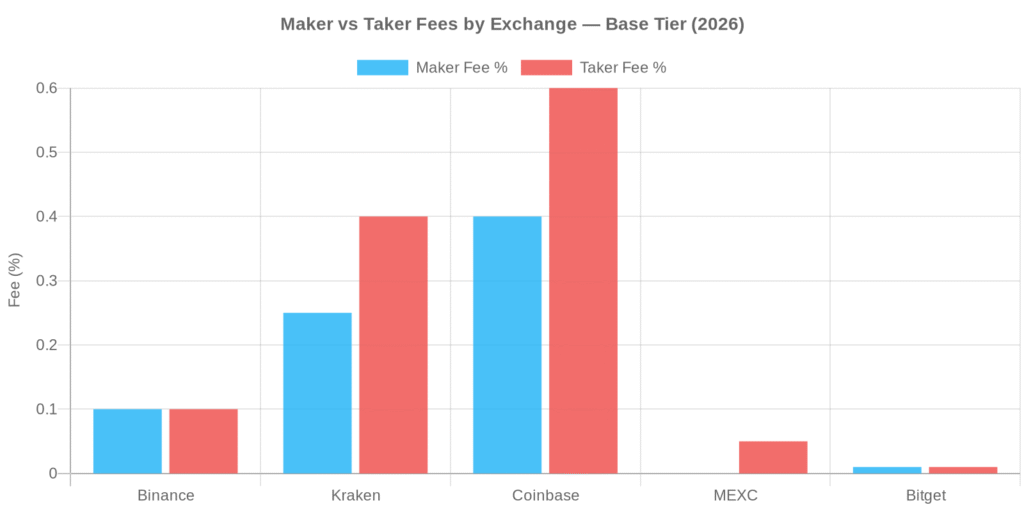
Because makers add liquidity, exchanges reward them with lower fees. Binance charges 0.10% for makers at the base tier (dropping as low as 0.011% for high-volume accounts). MEXC goes further — 0% maker fees on spot trading, which means you can place limit orders on that platform without any per-trade cost at all. The industry average maker fee sits around 0.024%, according to Bitget Academy’s 2026 fee analysis.

What Is a Taker Fee in Crypto?
Takers do the opposite. A market order — “buy Bitcoin at whatever price it’s at right now” — executes immediately by pulling from the existing order book. That’s consuming liquidity, and exchanges charge more for it.
Standard taker fees across major platforms run between 0.10% and 0.60% at the base tier. Kraken starts at 0.40% taker for spot trades (though active traders work that down to 0.08% at higher monthly volume thresholds). Coinbase’s standard taker rates sit at 0.40%-0.60% depending on the trading pair and order type. Industry-wide, the average taker fee is approximately 0.053% — a figure that drops sharply at higher volume tiers but represents real cost for most retail accounts.
Here’s the practical impact: on a $5,000 BTC position on Coinbase’s standard interface, you’re paying $20-$30 in taker fees alone, before any other costs. That adds up fast for anyone trading actively, especially for approaches like day trading cryptocurrency where you might make dozens of entries and exits per week. The math on a 50-trade month at those rates is not pretty.
Spread Fees: The Hidden Tax on Every Trade
This is the one most beginners miss completely. Spreads aren’t listed as a fee — they’re embedded in the quoted price, silently.
If Bitcoin’s true market price is $65,000, a platform might show you a buy price of $65,300 and a sell price of $64,700. That $600 gap (roughly 0.9%) goes to the exchange as revenue, and it never shows up on your transaction summary. Platforms that advertise “zero trading fees” are almost always monetizing through spreads instead — the fee didn’t disappear, it just moved somewhere less visible.
“Spread fees are one of the most misunderstood costs in crypto,” as Gemini noted in its Cryptopedia documentation. “An advertised rate of zero doesn’t mean trading is actually free.”
The spread matters most on larger transactions and thinner markets. Altcoins with lower trading volume tend to have significantly wider bid-ask gaps than major pairs like BTC/USDT or ETH/USDT. It’s also where slippage enters: on a large market order, the price you execute at can shift mid-fill because you’re consuming multiple levels of the order book simultaneously.
I discovered this on a mid-cap altcoin purchase (not worth naming — it’s since been delisted anyway). The platform showed 0% trading fees in the header. What it didn’t show was a 1.8% spread baked into the quote. On a €2,000 position, that was €36 going in and another €36 coming out — €72 in exchange revenue I hadn’t budgeted for, on a trade I thought was “free.” Lesson absorbed.
Deposit and Withdrawal Fees — Where the Nickel-and-Diming Starts
Most exchanges accept crypto deposits at no charge. Fiat deposits are where the fee structures diverge sharply.
Bank transfers (SEPA in Europe, ACH in the US) are typically free or very cheap — some platforms add a flat $1-3 per transfer. Credit and debit card deposits are a different story: most exchanges charge between 1.5% and 5% for card funding, because card networks charge interchange on their end and pass that cost through. A $5,000 deposit via credit card at 3% costs you $150 before a single trade is placed.
Withdrawal fees depend on the asset and the specific blockchain network used. Binance charges approximately 0.00011 BTC (roughly $7-8 at current prices) to withdraw Bitcoin. Coinbase adds a service fee on top of the actual network cost. Choosing networks strategically helps: the same $1,000 USDT withdrawal costs around $1 on Tron’s TRC-20 network versus $15-20 on Ethereum’s ERC-20 during busy periods.
| Funding Method | Deposit Fee | Notes |
|---|---|---|
| Crypto deposit | Free | Network fee on withdrawal applies |
| Bank transfer (ACH/SEPA) | Free – $3 flat | Slowest, but cheapest |
| Credit / debit card | 1.5% – 5% | Instant but expensive |
| PayPal (where available) | 1% – 2.5% | Limited availability by exchange |
Ranges based on major exchange averages as of Q1 2026. Verify on each platform’s fee schedule before funding.
Network Fees: The Third Party Nobody Asked For
Network fees (gas fees on Ethereum) aren’t set by the exchange — they go to the validators or miners processing your transaction on-chain. Exchanges display an estimate, but the actual cost fluctuates based on network congestion at the moment of the transaction.
Ethereum gas has historically swung from under $1 to over $50 per transaction depending on demand. During peak activity periods — bull run peaks, major NFT drops, DeFi farming rushes — gas fees alone can make small transfers economically pointless. Bitcoin network fees are generally more stable but spike during periods of high mempool activity.
What some exchanges do, and it’s worth watching for, is add a markup on top of the actual network fee. The display shows “blockchain fees,” but the amount includes the exchange’s margin. This is disclosed in most fee schedules but rarely highlighted.
If you’re moving funds regularly across platforms, understanding the CEX vs DEX differences also means understanding that networks like Solana, Avalanche, and Binance Smart Chain run gas fees well below $0.01. For high-frequency on-chain activity, the network choice matters as much as the exchange choice.

Are There Other Fees You’re Not Seeing?
Several, actually.
Conversion fees. When you swap between two non-stablecoin tokens on the same platform — say, SOL to MATIC — many exchanges route that through an intermediate conversion to USDT or BTC. Each leg of the conversion carries its own fee, even if the interface presents it as a single, seamless swap.
Inactivity fees. Some platforms (particularly those positioned as brokerage services rather than exchanges) charge monthly fees if your account sits dormant below a certain trading volume. These are rare but not unheard of, and they’re usually buried in the terms and conditions rather than the fee schedule.
KYC-gated tiers. Unverified accounts on several exchanges are locked out of the lower fee tiers. The maker/taker rates advertised on the fee schedule may apply only after full identity verification. An unverified account might face flat percentage fees significantly higher than the promoted figures.
Margin and funding rates. If you’re using spot vs margin trading and holding leveraged positions overnight, the funding rate applies every 8 hours on perpetual futures contracts. At 0.01% per 8 hours, that’s 0.03% daily — or roughly 11% annualized on a held position. Irrelevant for short-term trades. Very relevant for anyone holding for days or weeks.
Staking and yield product fees. If the platform offers yield products (staking pools, savings accounts, auto-compound vaults), there’s almost always a performance fee or management fee attached — often 10-20% of earnings. The headline APY often doesn’t reflect this.
How Do You Actually Reduce Crypto Exchange Fees?
Start with the biggest lever: place limit orders instead of market orders. This alone flips you from taker rates to maker rates — a difference of 0.10-0.40 percentage points per trade depending on the platform. On $10,000 in monthly volume, that’s $10-40 saved before anything else changes.
Use the exchange’s native token where applicable. Binance’s BNB token provides a 25% discount on trading fees when selected as the payment method — turning a 0.10% taker fee into 0.075%. KuCoin’s KCS, OKX’s OKB, and similar exchange tokens offer comparable discounts. If you’re trading regularly on one platform, holding a small amount of its native token is straightforward fee optimization.
Trade more, pay less. Every major exchange uses a volume-based tiered structure. Binance’s highest tier reaches 0.011% maker and 0.023% taker — a fraction of the base rate. If you’re consistently hitting $100K-$500K+ in monthly volume, reviewing which tier you’re in and how close you are to the next bracket is worth the attention.
Fund via bank transfer, not card. A $5,000 credit card deposit at 3% costs $150 upfront. The same amount via ACH or SEPA typically costs nothing, just takes 1-3 business days. For anyone funding regularly, this is the lowest-effort fee reduction available.
Compare total cost, not just headline rate. Two exchanges both advertising 0.10% can have wildly different all-in costs once spreads, withdrawal fees, and network markups are included. Tradelize’s crypto exchange reviews compare exchanges across full cost metrics — not just trading fee rates.
And if you’re evaluating whether HODLing vs active trading makes more sense for your situation, fee costs are part of that equation — active strategies bear repeated round-trip costs that long-term holders don’t.
CEX vs. DEX Fees: Which Is Actually Cheaper?
Centralized exchanges (CEXs) charge structured trading fees and control withdrawal costs. Decentralized exchanges (DEXs) like Uniswap operate differently — there’s no central operator taking a trading fee. Instead, liquidity providers earn swap fees (0.01%-1% on Uniswap v3 depending on the pool), and you pay gas costs to execute the swap on-chain.
For small trades on a congested network like Ethereum, DEX fees can be painfully expensive. A $200 swap during a high-gas period might cost $15-25 in transaction fees alone — making the all-in cost far higher than any CEX taker rate. On cheaper networks, the math flips: Solana-based DEXs running sub-$0.01 gas with 0.25% swap fees beat most CEX taker rates at standard volume.
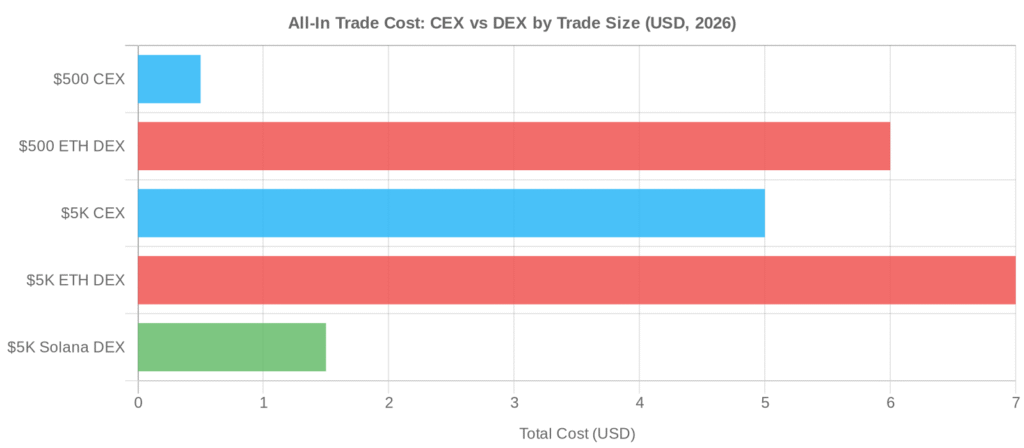
For most beginners working through how to choose a crypto exchange, the CEX route is more predictable — you know what you’re paying upfront. DEXs have real advantages: no KYC, direct wallet control, access to tokens that haven’t listed on centralized platforms yet. But the gas variable makes cost planning harder, and the interface is less forgiving for new traders.
Having said that, if you’re actively operating in DeFi on Solana or Avalanche, the CEX fee comparison becomes largely irrelevant. Different tools for different contexts.
The Bottom Line on Crypto Exchange Fees
Crypto exchange fees aren’t just the headline percentage. They’re trading fees plus spreads plus deposit costs plus network charges, and the actual total is almost always higher than whatever number got your attention during signup. A 0.10% trading fee means something very different at Binance (tight spreads on BTC/USDT, competitive withdrawal fees, native-token discounts available) versus a smaller platform where a wide spread and card deposit add 3-4% before a single trade is placed.
Know your maker/taker status. Check the spread on the pairs you actually trade, not just the featured pairs. Fund via bank transfer rather than card. Use limit orders where your strategy allows it. Those four habits will cut your fee costs substantially without changing what you trade.
For a ranked comparison of exchanges by actual all-in cost, Tradelize’s top crypto exchanges guide benchmarks platforms across trading fees, spreads, and withdrawal costs together.
Frequently Asked Questions
What is a typical crypto exchange trading fee?
Most major exchanges charge between 0.01% and 0.40% per trade at the base tier, with maker fees lower than taker fees. The industry average sits around 0.024% maker and 0.053% taker for spot trading, according to Bitget Academy’s 2026 data. High-volume tiers and native-token discounts can bring this significantly lower for active traders.
What’s the difference between maker and taker fees?
A maker places a limit order that doesn’t execute immediately — adding liquidity to the order book. A taker places a market order that fills right away — removing liquidity. Exchanges charge makers less because their pending orders improve market depth. Takers pay more because their orders require immediate matching against existing book entries.
Are crypto exchange fees tax-deductible?
In most jurisdictions (including the US and UK), trading fees paid to acquire or sell crypto are added to your cost basis or subtracted from proceeds — which effectively reduces the taxable gain. The exact treatment varies by country and by whether you’re classified as a trader or investor. Consult a local tax professional who handles digital assets before filing.
Which crypto exchange has the lowest fees?
MEXC currently offers 0% maker fees and 0.05% taker fees on spot trading, making it the lowest by headline rate. Binance is competitive at 0.10% base with further discounts for BNB holders and high-volume tiers. However, total cost depends on spreads and withdrawal fees — always compare all-in cost for the specific pairs you trade.
Can exchange fees eat into my trading profits?
Yes — significantly for active strategies. A 0.20% round-trip fee (entry plus exit) means you need at least a 0.20% price move just to break even on the trade. For strategies with thin margins — like the arbitrage opportunities approach where price gaps between exchanges are often well under 1% — fee minimization isn’t optional. It determines whether the strategy is profitable at all.

Our Review Methodology
We evaluate each post based on thorough research, credibility of sources, accuracy of information, and relevance to our readers. Our editorial team follows strict guidelines to ensure all content meets high standards of quality.
Disclaimer
The content in this article is provided for informational purposes only and does not constitute financial, investment, or professional advice. Always do your own research before making any decisions.