Day trading cryptocurrency means buying and selling digital assets within the same day to profit from short-term price swings. The cryptocurrency market averaged $264.5 billion in daily trading volume throughout 2025 (CoinGecko 2025 Annual Report, 2025), making it one of the most active markets for short-term traders. But that activity cuts both ways. Most people who try day trading crypto lose money — and the ones who don't treat it as a skill that takes months, sometimes years, to develop.
This guide breaks down how day trading cryptocurrency works, which strategies actually get used by active traders, how to pick the right assets, and — just as important — how to manage the risks that blow up most beginners.
TL;DR: Day trading cryptocurrency involves buying and selling crypto within a single day to capture short-term price moves. The crypto market averaged $264.5 billion in daily volume in 2025 (CoinGecko, 2025), but roughly 84% of retail crypto traders lose money in their first year. Success demands technical analysis skills, strict risk rules, and emotional discipline.
What Is Day Trading Cryptocurrency?
Day trading cryptocurrency is a short-term trading approach where all positions are opened and closed within the same day. The crypto market averaged $264.5 billion in daily trading volume in 2025 (CoinGecko 2025 Annual Report, 2025). Unlike buy-and-hold investing, day traders aim to profit from small intraday price movements rather than long-term trends.
"The most important lesson for anyone entering crypto markets is that volatility is not the enemy; lack of understanding and poor risk management are," explains Andreas M. Antonopoulos, cryptocurrency educator and author of Mastering Bitcoin.
A day trader might execute anywhere from 2 to 20 trades in a single session. Some hold positions for hours, others for minutes. The common thread? Everything gets closed before you go to sleep. No overnight exposure. No waking up to a 15% gap against your position because some exchange got hacked at 3 AM.
What separates crypto day trading from stocks or forex? The market never closes. Crypto trades 24 hours a day, 7 days a week, 365 days a year. That's both an advantage and a trap — more opportunities, but also more chances to overtrade when you should be away from the screen.
Why Are Crypto Markets Ideal for Day Trading?
Cryptocurrency markets hit their highest average daily trading volume in Q4 2025 at $161.8 billion (CoinGecko 2025 Annual Report, 2025). That liquidity, combined with round-the-clock access, makes crypto one of the most active environments for day traders.
Three things make crypto markets attractive for short-term trading.
Volatility creates opportunity. Bitcoin can swing 3-5% in a single day. Altcoins can move 10-20%. For day traders, those swings are the raw material. A stock trader working with a 0.5% daily range has to use heavy leverage to make the math work — crypto gives you that movement naturally.
Liquidity on major pairs is deep. Bitcoin, Ethereum, and top-20 assets by market cap trade billions of dollars daily. You can enter and exit positions quickly without moving the price against yourself. Slippage on a $10,000 BTC/USDT order on a major exchange? Virtually zero.
24/7 access means flexible scheduling. Traditional stock markets operate roughly 6.5 hours per day. Crypto doesn't close. Asian session, European session, US session — volatility spikes happen around the clock, and you pick the hours that fit your schedule.
The flip side: 24/7 markets also mean 24/7 temptation. There's always "one more trade" available. That's why discipline matters more in crypto than in any other market.
How Much Do Crypto Day Traders Actually Make?
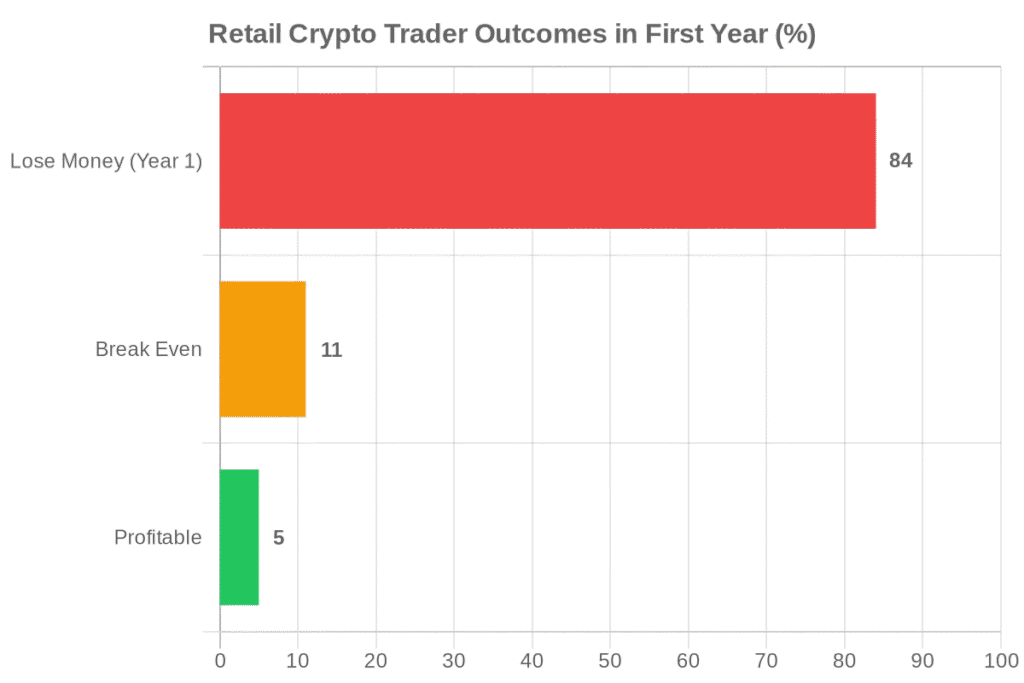
An estimated 84% of retail crypto traders lose money within their first year of trading, according to a 2025 survey of retail trader outcomes. Broader research on day trading suggests roughly 95% of day traders eventually lose money (Cointelegraph, 2025). These aren't scare tactics — they're the reality that anyone considering day trading cryptocurrency needs to absorb before risking real money.
So who makes up the profitable 5%? Traders who spent significant time developing a strategy, testing it with paper trading, and building the discipline to follow their rules even when emotions scream to do something different.
The profitable minority shares common traits: they risk small percentages per trade (typically 1-2% of their account), they keep detailed journals, and they treat losing trades as data rather than failures. They also tend to specialize — one asset, one timeframe, one or two setups — rather than chasing every opportunity across dozens of coins.
Here's the honest picture: day trading cryptocurrency can generate returns, but expecting consistent income from month one is unrealistic. Most successful traders describe their first 6-12 months as an expensive education.
What Are the Best Strategies for Day Trading Crypto?
Day trading cryptocurrency relies on repeatable strategies rather than gut feeling. Four approaches dominate among active crypto day traders, each suited to different market conditions (Gemini Cryptopedia, 2026). No single strategy works in every environment, and the best traders switch between them depending on what the market is doing that day.
Scalping
Scalping targets very small price movements — often fractions of a percent — across many trades per day. A scalper might enter and exit a position within seconds or minutes. The profit per trade is tiny, but it adds up over dozens of executions.
Scalping works best in high-liquidity environments where spreads are tight. It's mentally exhausting and requires fast execution. Not a great starting point for beginners.
Range Trading
When a cryptocurrency bounces between clear support and resistance levels, range traders buy near support and sell near resistance. This works well during consolidation periods when there's no strong directional trend.
Identifying those levels accurately is everything. A support level that's held three times is more reliable than one that's held once. Range traders also need to recognize when a range is about to break — getting caught on the wrong side of a breakout is the classic range-trading mistake.
Breakout Trading
Breakout traders wait for price to push through a key support or resistance level, then enter in the direction of the move. The logic: a breakout signals strong momentum, and you ride it before it fades.
Not every breakout is real. False breakouts — where price pushes through a level and immediately reverses — happen constantly in crypto. Many traders wait for confirmation: a candle close above resistance, or a volume spike accompanying the move.
News and Sentiment Trading
Crypto markets react sharply to news. A regulatory announcement, an exchange hack, a major institution buying Bitcoin — these events can move prices 5-10% in minutes. News traders position themselves to capture those moves.
Sentiment analysis tools track social media activity, whale wallet movements, and funding rates on derivatives exchanges. When fear or greed reaches extremes, reversals often follow. The challenge? By the time you read about it on Twitter, the move may already be priced in.
| Strategy | Core Idea | Best Market Condition | Difficulty |
|---|---|---|---|
| Scalping | Capture tiny price moves across many trades | High liquidity, tight spreads | Advanced |
| Range Trading | Buy support, sell resistance | Sideways / consolidating markets | Intermediate |
| Breakout Trading | Enter after key level breaks | High volatility transitions | Intermediate |
| News/Sentiment | Trade on market-moving events | Any (event-driven) | Advanced |
Which Cryptocurrencies Are Best for Day Trading?
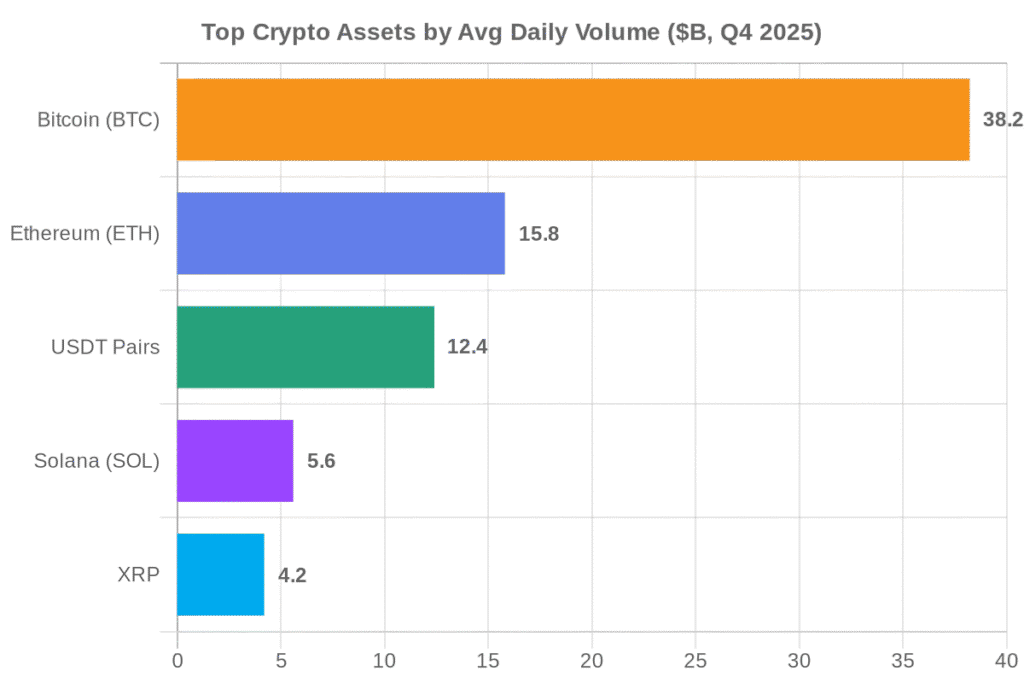
The best cryptocurrencies for day trading share three characteristics: high daily trading volume, consistent volatility, and deep order books on major exchanges. Without these, you'll struggle with slippage, wide spreads, and the inability to exit quickly when trades go wrong.
Bitcoin (BTC) remains the default choice. It has the highest daily volume of any cryptocurrency and tight spreads on every major exchange. Bitcoin's volatility is lower than most altcoins, but it's more predictable — patterns and support/resistance levels tend to hold more reliably.
Ethereum (ETH) offers more volatility than Bitcoin while still providing deep liquidity. ETH reacts strongly to DeFi and ecosystem news, giving sentiment traders additional catalysts to work with.
Solana (SOL), XRP, and BNB are popular altcoin day trading targets. Higher volatility means larger potential moves, but also wider spreads and more erratic price action. These assets suit traders who've graduated beyond Bitcoin and handle faster markets comfortably.
A practical rule: stick to coins in the top 20 by market capitalization when starting out. Below that threshold, liquidity drops fast, spreads widen, and a single large order can move the price against you. For specific exchange options, check our crypto exchange reviews.
What Tools and Indicators Do Crypto Day Traders Use?
Successful day trading cryptocurrency depends on combining chart reading skills with the right technical indicators. No single indicator works alone — experienced traders use two or three together to confirm signals before entering a trade.
RSI (Relative Strength Index)
RSI measures momentum on a scale of 0 to 100. Readings above 70 suggest an asset is overbought and may pull back. Below 30 signals oversold conditions and a potential bounce. Day traders watch for RSI divergence — when price makes a new high but RSI doesn't — as an early reversal signal.
Moving Averages
Moving averages smooth out price data to show trends. The 9-period and 21-period exponential moving averages (EMAs) are popular among crypto day traders. When the 9 EMA crosses above the 21 EMA, that's a bullish signal. The reverse suggests bearish momentum. Simple concept, but it filters out a lot of noise on lower timeframes.
MACD (Moving Average Convergence Divergence)
MACD tracks the relationship between two moving averages. When the MACD line crosses above the signal line, it suggests upward momentum. Histogram bars growing or shrinking give you an early read on whether momentum is building or fading.
Volume Indicators
Volume confirms price moves. A breakout on high volume is more likely to follow through than one on low volume. On-Balance Volume (OBV) tracks cumulative buying and selling pressure, while Volume Weighted Average Price (VWAP) shows the average price weighted by volume — institutional traders use VWAP as a benchmark, so it often acts as support or resistance. For deeper explanation of these concepts, see our crypto glossary.
How Do You Manage Risk When Day Trading Crypto?
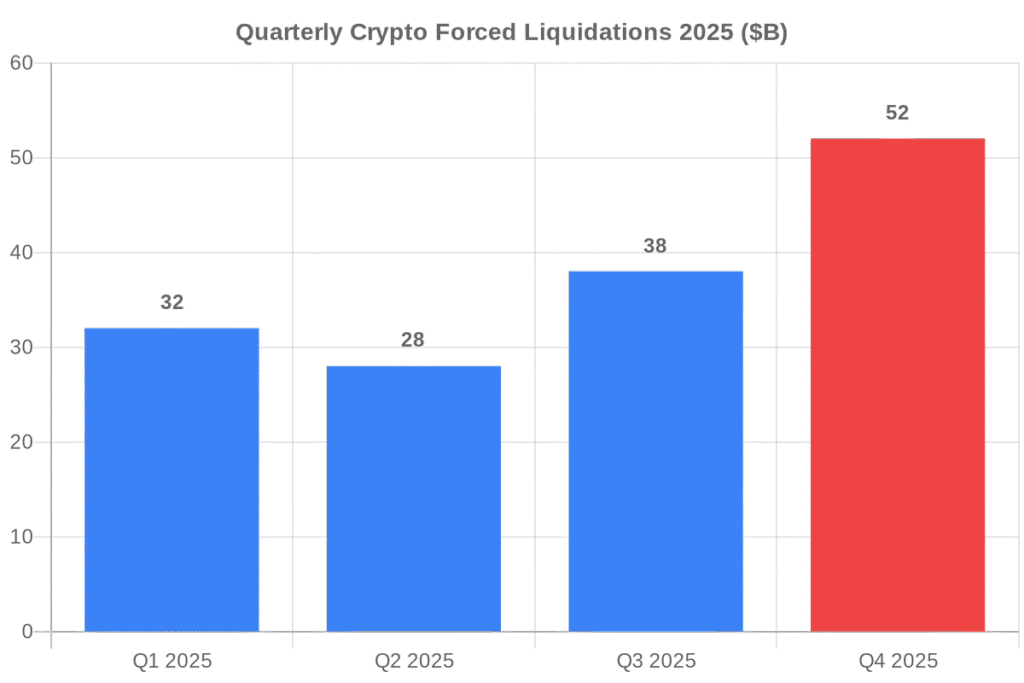
Forced liquidations in cryptocurrency markets totaled approximately $150 billion in 2025, with open interest peaking at $235.9 billion before a massive deleveraging event wiped out over $70 billion in positions (CoinGecko 2025 Annual Report, 2025). Those numbers should be sobering. Risk management isn't optional in crypto day trading — it's the difference between surviving to trade another day and getting wiped out in a single session.
The 1-2% rule. Never risk more than 1-2% of your total trading capital on a single trade. If you have a $10,000 account, your maximum loss per trade is $100-$200. Even a string of 10 consecutive losers — which happens more often than you'd think — only costs 10-20% of your account.
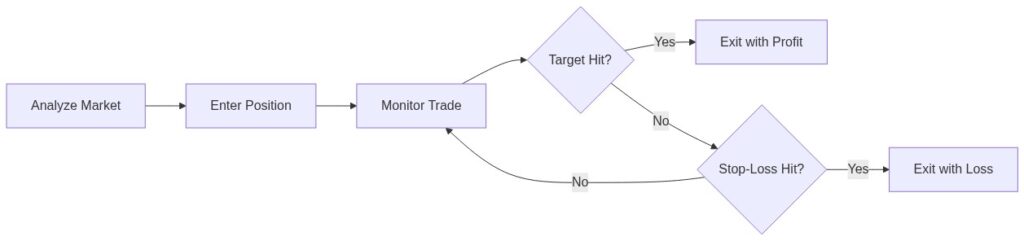
Stop-loss orders are non-negotiable. Set your stop before entering the trade. Decide where the trade thesis breaks down, calculate position size based on the distance to that stop, and don't move it further away once live. Moving stops is how small losses become account-killing disasters.
Position sizing beats win rate. A trader who wins 40% of trades can still profit if their average win is 2-3x their average loss. Proper position sizing ensures no single trade — regardless of how convincing the setup — can seriously damage your capital.
I started keeping a trading journal six months into day trading crypto, and it changed everything. Each entry logs the pair (usually BTC/USDT on the 15-minute chart), the setup that triggered my entry, and my emotional state before clicking buy. The pattern became obvious fast — my worst trades clustered on days where I'd already taken a loss and was trying to "make it back." Now I have a hard rule: two consecutive losses and I close the platform for the day. It's saved me more money than any indicator ever has.
Essential risk management rules for crypto day traders:
- Set a fixed risk per trade (1-2% of capital)
- Use stop-loss orders on every position
- Limit leverage — 2x-5x maximum for day trading (skip 50x or 100x)
- Cap daily losses at 5% of account; stop trading if you hit it
- Keep a trading journal tracking both trades and emotional state
- Never add to a losing position
What Are the Psychological Challenges of Crypto Day Trading?
Beyond technical skills, day trading cryptocurrency demands emotional control that most people underestimate. The 24/7 nature of crypto markets intensifies every psychological trap. There's no closing bell forcing you to walk away. No weekend break to reset. The market is always there, always tempting.
FOMO drives more bad trades than any technical mistake. You see a coin pumping 15% on your feed, jump in without a plan, and it reverses the moment you buy. FOMO trades rarely work because you're buying exactly when everyone else already has — at the worst possible entry.
Revenge trading follows a loss. You're frustrated, want your money back, and take the next setup without proper analysis. One loss becomes two, then three. Before you know it, you've blown through your daily limit. The fix is simple but hard: step away after consecutive losses. Come back tomorrow.
Overconfidence after winning streaks is equally dangerous. Three profitable trades and you start sizing up, skipping your checklist, taking trades you'd normally pass on. Winning streaks feel like skill. Losing streaks feel like bad luck. Usually, it's the opposite.
The traders who survive long-term follow a written plan. Entry rules, exit rules, position sizing, daily loss limits — all documented before the market opens. When emotions kick in, the plan takes over. If you're new to cryptocurrency concepts, get comfortable with the basics before adding the emotional pressure of real-money day trading.
How Are Crypto Day Trading Profits Taxed?
The tax treatment of day trading cryptocurrency varies by jurisdiction, but one thing is consistent: most countries treat crypto trading profits as taxable events. In the United States, the IRS classifies cryptocurrency as property, and every profitable trade triggers a capital gains obligation.
In September 2025, SEC Chairman Paul Atkins and CFTC Acting Chairman Caroline Pham issued a joint statement on harmonizing crypto regulation through "Project Crypto" — a coordinated federal initiative creating clear rules for digital asset markets while maintaining investor protection (SEC.gov, 2025).
Key tax considerations for crypto day traders:
- Short-term capital gains apply to assets held under one year (all day trades qualify) and are taxed at your ordinary income rate
- Every trade is a taxable event — swapping BTC for ETH counts, even without converting to fiat
- Record-keeping is essential — with dozens of daily trades, you need software (CoinTracker, Koinly, TaxBit) to calculate liabilities accurately
- Wash sale rules — as of 2025, the IRS has been expanding application of wash sale provisions to cryptocurrency
Outside the US, the UK (HMRC), Australia (ATO), and most EU jurisdictions also tax crypto trading gains. Ignoring tax obligations doesn't make them disappear — it compounds them with penalties and interest.
The Bottom Line on Day Trading Cryptocurrency
Day trading cryptocurrency can generate returns from the market's natural volatility, but the data doesn't lie: the vast majority of retail traders lose money, especially in their first year. The crypto market's 24/7 access, deep liquidity, and price swings create genuine opportunities — but they also create an environment that punishes underprepared traders quickly.
The traders who survive approach this as a skill requiring months of study, paper trading, and disciplined execution. If you're considering getting started, begin with our beginner's guide to crypto trading and practice on a demo account before risking real capital.
Frequently Asked Questions
Is day trading cryptocurrency legal?
Day trading cryptocurrency is legal in most countries, including the United States, UK, Australia, and the EU. Regulations focus on exchange licensing and tax compliance rather than banning the practice. The SEC and CFTC launched "Project Crypto" in 2025 to build clearer regulatory frameworks for digital asset trading. Check your local jurisdiction's specific rules before starting.
How much capital do you need to start day trading crypto?
Unlike US stock markets where pattern day traders need $25,000 minimum, crypto has no legal capital requirement. Some exchanges accept deposits as low as $10. Most experienced traders recommend starting with $500-$1,000 so that transaction fees don't consume your profits. Only trade with money you can afford to lose entirely.
Can you make consistent profits from day trading cryptocurrency?
Consistent profits are possible but statistically uncommon. Research suggests only about 5% of day traders end up profitable over time. Success requires a tested strategy, strict risk management at 1-2% per trade, detailed trade journaling, and the emotional discipline to follow rules through inevitable losing streaks.
What is the best time to day trade crypto?
Crypto markets trade 24/7, but volatility peaks during major session overlaps. The US market open (1:30-4:30 PM UTC) and Asian session (midnight-3:00 AM UTC) typically produce the largest price movements. Bitcoin and Ethereum see their highest volumes during US trading hours.
Is day trading crypto suitable for beginners?
Day trading crypto is one of the most challenging entry points for beginners. High volatility, easy leverage access, and 24/7 availability punish mistakes quickly. Beginners should start with longer timeframes like swing trading, learn chart analysis fundamentals, and paper trade before risking real money on day trades.
Cryptocurrency trading involves substantial risk of loss and is not suitable for every investor. Past performance does not guarantee future results. This article is for educational purposes only and does not constitute financial advice. Always conduct your own research and consider consulting a qualified financial advisor before trading.

Our Review Methodology
We evaluate each post based on thorough research, credibility of sources, accuracy of information, and relevance to our readers. Our editorial team follows strict guidelines to ensure all content meets high standards of quality.
Disclaimer
The content in this article is provided for informational purposes only and does not constitute financial, investment, or professional advice. Always do your own research before making any decisions.