Key Takeaways
- Bitcoin is money that settles without any intermediary, and this is what separates it from the balance in your bank account.
- Its supply is capped in code, and almost all of it has already been issued, so new issuance now barely adds to supply.
- Owning bitcoin implies holding a private key. If you lose the key, the coins are gone, and there is no authority to appeal to.
- Apart from a 2010 bug fixed within hours, the network itself has never been broken. Nearly every major loss in Bitcoin’s history came from an exchange, not from any protocol.
A bank transfer abroad takes days to arrive, carries a fee you cannot see in advance, and passes through at least one institution. Bitcoin settles the same payment in less than an hour, and no one in the chain can block it, reverse it, or ask you for a form.
So, what is bitcoin? It’s digital money that moves directly between two people over a public network, without any bank, clearing house, or payment processor in the middle. The network verifies and validates the payment transaction itself. Thousands of independent computers agree on who owns what, and no single one of them can overrule the rest.
This guide covers everything you need to know about Bitcoin, its working, and its utility.
What Is Bitcoin?
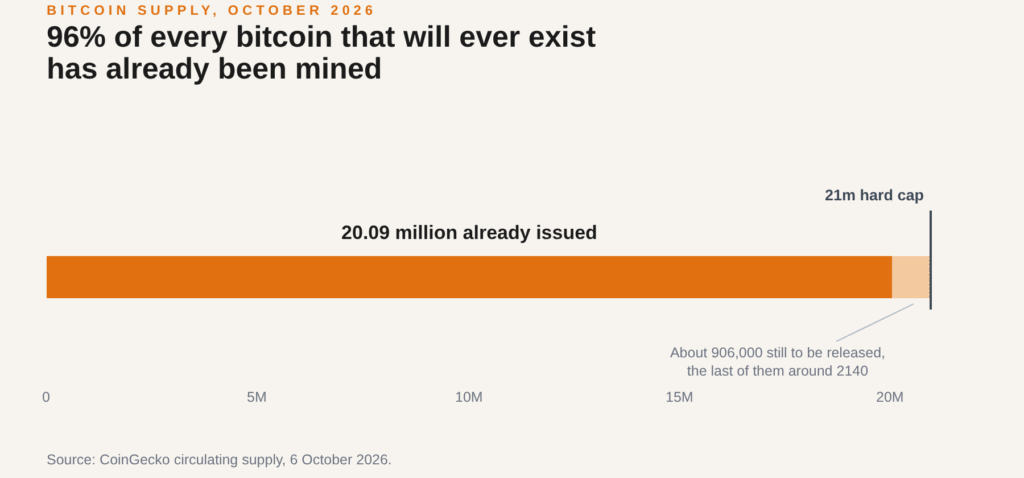
Bitcoin is a decentralized P2P payment network working on a public blockchain. Its native unit of account, Bitcoin (BTC), functions as a digital currency with a software-enforced supply hard cap of 21 million coins. About 20.09 million of them had been issued by October 2026 (Blockchain.com, 2026).
In simple words, consider Bitcoin as a shared spreadsheet that anyone can read, no one can edit alone, and no governmental authority can print.
The dollars in your bank account are rows in a private database that a bank controls and can also freeze. But Bitcoin balances are on a ledger that no one owns, and anyone can download or audit. Modifying the 21 million cap entails agreement from nearly every participant on the network at the same time, and that has never happened till now. Scarcity enforced by software rather than by any central bank is the new notion of money.
Besides, you don’t have to buy a complete coin. One BTC splits into 100 million units called satoshis, named after the pseudonymous author of the original design. Twenty dollars buys a usable amount at any price level.
Who Created Bitcoin?
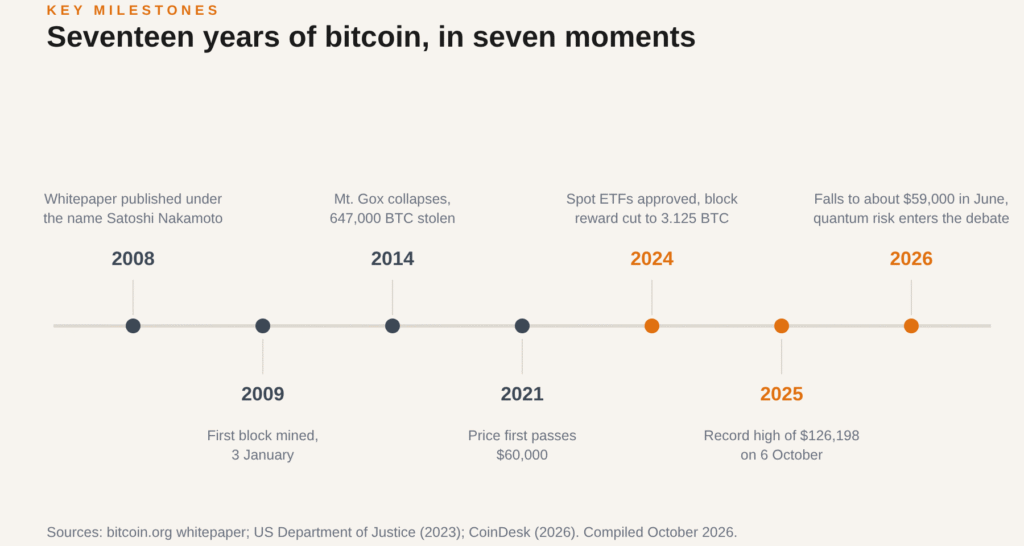
There is no accurate answer for this. Until now, the only known fact is that in the year 2008, a paper called “Bitcoin: A Peer-to-Peer Electronic Cash System” was posted to a cryptography mailing list under the name ‘Satoshi Nakamoto’. It described digital cash that needed no trusted third party. And on 3 January 2009, the first block was mined. Then, on 12 January 2009, Satoshi sent 10 BTC to the cryptographer Hal Finney, making it the first Bitcoin transaction ever.
For about two years after that, Satoshi kept posting on forums and working with some developers, then stopped in April 2011 after writing that they had moved on to other things. An estimated one million coins linked to that early mining have never been spent.
Hal Finney, who received the first payment in 2009, is among the most plausible candidates, as is Nick Szabo, who designed a pre-Bitcoin concept called ‘bit gold’ in the 1990s. An Australian computer scientist, Craig Wright, spent several years claiming publicly that he is ‘Satoshi’. But in 2024, the High Court in London rejected that claim, and in December of the same year, Mr Justice Mellor found Wright in contempt for repeating it, handing him a suspended 12-month prison sentence (Courts and Tribunals Judiciary, 2024).
The missing founder does indeed hold significance as Bitcoin has no CEO to sue, no head office to raid, and no founder whose reputation the price depends on. It simply runs on code that anyone can read.
How Does Bitcoin Work?
When you send Bitcoin, nothing moves physically. You broadcast a signed instruction to its network that tells it to move a certain amount from this address to that address. Thousands of computers, called nodes, receive it and examine two things: that your address holds the funds, and that the cryptographic signature proves you authorised the payment.
From there on, how bitcoin works becomes mechanical. Verified payments get grouped into a block, miners compete to attach that block to the chain, and once one of them succeeds. The record is public and permanent. Each block carries a cryptographic fingerprint of the block before it, so editing an old payment means redoing every block since. At today’s scale, this isn’t achievable.
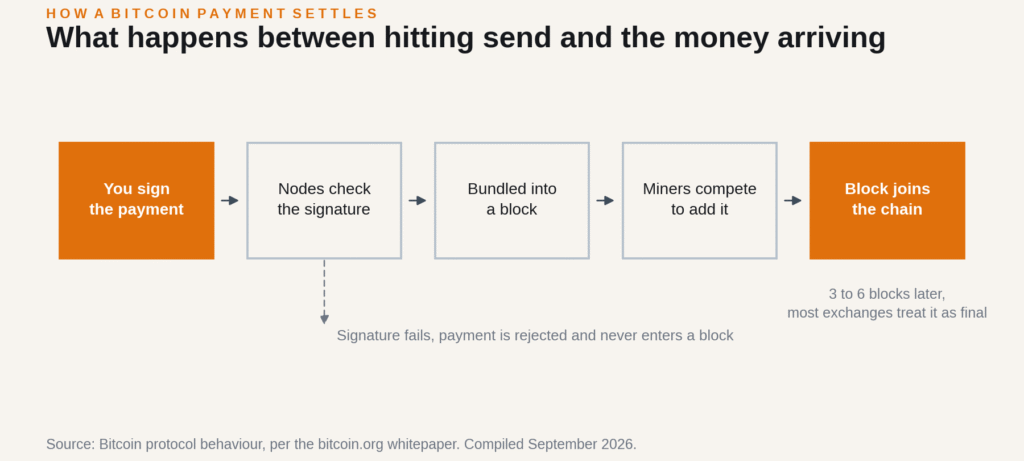
Alt text: How a bitcoin payment settles, from signing through node checks to a block joining the chain
Payments need confirmations before businesses can perceive them as final. Every block added after yours counts as one, and each one makes the record difficult to undo. Blocks arrive around every ten minutes, so waiting for a handful of them converts a broadcast payment into a settled one.
Your wallet doesn’t hold coins, but a private key: a 256-bit number that proves you control an address on the shared ledger. If you lose it, the coins stay visible on the ledger forever unspendable by anyone. There’s no recovery flow, support ticket, or password reset. “Not your keys, not your coins” keeps getting repeated in the crypto community because it carries literal meaning.
How Does Bitcoin Mining Work?
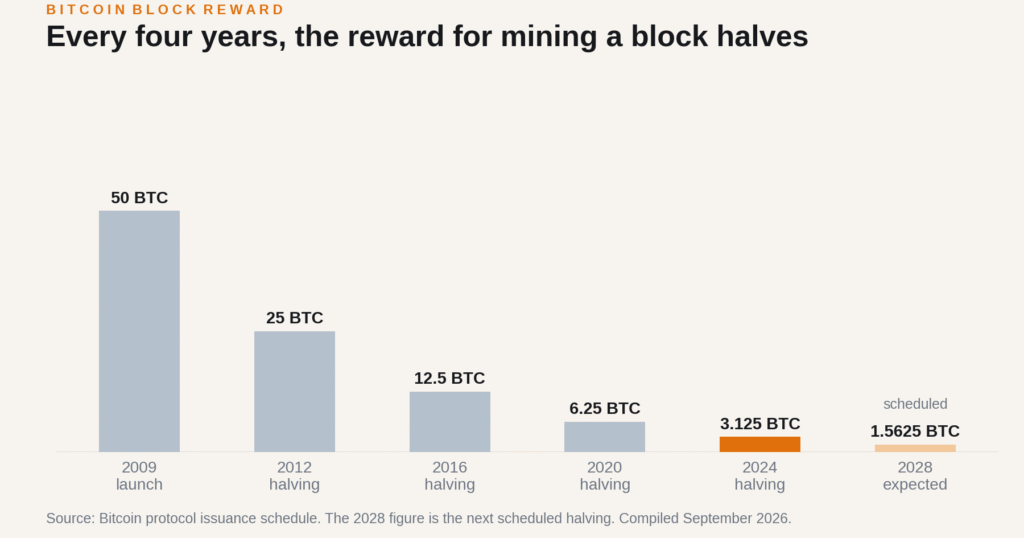
New bitcoin enters circulation through mining, and the amount released halves on a fixed schedule. Miners run purpose-built machines that race to solve a maths problem. Whoever solves it first gets to add to the next block and get their block reward, which is a newly created bitcoin plus the fees related to the payments in that block.
The reward began at 50 BTC per block in 2009. It halves almost every four years in an event called the halving. After the April 2024 halving, miners earn 3.125 BTC for each block. Block-height projections put the next one around April 2028, cutting the reward to 1.5625 BTC. When the last bitcoin is issued, around the year 2140, miners will earn transaction fees alone.
Mining does more than mint coins. The competition between miners makes the ledger quite expensive to rewrite. An attacker controlling more than half the network’s computing power could theoretically reorder recent payments, which is the much-discussed 51% attack. Doing it implies outspending an industry with billions tied up in hardware and electricity, for a payoff the market would price to zero the moment it was noticed. The attack may be possible on paper but pointless in practice, which is what the design stands for. If you want to know the mechanics of why this design costs so much on purpose, our guide to proof of work versus proof of stake covers the trade-off.
Which Bitcoin Wallet Do You Need?
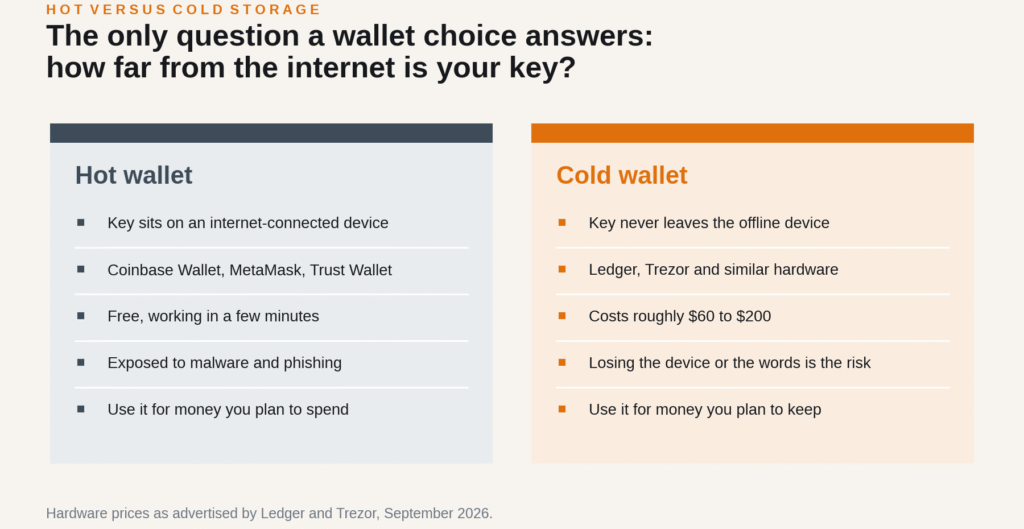
A Bitcoin wallet manages keys without storing coins. The ledger holds your BTC, and the wallet holds your key that proves only you can move the coins. Every wallet decision comes down to one question: how far from the internet do you want that key to be?
Hot wallets are applications connected to the internet, such as Coinbase Wallet, MetaMask, Trust Wallet, etc. They’re quick for spending and for small balances, and they’re exposed to everything the internet is exposed to. Cold wallets are physical devices like a Ledger or Trezor that store the key offline and sign payments without revealing it. For anything you plan to hold rather than spend, cold storage is a better choice.
Remember that buying a hardware wallet will not buy you privacy. Ledger’s customer database was breached in 2020, and again in January 2026 through its payments partner Global-e. Private keys were never at risk in either case, but names and contact details of customers were, which turned a list of confirmed crypto owners into a phishing target. Beginners usually get tripped up by assuming the device protects everything, whereas it just protects the key, not the fact that you own one.
Your seed phrase is the real master key: 12 or 24 words generated when you first set the wallet up, which can restore your coins on any compatible device. You must write it on paper, store it somewhere physically safe, and never type it into anything online. Legitimate wallets never ask for it after setup. We’ve unpacked the storage options in more detail in our guide to seed phrase.
Is Bitcoin Safe?
It depends entirely on which part you mean. Apart from a 2010 software bug that was fixed within hours, no one has been able to alter the Bitcoin ledger or create counterfeit BTC in seventeen years of continuous operation. But everything built around it has fared much worse, and that’s where beginners often lose money.
Exchange failures are the biggest practical risk. Mt. Gox was the biggest Bitcoin exchange in the world before collapsing in 2014. US prosecutors say roughly 647,000 BTC were stolen from it between September 2011 and May 2014, which was the vast majority of customer holdings (US Department of Justice, 2023). Creditors are still being repaid more than a decade later. FTX failed in 2022 through fraud rather than hacking, and wiped out billions. In both cases, the network itself didn’t miss a block, but the exchange failed.
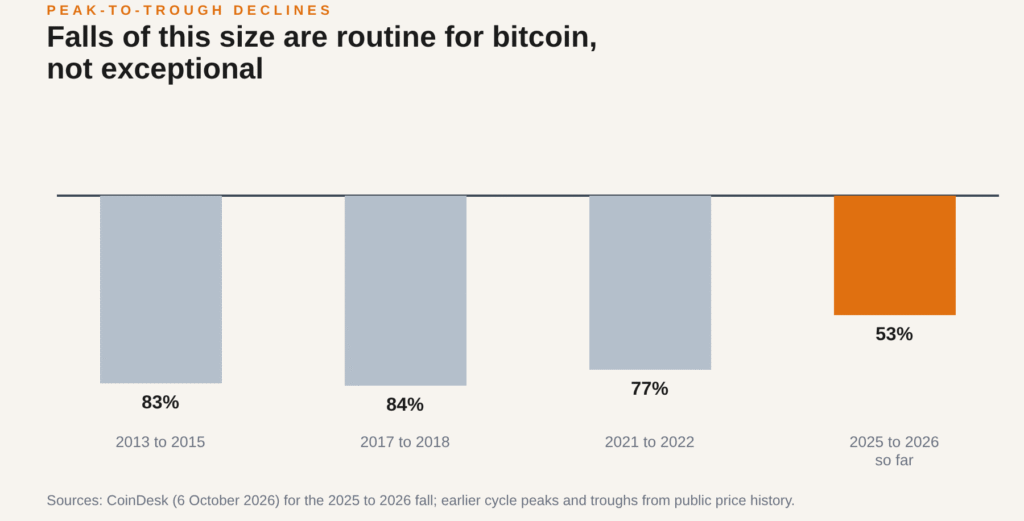
Volatility is the second risk, and it is the one beginners generally underestimate. Bitcoin set a record of $126,198 on 6 October 2025. By 30 June 2026, it had fallen to about $59,000, roughly 53% below that peak, and on 6 October 2026 it traded near $85,900 (CoinDesk, 2026). It has fallen much further than that in each of its three previous cycles, and each time the same pattern shows up: the people who got hurt were holding more than they could sit through for two years.
The new thing to worry about is quantum computing. The elliptic curve cryptography used by Bitcoin cannot be broken by any existing machine. What changed in 2026 is the timeline. Around 6.9 million BTC, close to a third of all coins mined, are at addresses whose public keys are already visible on the ledger, including addresses attributed to Satoshi, and those are the ones a sufficiently powerful quantum computer would reach first (CoinDesk, 2026).
The people who build this stuff are openly split on how urgent it is.
“Elliptic curve cryptography is on the brink of obsolescence. Whether it’s 3 or 10 years; it’s over, and we need to accept that.”
– Nic Carter, founding partner at Castle Island Ventures (Cointelegraph, 2026)
Adam Back, the Blockstream chief executive and an early bitcoin contributor, reads it differently, telling CoinDesk that quantum computing “still has a lot to prove.” Both are right about something: The attack isn’t practical yet, and the fix, a migration to quantum-safe addresses, would take years. A proposal called BIP-360 was added to Bitcoin’s official list of improvement proposals in February 2026, but there is no agreement yet on activating it.
But none of this costs a beginner money. The realistic risks are fake Coinbase and Kraken login pages, someone posing as support and asking for your seed phrase, and coins promoted loudly on social media by accounts that already own them. A regulated exchange, a hardware wallet for anything meaningful, and a flat refusal to act on unsolicited messages handle most of it.
How to Buy Bitcoin
The simplest route is through a regulated centralised exchange. Coinbase, Kraken, and Binance are among the most popular and largest ones, though availability depends on your country (Binance, for example, does not serve US residents). You open an account, complete identity checks with a government-issued ID, which is standard anti-money-laundering compliance, and fund it by bank transfer or card.
Bank transfers cost less, while card purchases clear faster. Most platforms let you start at $5 or $10, and as said before, you can buy a fraction of the coin too. Our step-by-step walkthrough on how to buy cryptocurrency covers the account setup fully.
Once you’ve bought the desired amount, decide where to put it. Leaving the coins on an exchange means trusting that company’s security, its solvency, and continued existence, which is the bet Mt. Gox and FTX customers lost. The best bet is to put them in a hardware wallet that you can control.
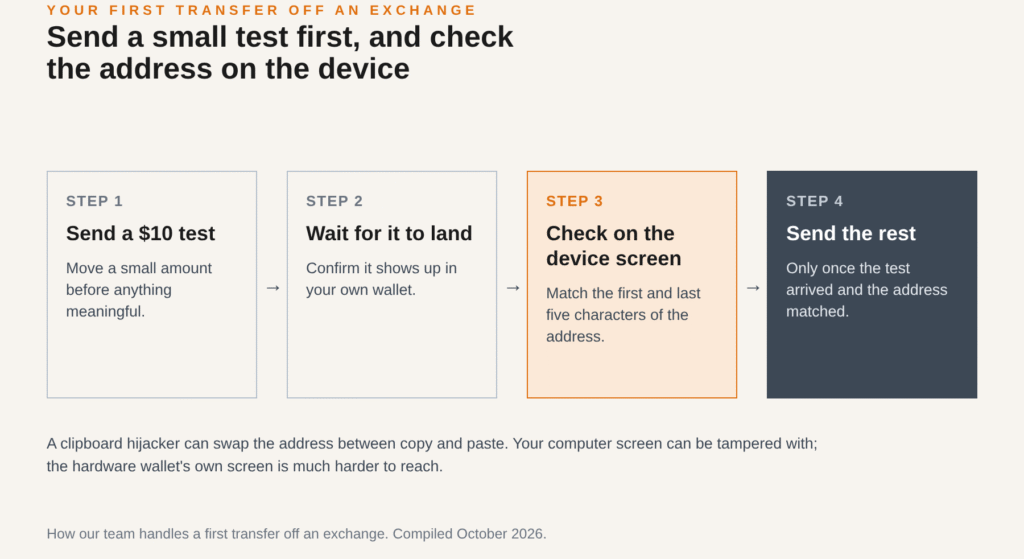
A word on that first transfer off an exchange, because it’s where our team sees beginners get stuck. The moment you paste an address and hit send, you’re doing something no support desk can undo. So we send a test first. Ten dollars: wait for it to land in the wallet, then move the rest. It costs a small network fee, and it catches the failure that happens, which is a clipboard hijacker swapping the address between the copy and the paste. It’s also why a hardware wallet shows the receiving address on its own small screen and makes you confirm it there. The screen on your computer can be tampered with, but the one on the device is much harder to reach. Check the first and last five characters against each other before you approve anything.
A spot bitcoin ETF is another route, legal in the US since regulators approved them in January 2024, and for some people it’s more relevant. If your money already exists in a brokerage or a pension account, buying a fund that holds bitcoin skips exchanges, wallets, and seed phrases entirely. What you give up is the part that makes bitcoin bitcoin. You can’t send it or hold the keys, and you’re trusting the fund and its custodian to stay solvent. Such a trade suits long-term holders and frustrates anyone who wants to use the network itself.
Two other routes cost more: Bitcoin ATMs sit in shopping centres and petrol stations, and their fees are the worst of any option by a wide margin, which makes them fine in an emergency but tough to defend as a habit. Peer-to-peer platforms such as Bisq let you buy directly from another person with more privacy, at the price of slower trades and counterparty risk. Neither of these is a good option for your first purchase.
The Bottom Line on Bitcoin
By now, you can easily answer the question ‘What is bitcoin?’ A ledger that settles payments without asking anyone’s permission, secured by the cost of rewriting it, with a supply that no institution can expand. It’s the reason bitcoin still exists after seventeen years.
For a beginner, the practical work is choosing a regulated exchange, moving anything meaningful into their own custody, writing the seed phrase down on paper, and sizing the position so that a 50% fall changes nothing about that month. If you want to go in more detail before you buy, start with our crypto trading guide for beginners.
Frequently Asked Questions
Is bitcoin legal?
Yes, in most of the world. The United States, the European Union, the United Kingdom, Japan, and Australia permit owning and trading bitcoin, though the tax and licensing rules differ in each. China has restricted trading and mining since 2021, and a small number of other countries impose limits. Rules have moved quickly since 2024: the EU’s MiCA regime is now in force, and the US government established a Strategic Bitcoin Reserve under Executive Order 14233 in March 2025. Check your own country’s current position rather than relying on an article, including this one.
Do I have to pay tax on bitcoin?
In the United States, the IRS treats digital assets as property instead of currency. Selling bitcoin, swapping it for another cryptocurrency, or spending it on goods creates taxable events. Gains on assets held for less than a year are taxed as ordinary income; those held longer qualify for capital gains rates (IRS, 2026). From the 2025 tax year, US brokers report your gross proceeds on Form 1099-DA, and cost basis reporting begins with 2026 transactions, so the tax authority increasingly sees the trades whether or not you report them. Keep your own records anyway, because transfers between your own wallets often confuse broker reporting.
Can bitcoin be counterfeited or spent twice?
No. Every payment is checked against the full ledger before it’s accepted, so the same coin cannot be spent at two addresses. Solving that problem was the central technical achievement of the 2008 whitepaper. Earlier attempts at digital cash failed on it, because a digital file can be copied and there was no way for strangers to agree on the real copy.
What’s the difference between Bitcoin and other cryptocurrencies?
Bitcoin was launched in 2009 and remains the largest cryptocurrency by market value. Ethereum, launched in 2015, added programmable smart contracts, which are bits of code that run automatically when conditions are met, and that opened the door to lending, trading, and other applications running on-chain. Thousands of others followed with different designs and different claims. Bitcoin is usually described as digital gold, meaning a store of value and a settlement layer rather than a platform. “Crypto” covers everything, while “Bitcoin” means BTC specifically.
How much bitcoin should I buy?
There isn’t a number that fits everyone. Think about these two things: First, will you need this money in the next 12 to 24 months? If so, it shouldn’t be in bitcoin at all. Second, would you still be able to leave the position alone after a bad year? Buying in fixed amounts on a schedule, rather than in one go, takes the timing decision out of your hands and is how most of the long-term holders build a position.
How long does a bitcoin transaction take?
Usually under an hour, and the fee you attach is what decides it. Miners pick the best-paying transactions first, so a payment sent with a low fee can lie in the queue for hours when the network is busy, while a well-priced one is normally in the next block or two. Many wallets estimate the fee for you and let you raise it afterwards to jump the queue. If you need small payments to clear in seconds rather than minutes, the Lightning Network handles them off-chain and settles to the main ledger later.

Our Review Methodology
We evaluate each post based on thorough research, credibility of sources, accuracy of information, and relevance to our readers. Our editorial team follows strict guidelines to ensure all content meets high standards of quality.
Disclaimer
The content in this article is provided for informational purposes only and does not constitute financial, investment, or professional advice. Always do your own research before making any decisions.