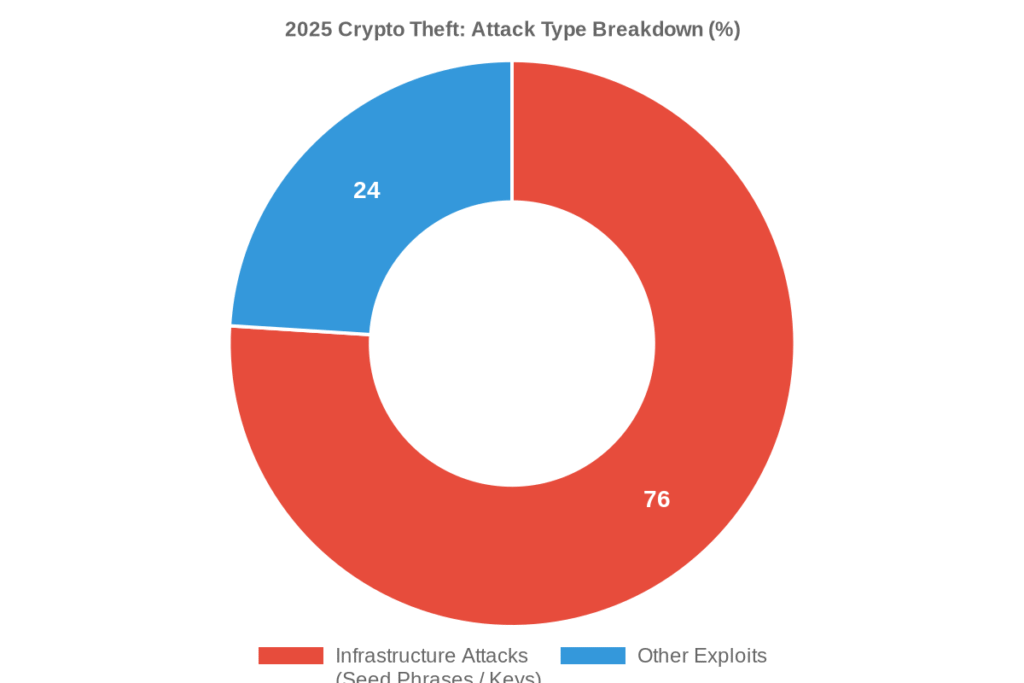
A seed phrase crypto is a sequence of 12 or 24 randomly chosen words that serves as the master key to your cryptocurrency wallet. Lose it — your funds are gone, permanently, with no reset button. In 2025, compromised seed phrases and private keys drove $2.2 billion in losses, accounting for 76% of all crypto theft that year (TRM Labs, 2026). Store yours offline, engraved on metal if you can, in two separate physical locations.
What Is a Crypto Seed Phrase?
A crypto seed phrase — also called a recovery phrase, mnemonic phrase, or Secret Recovery Phrase — is a sequence of 12 or 24 words generated the first time you create a non-custodial cryptocurrency wallet. These words come from a standardized list of exactly 2,048 English words defined under Bitcoin Improvement Proposal 39 (BIP-39), introduced in 2013 by developer Marek Palatinus. The order is everything. Change one word, swap two, or misread your handwriting — and the phrase recovers nothing.
Think of it this way: the seed phrase doesn’t just back up one wallet address. It generates every private key your wallet will ever use — for Bitcoin, Ethereum, and dozens of other networks, all from those same 12 or 24 words. That’s what makes it so powerful. And so dangerous to lose.
“Why 2,048 words?” is actually a good question. A 12-word phrase chosen from that list produces roughly $2^{128}$ possible combinations. Brute-forcing that takes longer than the universe has existed. Not glamorous math, but it’s why seed phrases work.

How Does a Seed Phrase Actually Work?
Your seed phrase feeds into a process called hierarchical deterministic (HD) wallet derivation. The phrase is converted into a 512-bit master seed using the PBKDF2 key-stretching algorithm. That master seed generates a master private key, which in turn derives an almost unlimited number of child keys — each one corresponding to a different wallet address on a different blockchain.
The practical result? One phrase backs up everything. Every Bitcoin address, every Ethereum address, every token balance — all regenerated from the same 24 words, in the same order, on any BIP-39-compatible wallet. That’s why Trust Wallet, MetaMask, Exodus, Ledger, and most other non-custodial wallets all use the same standard — they’re all reading from the same playbook.
The phrase itself is deterministic. Give it the same seed phrase twice, and it will always produce the exact same keys. This is actually what allows wallet recovery: you’re not retrieving saved data from a server somewhere. You’re regenerating the keys from scratch, mathematically, from the phrase.
Seed Phrase vs. Private Key: What’s the Difference?
This distinction trips up a lot of new users. Short answer: the seed phrase creates private keys. A private key is what actually authorizes a transaction on a specific blockchain. But one wallet contains many private keys — one per address, per network. Managing them individually would be unworkable.
The seed phrase sits one level above all of that. It’s the master secret that generates the entire tree.
| Seed Phrase | Private Key | |
|---|---|---|
| Format | 12–24 English words | Long hexadecimal string |
| Controls | All addresses across all chains | One specific address |
| Recovers | Entire wallet | Single address only |
| Exposure risk | Critical — full wallet access | Serious — single address |
| Stored by user? | Yes, always | Rarely, wallet handles it |
Losing your private key for a single address is bad. Exposing your seed phrase is worse — it hands over everything, every address, every coin, to whoever has it.
What Are the Best Ways to Store Your Seed Phrase?
Seed phrase storage is not a solved problem. The crypto industry has spent a decade arguing about it, and no single method is perfect. But the hierarchy is fairly clear.
Engraved metal plates are the gold standard for physical durability. Steel and titanium survive house fires, floods, and physical damage that would destroy paper within seconds. Several companies (Cryptosteel, Bilodeau, Hodlinox) sell stainless steel plates specifically for seed phrase storage, with letter stamps or tile systems. They’re not free — expect to spend $60–$150 — but compare that to the alternative.
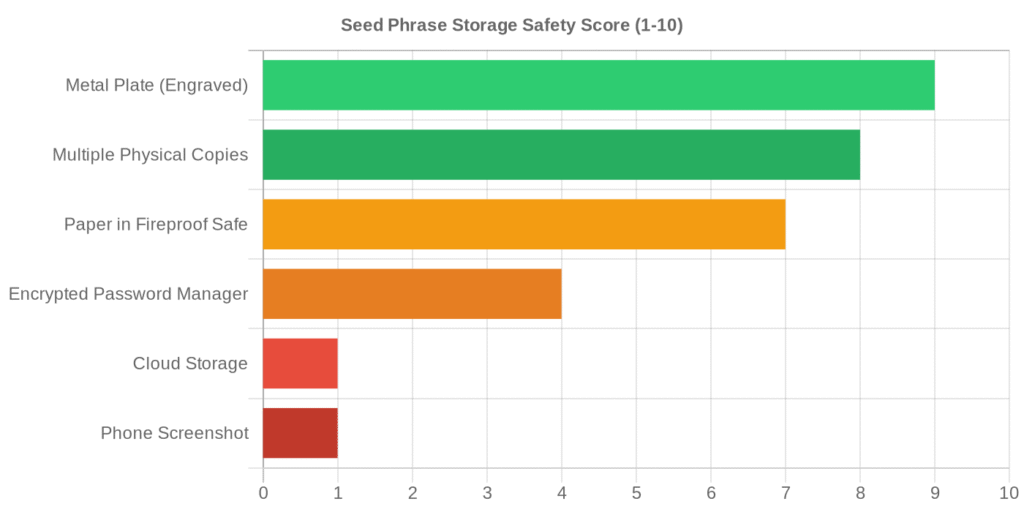
Paper backup is where most people start. It works — until it doesn’t. Paper burns. Paper gets wet. Paper fades over 10 years. If you use paper, store it inside a fireproof, waterproof safe. And write clearly. A 4 mistaken for a 9, or “world” confused with “word,” and you’re locked out permanently.
Hardware wallets don’t eliminate the need for a seed phrase — they just protect the private keys during daily use. Your Ledger or Trezor device generates a seed phrase on setup. That phrase still needs to be backed up properly offline. The device is the protection layer for active transactions; the metal plate is the protection layer for catastrophic loss.
Multiple physical copies in separate locations is what security professionals actually recommend. Two copies minimum — one in your home safe, one in a bank safe deposit box or with a trusted family member in a different city. If a fire destroys one location, the other survives. Coinomi and other multi-asset wallets specifically recommend this approach in their onboarding documentation.
I’ve run through the wallet recovery process myself, after a hardware wallet failure mid-upgrade. Had the seed phrase on paper — handwritten, in a drawer. The moment I needed it, I was grateful it existed. But I also realized I’d been one house fire away from a permanent loss. Moving to a steel plate backup after that wasn’t a dramatic decision. It was obvious.
What about digital storage? Short answer: no. Screenshots, notes apps, Google Drive, email — all of these expose your seed phrase to malware, phishing, and server-side breaches. A screenshot on an iOS device syncs to iCloud automatically unless you’ve explicitly disabled it. The moment your seed phrase touches the internet, the risk calculus changes completely.
If you want a digital layer, use an air-gapped encrypted device — one that never connects to the internet — and understand that even then, this is a last resort, not a first choice.
One option worth considering: Zengo Wallet uses a keyless architecture that removes the seed phrase burden entirely through multi-party computation. If you’d rather not manage a phrase at all, read our Zengo Wallet review for how it handles key security differently.
What Are the Biggest Threats to Your Seed Phrase Crypto?
This is where the real money is being lost. Not from clever cryptographic exploits. From people being tricked into handing their phrase over.
Infrastructure attacks — targeting seed phrases and private keys directly — drove $2.2 billion in losses in 2025, representing 76% of all crypto theft that year (TRM Labs 2026 Crypto Crime Report). The attack vectors are not exotic:
- Phishing sites that mimic wallet interfaces and capture your phrase at import
- Fake customer support — the Trezor impersonation attack that cost one investor $284 million in January 2026 started with a “support” email
- Infostealer malware that scans browser extensions and local files for stored seed phrases
- Fake wallet apps in app stores that exfiltrate your keys the moment you enter them
Impersonation scams rose 1,400% year-over-year between 2025 and 2026 (Crypto Impact Hub). These aren’t technically sophisticated attacks. They’re social engineering. And they work because people are caught off guard, dealing with a panicking situation, and talking to someone who sounds authoritative.
“The support team is asking for my seed phrase to verify my account.” That’s not how wallets work. No legitimate wallet company, exchange, or support agent will ever ask for your seed phrase. Ever. If someone asks for it, the call is over.
A word about phishing emails: the fake support domain might be ledger-support.com or metamask-help.net instead of the official domains. Worth double-checking the URL before you do anything.
What Happens If You Lose Your Seed Phrase Crypto?
There is no customer service line. No recovery email. No “forgot my seed phrase” button.
Lose a non-custodial wallet’s seed phrase and the funds are permanently inaccessible. The keys exist only in mathematical relationship to those words. Without them, there’s no way in. The blockchain doesn’t store your identity or offer account recovery. It only accepts the correct cryptographic signature — which can only be produced by the private key — which can only be regenerated from the seed phrase.
This isn’t theoretical. Between 2.3 million and 3.7 million Bitcoin is estimated to be permanently lost as of early 2025, largely due to lost access credentials and forgotten seed phrases (Ledger analysts, 2025). At current prices, that’s hundreds of billions in crypto that no one can ever spend.
If you’ve lost a seed phrase but still have the device and wallet app running, you may still have access to the underlying private keys through the wallet’s export function. Some wallets allow you to export individual private keys per address — not the seed phrase itself, but the key for specific addresses. This doesn’t help if the device is lost too, but it’s worth checking before assuming total loss.
For custodial wallets — Coinbase, Kraken, Binance — this problem doesn’t exist in the same way. The exchange controls the keys, so you recover access through standard account verification. The tradeoff: you’re trusting the exchange with custody of your funds. That’s a different kind of risk.
The Bottom Line on Crypto Seed Phrases
A crypto seed phrase is the master backup for your non-custodial wallet — 12 or 24 words generated from the BIP-39 standard that reconstruct every private key you own. Lose it and recovery is impossible. Expose it and someone else owns your crypto. The best protection is physical: engrave it on metal, store two copies in separate secure locations, and treat it with the same seriousness as a bank PIN — except with no bank to call if things go wrong. If you’re new to self-custody wallets, start with our complete crypto trading guide before committing significant funds.
Frequently Asked Questions
Is a recovery phrase the same as a seed phrase? Yes. Recovery phrase, seed phrase, mnemonic phrase, and Secret Recovery Phrase all refer to the same thing: the 12 or 24-word backup that generates your wallet’s private keys. Different wallets use different terminology but the underlying standard (BIP-39) is the same.
What is a 12-word seed phrase? A 12-word seed phrase is the shorter version of the BIP-39 standard, offering roughly $2^{128}$ possible combinations — effectively unguessable. Some wallets default to 24 words for additional security headroom, though 12-word phrases are considered cryptographically sufficient for most users. The longer phrase is overkill for most practical purposes.
Can someone steal my crypto with just my seed phrase? Yes, completely. Anyone who has your seed phrase can import your wallet into any BIP-39-compatible app and transfer all of your funds immediately. No password required. No device required. This is why the phrase must never be shared, stored digitally, or photographed.
Should I store my seed phrase in a password manager? No. Password managers are encrypted, but they’re connected to the internet and accessible through your device. A malware infection, phishing attack, or database breach at the password manager company could expose your phrase. The only safe medium is offline physical storage — paper or, better, engraved metal.
What’s the difference between a custodial and non-custodial wallet for seed phrases? Non-custodial wallets (MetaMask, Trust Wallet, Ledger) give you — and only you — the seed phrase. You own the keys, you own the crypto. Custodial wallets (Coinbase, Binance) hold the keys on your behalf — no seed phrase to manage, but you’re trusting them with custody. The tradeoff is security vs. convenience.

Our Review Methodology
We evaluate each post based on thorough research, credibility of sources, accuracy of information, and relevance to our readers. Our editorial team follows strict guidelines to ensure all content meets high standards of quality.
Disclaimer
The content in this article is provided for informational purposes only and does not constitute financial, investment, or professional advice. Always do your own research before making any decisions.