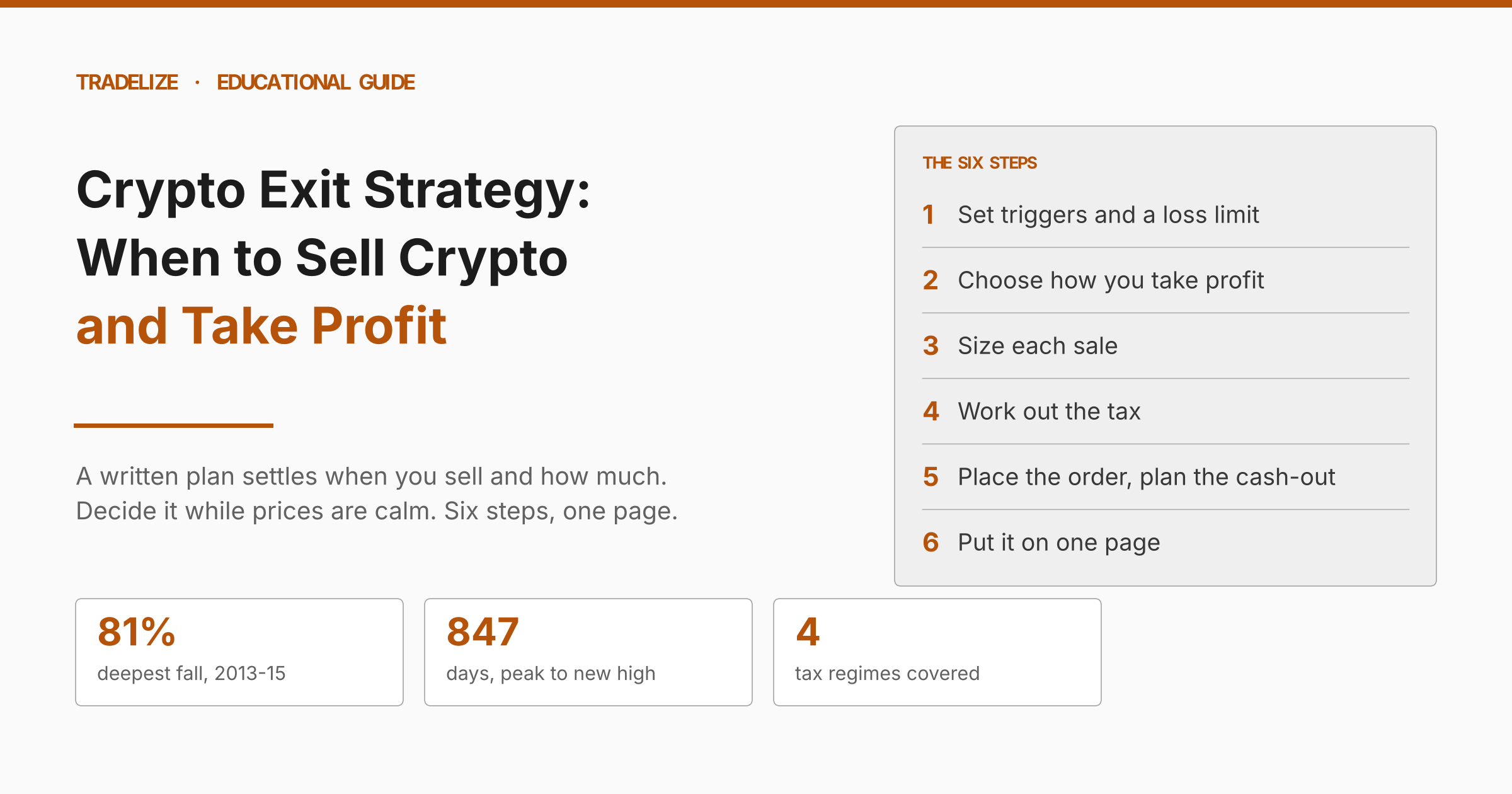
A crypto exit strategy is a written plan that settles four things before prices move: what triggers a sale, how far a fall you will sit through, how much you sell each time, and where the money goes. Writing it down is the point, because those calls are simple to make calmly and close to impossible mid-fall.
| Key takeaways 1. Set your triggers and loss limit while prices are calm, not during a fall. 2. A schedule removes the timing decision, because the calendar sets each sale date. 3. Selling a loser alongside a winner can cut the tax bill in most markets. 4. Sales and swaps are both taxable events in the US, UK, Canada, and India. 5. A sell order can fill below its trigger price, or not fill at all. |
What is a crypto exit strategy?
It is the set of rules you write down for selling: the trigger, the loss limit, the size of each sale, the tax it creates, and the route the cash takes to your bank. Six steps build it, answering when to sell crypto, how much, and where the money ends up.
When should you sell crypto?
Set your triggers while prices are calm, and make them specific: a target price, a holding grown past the share of your portfolio you intended, or a date you need the money. Vague ones, such as waiting until it feels toppy, are the ones people talk themselves out of.
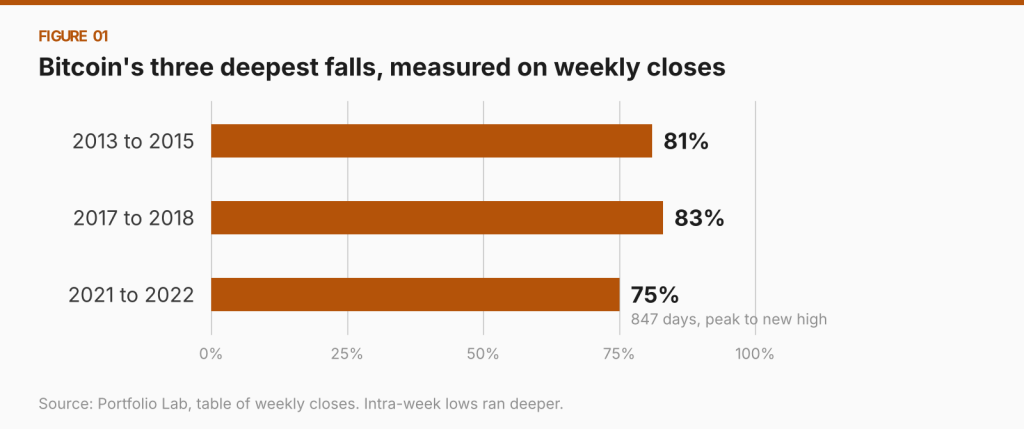
Your loss limit is the deepest fall you will sit through, measured from your purchase price or from the peak. Bitcoin’s history sets the scale: in Portfolio Lab’s table of weekly closes it fell 81% from 2013 to 2015, 83% from 2017 to 2018, and 75% from 2021 to 2022, the last of those a round trip of 847 days. Those are weekly closes, so intra-week lows ran deeper, and nothing stops a future fall from running deeper still.
Which is why “should I sell my crypto” is the wrong question mid-fall. Set the number now, and the fall answers it for you. If you could not sit through 80%, the position is too large.
How do you take profit in crypto?
Guides on how to take profit in crypto stop at naming the methods. Choosing between them is the part that matters, and it turns on how often you want to think about the position.
| METHOD | WHAT TIMES THE SALE | SUITS |
|---|---|---|
| A fixed schedule | The calendar, whatever the price | Anyone who would rather not watch prices |
| Rebalancing | A holding growing past its target share | A portfolio holding several assets |
| A trailing stop | A set fall from the recent high | One position you follow closely |
A fixed schedule is the mirror image of buying on a schedule. The SEC’s asset allocation guide says many investors rebalance every six or twelve months, and that it works best done infrequently. Its warning on trailing stops applies here too: short swings can trigger one before a trend turns.
Then size each sale. The options are back to a target share, your original stake out first with the rest run as profit, or a fixed split. Koinly’s 50/25/25 is the common one: half once the position has doubled, a quarter higher up, a quarter kept as the moon bag. Write the number down, because a sale sized in the moment is sized by the mood.
What does selling cost you in tax?
Most tax authorities see a sale as a disposal and tax the gain, the profit over what you paid. Several treat a coin-for-coin swap the same way, so moving between coins can create a bill before any cash reaches your bank.
| MARKET | WHAT COUNTS AS A SALE | TIMING RULE OR RATE |
|---|---|---|
| US (Internal Revenue Service, IRS) | Selling or exchanging | Held 1 year or less: short-term gain. Longer: long-term |
| UK (HM Revenue & Customs, HMRC) | Selling, swapping, gifting or spending tokens | Pooled cost per token type, with a separate calculation within 30 days of buying |
| Canada (Canada Revenue Agency, CRA) | Trading for cash or another crypto | Half of a capital gain counts as income, unless it is business income |
| India (Income Tax Department) | A transfer | 30% on the income, plus 1% deducted at source above Rs 10,000 in a financial year. Losses cannot be carried forward |
Crypto tax-loss harvesting can change your tax bill. If you sell crypto for less than you paid, you realise a loss. You may be able to use that loss to offset gains from other investments in the same tax year. Buy-back rules differ. HMRC applies a separate calculation to anything repurchased within 30 days, and India does not allow a crypto loss to be carried forward. Check how crypto is taxed by country first, and keep the dates.
How do you cash out crypto safely?
Two things stay between the decision to sell and money in your bank. A stop-loss order sells once the price falls to your loss limit; a take-profit order sells once it rises to your target. Neither guarantees the price.
Kraken turns both into market orders and says that in thin, volatile markets the fill is “likely” to be much lower than the stop price. Coinbase Advanced pairs the two in a bracket order, and warns that in extreme volatility, if the price drops more than 5% before the sell is re-priced, the new stop order will not execute.
Then the withdrawal, which is where how to cash out crypto is decided. Kraken’s table as of 4 November 2026:
| ROUTE | FEE | MINIMUM | TIME |
|---|---|---|---|
| US ACH bank transfer | Free | 1 USD | 0-2 business days |
| SEPA euro transfer via Bank Frick | 1 EUR | 2 EUR | 0-5 business days |
| SWIFT international wire | 13 USD plus any other SWIFT fees | 100 USD | 1-5 business days |
Times are estimates, and fees vary by country of residence.
Can you prove where the money came from?
A large deposit from a crypto exchange is where a bank asks questions, and the answer has to be documentary. Keep, for anything you sell: the purchase records, the statements covering the buy and the sell, the transaction IDs for any wallet transfer, and that year’s tax report.
The IRS asks for records of every purchase, sale, and swap of digital assets. HMRC wants records per pool of tokens in a compliance check. Canada’s CRA lists units, date, Canadian-dollar value, and the addresses used. Assemble them when you sell, not when you are asked.
Your one-page crypto exit strategy
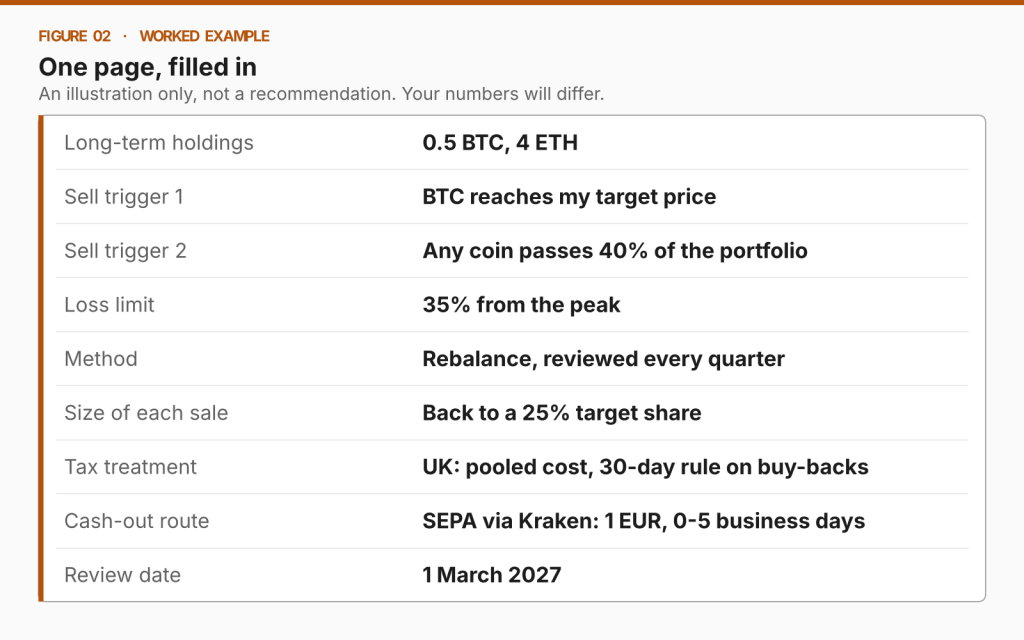
Copy the table, fill in the right-hand column, and set a review date before you close it.
| FIELD | YOURS |
|---|---|
| Long-term holdings | |
| Sell trigger 1 (price, share or date) | |
| Sell trigger 2 | |
| Loss limit (% from purchase or peak) | |
| Method (schedule, rebalance, trailing stop) | |
| Size of each sale | |
| Tax treatment where I live | |
| Cash-out route, fee and expected time | |
| Review date |
We filled this in for a test holding before writing the piece. The slow field was not the target price. It was the cash-out route, because on every exchange we checked the withdrawal fees sit on a different page from the trading fees, and the two do not cross-reference.
The Bottom Line on Crypto Exit Strategies
A good crypto exit strategy gives you a clear answer to when to sell, how much to sell, what taxes to account for, and how to move the money to your bank. Set your price triggers, loss limit, and sale sizes in advance, then record them in one place. Review the plan as your holdings or financial needs change, and follow the rules you have set instead of making decisions in the middle of a market fall.
Frequently Asked Questions
When should I sell my crypto?
When a trigger you set earlier fires. The point of writing it down is that you are not making the call in the moment, when every argument for waiting is available, and none is new. If no trigger has fired, the answer is no.
What is a good exit strategy?
One you will actually follow: specific enough to act on without further thought, sized so no single sale decides your year, and written somewhere you will see it. The method matters less than whether you execute it.
Does the tax office know if I sell Bitcoin?
Assume so. Reporting rules are widening, and the IRS, HMRC and the CRA each expect records of every disposal. India deducts 1% at source on transfers above Rs 10,000 a year, so the transaction is visible before you file.
What is a moon bag?
The slice of a holding you keep after selling most of it, in case the price keeps running. Coincub’s rule of thumb is “typically around 5% to 10%”. It hedges regret rather than risk, and it only works if you fix its size in advance.
What does a sell order cost on a crypto exchange?
On a top-rated exchange like Kraken, a take-profit order fills at once and pays the taker fee, while a limit order that waits pays the lower maker fee. Another top-rated exchange, Coinbase, builds a spread, the gap between its buy and sell prices, into simple sell prices, and lists a separate 1% fee on simple limit orders where offered.

Our Review Methodology
We evaluate each post based on thorough research, credibility of sources, accuracy of information, and relevance to our readers. Our editorial team follows strict guidelines to ensure all content meets high standards of quality.
Disclaimer
The content in this article is provided for informational purposes only and does not constitute financial, investment, or professional advice. Always do your own research before making any decisions.