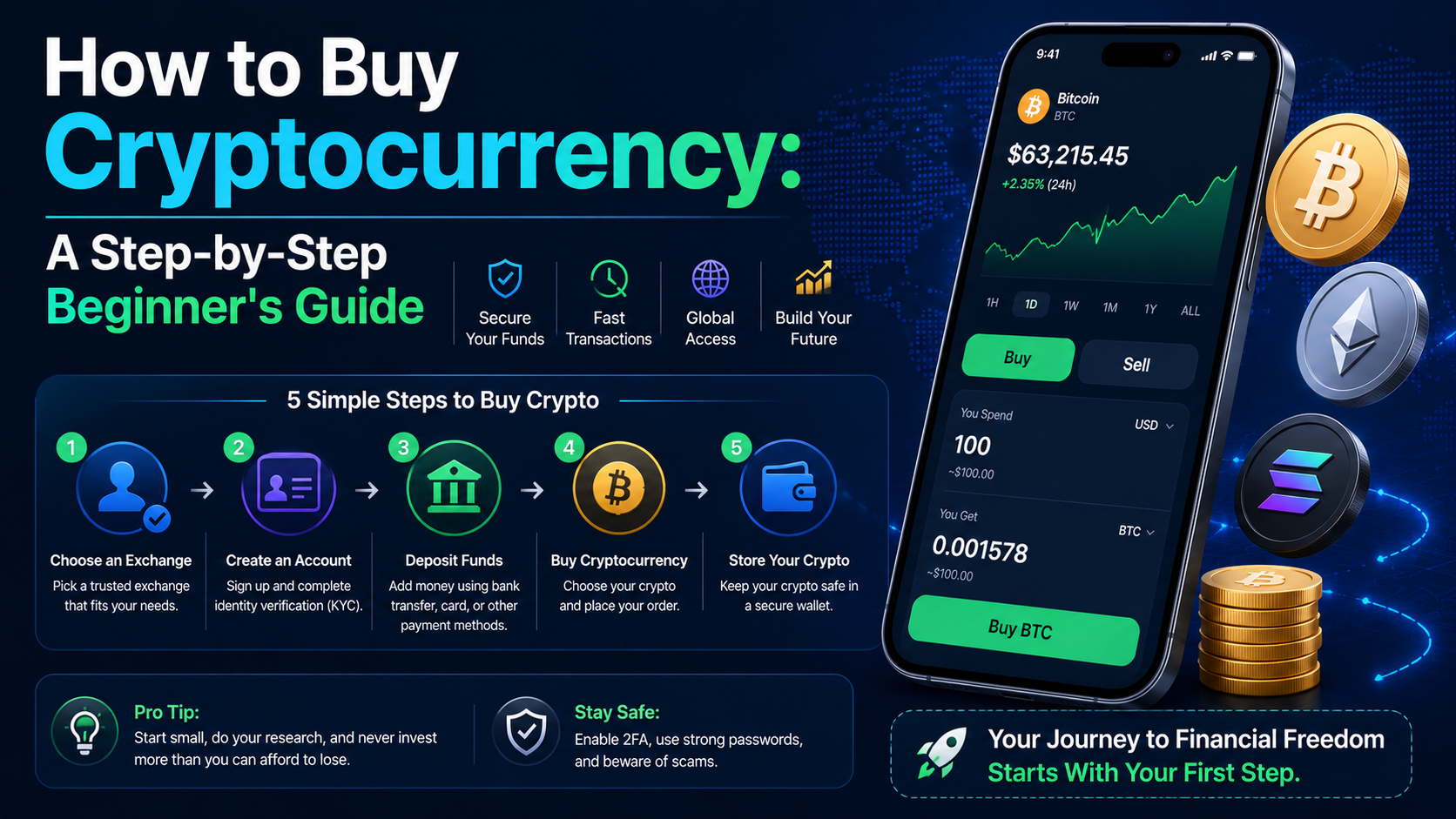
You are asking: How To Buy Cryptocurrency? You’ve got $50 and you want in on crypto. Maybe you watched someone ride a rally from the sidelines and sat out. Maybe your feed has been full of price charts for months and you finally want to understand what you’re actually looking at. Either way, you’re in the same position as the 659 million people who already own digital assets — the ones who had to figure out this same process from scratch, usually with worse resources than you have right now.
The global crypto market hit roughly $3.9 trillion in total market capitalisation in 2025, according to CoinGecko data, and around 30% of American adults now hold some form of cryptocurrency, per Security.org’s 2026 Cryptocurrency Adoption Report. The infrastructure has never been more accessible. What trips up first-time buyers isn’t the technology — it’s the sequence of steps and the terminology. Get those right and the rest follows quickly.
Here’s the full process, in order.
What You Actually Need Before You Start
To open an account on any regulated cryptocurrency exchange, you need a government-issued photo ID (passport, driver’s licence, or national ID card), a bank account or debit card to fund your purchases, an email address, and a phone number for verification. That’s it.
The ID requirement catches some people off guard. It exists because exchanges operating in regulated jurisdictions — the US, UK, EU, Australia — are required to follow Know Your Customer (KYC) and Anti-Money Laundering (AML) rules. Every major platform will ask you to upload a photo of your document and usually take a selfie. This is true of Coinbase, Kraken, Gemini, and Binance, without exception.
One important thing to set straight before anything else: you don’t need thousands of dollars to start. Most regulated exchanges set a minimum purchase of $10 to $50. Bitcoin (BTC), for example, is divisible to eight decimal places — the smallest unit is called a satoshi (0.00000001 BTC). Buying $30 worth gives you a fraction of a coin. That’s a completely valid entry point and, frankly, a sensible way to start.
Step 1 — Choose a Cryptocurrency Exchange
This is the decision that matters most for a first-time buyer, and the one most guides spend the least time on. The exchange you use determines your fee structure, the assets you can access, and — in the worst case — whether your funds are protected if something goes wrong with the platform.
- A centralized exchange (CEX) — Coinbase, Kraken, Binance US, Gemini — operates like a traditional brokerage. You create an account, the exchange holds your funds in custody, and trades are matched through their order book. This is the practical starting point for beginners. A decentralized exchange (DEX) — Uniswap, dYdX, Curve — lets you trade directly from your own wallet, with no company holding your assets. To use a DEX, you need crypto already in a self-custody wallet, which creates a problem for anyone making their first purchase. Start with a CEX.
- When comparing centralized exchanges for your first account, four things actually matter:
- Regulation and licensing. Is the exchange authorized to operate in your country? In the US, look for platforms registered with FinCEN (the Financial Crimes Enforcement Network) and, where applicable, licensed at the state level. Coinbase is publicly listed on NASDAQ and subject to SEC reporting requirements. Gemini holds New York’s BitLicense — one of the most demanding regulatory frameworks in the US. That kind of oversight matters because it gives you some recourse if something goes wrong. See our guide to evaluating exchange safety for the specific checks worth running.
- Fee structure. Most exchanges use a maker-taker model. According to Fidelity’s published fee data, taker fees (what you pay when you take liquidity from the order book, as a first-time buyer almost always does) range from 0.01% to 0.40% depending on the platform and your monthly trading volume. The method you use to fund your account also affects fees dramatically — more on that in Step 3. Our breakdown of crypto exchange fees covers the full picture.
- Supported assets. For a first purchase of Bitcoin or Ethereum, every major exchange has you covered. Coin count starts to matter when you’re looking at smaller altcoins — Kraken supports over 300 cryptocurrencies as of 2026, Coinbase over 250. Don’t choose an exchange based on obscure coin support until you’ve got the basics sorted.
- Geographic restrictions. This catches people by surprise. The global version of Binance is not available to US residents — Binance US is a separate, more limited platform. Some exchanges don’t operate in certain EU member states. Check whether the platform accepts users from your country before you spend 20 minutes on the sign-up form.
Step 2 — Create Your Account and Verify Your Identity
Sign-up is fairly consistent across major platforms: email address, strong password (not reused from anywhere else), phone number, and you’re into the verification process.
Set up two-factor authentication (2FA) immediately — before you do anything else with the account. Use an authenticator app like Google Authenticator or Authy rather than SMS verification. SMS 2FA works, but SIM-swap attacks — where a bad actor tricks your mobile carrier into reassigning your phone number to a new device — have been used repeatedly to drain exchange accounts. An authenticator app generates codes locally on your device and doesn’t depend on your carrier at all.
KYC verification comes next. You’ll upload a photo of your government ID and typically complete a short identity verification step, often a selfie or a short video. On Coinbase and Kraken as of 2026, most straightforward verifications complete within 10 to 15 minutes using automated document scanning. Complex cases — mismatched address history, documents from certain jurisdictions — can take longer.
Most platforms have tiered verification levels. A basic tier (email plus phone) might allow small purchases but caps withdrawals at a low threshold. Full verification — photo ID plus proof of address — unlocks higher deposit and withdrawal limits. If you have any intention of investing more than a few hundred dollars, complete full verification from the start. It saves a frustrating interruption later.
Step 3 — Deposit Funds
With a verified account, you need to move money onto the platform. You have a few options, and the cost difference between them is significant.
- Bank transfer (ACH or SEPA). The cheapest method, generally free or very low cost. ACH transfers in the US are free on Coinbase, Kraken, and Gemini. SEPA transfers in Europe are similarly low-cost. The downside is speed: ACH typically takes one to five business days to clear, though some platforms offer “instant” ACH where you can start buying immediately against the pending deposit.
- Debit card. Faster — sometimes instant — but with higher fees, typically 1.5% to 2.5% per transaction. Worth considering if you want to buy today rather than wait several days, and the fee difference on a small initial purchase is manageable.
- Credit card. High fees (some platforms charge up to 4.5% per transaction, per Fidelity’s published exchange data), and your card issuer may categorise the purchase as a cash advance, which carries separate interest charges from day one. We’d generally advise against using a credit card for crypto purchases. If the asset drops in value — which is a real possibility — you’re paying interest on a loss. That’s a compounding problem.
- Crypto transfer. If you already hold crypto elsewhere, you can deposit it directly into your new account by sending to the exchange’s deposit address. Straightforward, though you need to make sure the sending network matches — more on that in our withdrawal and transfer guide.
- One approach worth considering for beginners: rather than depositing a lump sum and buying all at once, deposit in smaller amounts on a regular schedule and buy each time. This is dollar-cost averaging (DCA) — investing a fixed amount regardless of price, which spreads your entry point over time. It doesn’t guarantee better returns, but it does remove the pressure of trying to time the market, which even professional traders largely fail at.
Step 4 — Choose What to Buy
This is where most beginner guides either get frustratingly vague or start listing “top picks” that age badly.
We’ll be direct: for a first purchase, start with Bitcoin (BTC) or Ethereum (ETH). Not because they’re the most exciting assets in the space — they’re not — but because they’re the most liquid, the most studied, the most regulated (in terms of legal clarity), and the most likely to still be around in five years. Bitcoin has the longest track record of any cryptocurrency, having survived multiple 70-80% drawdowns and recovered each time. Ethereum has the broadest developer ecosystem and the most active on-chain activity.
Every other cryptocurrency requires a level of research that’s disproportionate for someone making their first purchase. Altcoins can generate extraordinary returns and equally extraordinary losses. The due diligence required to evaluate a smaller project intelligently — understanding its tokenomics, the team’s track record, competitive positioning, and on-chain metrics — takes months to develop. Get the basics right first.
A few concepts worth understanding before you place an order:
- Market capitalisation. Price multiplied by total circulating supply. Bitcoin’s market cap has been in the hundreds of billions of dollars for years, which means it takes enormous capital flows to move it meaningfully. A project with a $20 million market cap can swing 30% on a single influential tweet. Higher market cap generally means more liquidity and less volatility — not zero volatility, but less.
- Liquidity. Can you exit the position when you need to? For Bitcoin and Ethereum on a major exchange, yes — order books are deep, and you can sell meaningful positions without impacting the price. For small-cap altcoins, trying to sell a large holding can move the market against you before you’ve exited.
- Volatility. Cryptocurrency is not a savings account. Bitcoin dropped over 70% from its November 2021 peak to its November 2022 low during the Federal Reserve’s rate-hiking cycle. That’s not a historical anomaly — it’s roughly what happened in 2018, and partially what happened in 2014 as well. The recovery came, eventually, but only for people who held. The money you invest in crypto should be money you can afford to lose entirely without affecting your rent, your food, or your emergency savings. This isn’t boilerplate risk language — it’s the most practical constraint you can apply to this decision.
Step 5 — Place Your First Order
Most centralized exchanges offer two basic order types. A market order executes immediately at the best currently available price. A limit order lets you specify the price you’re willing to pay — your order sits in the queue until a seller matches it.
For a first purchase of a small amount of BTC or ETH on a major exchange, a market order is perfectly fine. The spread between the best buy and sell price on liquid pairs is typically tiny — fractions of a percent. For larger amounts or less liquid assets, a limit order gives you price certainty and, on many platforms, qualifies you as a “maker” (adding liquidity to the order book) rather than a “taker,” which can mean lower fees.
Here’s what a first purchase looks like in practice on a platform like Coinbase or Kraken:
Navigate to the Buy section and select your asset — Bitcoin or Ethereum. Enter the amount in your local currency (say, $50). The platform shows you the equivalent crypto amount at the current rate and breaks down the fee separately. Review the order summary, confirm it, and the purchase executes. For a market order on a major pair, this takes seconds. The crypto appears in your exchange account immediately.
One practical note: crypto prices are quoted continuously, 24/7, including weekends and holidays. Unlike stock markets, there’s no closing bell. Prices shown at any given moment are live. For your first purchase, the exact timing matters less than you might think — don’t spend hours trying to pick the perfect moment.
Step 6 — Store Your Crypto Safely
This is where most first-time buyers stay passive. It’s also where some of the worst crypto losses have happened — not through hacking, but through platform insolvency.
Leaving your crypto on the exchange where you bought it is the simplest option. The exchange holds your private keys on your behalf, and you access your holdings through your account login. The trade-off is counterparty risk: you’re trusting the platform to remain solvent and secure. When FTX collapsed in November 2022, users who held funds on the platform lost access to billions of dollars in assets — and most of that money was never fully recovered. Earlier examples include Celsius (2022), BlockFi (2022), and Mt. Gox (the original exchange failure, back in 2014, which was still being litigated a decade later).
This isn’t meant to scare you away from keeping anything on an exchange. For small amounts you’re actively trading, exchange custody is fine. For anything significant that you intend to hold long-term, self-custody is the better option.
- Hot wallets are software wallets connected to the internet. MetaMask, Trust Wallet, and Coinbase Wallet (separate from the Coinbase exchange) are widely used examples. They’re free, reasonably user-friendly, and appropriate for funds you’re actively using — interacting with DeFi protocols, making regular transactions, or bridging assets between chains.
- Cold wallets are hardware devices that store your private keys entirely offline. Ledger and Trezor are the two dominant brands. Ledger’s entry-level device (the Nano S Plus) retails at around $79; Trezor’s Model One is in a similar range. For anything you’d describe as a significant holding — a few hundred dollars and up — the cost of a hardware wallet is worth it. A full breakdown is in our crypto wallet safety guide.
The critical concept with self-custody: when you set up a wallet, you’ll receive a seed phrase — a sequence of 12 or 24 words generated by the wallet. This phrase IS the wallet. Anyone who has it can access your funds from any device, anywhere. Write it on paper (not in a phone note, not in a cloud doc, not a screenshot), store it somewhere physically secure, and treat it as the equivalent of the PIN to your entire financial account. If you lose the seed phrase and lose access to your device, the crypto is gone. Permanently. Ledger, Trezor, and no one else can retrieve it.
“Not your keys, not your coins” has been a crypto mantra since the early days. Having lived through enough exchange failures, it’s one worth taking seriously.
Common Mistakes First-Time Buyers Make
- Buying on FOMO. Crypto assets reliably attract maximum media coverage immediately after significant price runs. The coverage intensifies right around the time a lot of first-time buyers jump in — near local tops. Bitcoin’s most significant gains historically happen during periods of low sentiment, not during the months when your social feeds are full of gains screenshots. Worth noting before you make any decision based primarily on recent headlines.
- Skipping 2FA. Account takeovers are real. Exchanges flag suspicious logins, but attackers who have your email address and password can move fast, especially if the password was reused from another breached service. Set up an authenticator app the same session you create your account. Don’t come back to it.
- Ignoring the fee structure. A credit card purchase at 4% means you’re down 4% before the market even moves. Over repeated purchases, this compounds into a meaningful drag. Bank transfers cost nothing or close to it on major platforms. Use them.
- Storing everything on one exchange. Concentration on a single platform exposes you entirely to that platform’s counterparty risk. Moving larger holdings to self-custody — or at least spreading across two well-regulated exchanges — is the lesson everyone who went through the 2022 exchange collapses wishes they’d applied earlier.
- Losing the seed phrase. Self-custody only protects you if the seed phrase is preserved. Storing it digitally (in iCloud, Google Drive, a Notes app) defeats the purpose. Paper, stored securely, ideally in two separate physical locations. That’s the standard.
A broader point for anyone new to the space: the crypto trading for beginners guide covers the strategy layer once you’re past the mechanics — how to think about position sizing, when not to trade, and how to manage risk over time.
Frequently Asked Questions
- Do I need to buy a whole Bitcoin?
No. Bitcoin is divisible to eight decimal places — the smallest unit is a satoshi (0.00000001 BTC). You can purchase as little as $10 worth on most regulated exchanges, which gives you a fraction of a coin. Whole-coin ownership isn’t required to participate in price movements. Most platforms list the amount in both BTC and your local currency so the conversion is always visible.
2. Is it safe to buy crypto on a regulated exchange?
Generally, yes — with an important caveat. Regulated exchanges like Coinbase, Kraken, and Gemini operate under financial oversight, implement cold storage for the majority of user funds, and maintain cybersecurity standards. The risk that remains is platform insolvency, as demonstrated by FTX in November 2022. For holdings you want to protect long-term, moving to self-custody via a hardware wallet eliminates that counterparty risk. Leaving small, actively-traded amounts on exchange is a reasonable trade-off.
3. Can I buy cryptocurrency with a credit card?
Yes, most major exchanges accept them. We’d recommend against it, though. Fees are typically 3–4.5% per transaction, and many card issuers classify these purchases as cash advances — which means interest charges start accruing immediately, with no grace period. If the investment declines in value, you’re paying interest on a loss. Bank transfers are free or nearly free on all major platforms and available to virtually everyone with a bank account.
4. How long does verification take?
On major platforms in 2026, standard KYC verification completes within 10 to 30 minutes for clear, unambiguous cases. Some platforms (Coinbase, Kraken) allow small purchases while verification is still processing. Complex cases — documents from certain jurisdictions, name mismatches between ID documents — can take longer and may require additional documentation. Complete the process early to avoid delays at purchase time.
5. What is the difference between a hot and cold wallet?
A hot wallet (MetaMask, Trust Wallet, Coinbase Wallet) is software connected to the internet. It’s convenient and free, appropriate for funds you’re actively using or smaller amounts. A cold wallet (Ledger, Trezor) is a physical device that keeps your private keys completely offline, making remote access attacks effectively impossible. For any holding above a few hundred dollars that you plan to keep long-term, a cold wallet is worth the cost — roughly $50–$150 depending on the model.
6. Do I pay taxes on cryptocurrency?
In most jurisdictions, yes. In the United States, the IRS treats cryptocurrency as property, not currency. Selling crypto, trading one coin for another, or using crypto to pay for goods or services are all taxable events. Profit on assets held under a year is taxed at ordinary income rates (up to 37% for higher earners). Profit on assets held over a year qualifies for long-term capital gains rates (0%, 15%, or 20% depending on income). Keep records of every purchase, sale, and trade. Crypto tax software — Koinly and CoinTracker are the most widely used — can import exchange transaction history automatically and calculate your liability. Don’t wait until tax season to think about this.
The content above is for educational purposes only and does not constitute financial or investment advice. Cryptocurrency markets are highly volatile and investments can lose value rapidly. Only allocate funds you can afford to lose.

Our Review Methodology
We evaluate each post based on thorough research, credibility of sources, accuracy of information, and relevance to our readers. Our editorial team follows strict guidelines to ensure all content meets high standards of quality.
Disclaimer
The content in this article is provided for informational purposes only and does not constitute financial, investment, or professional advice. Always do your own research before making any decisions.