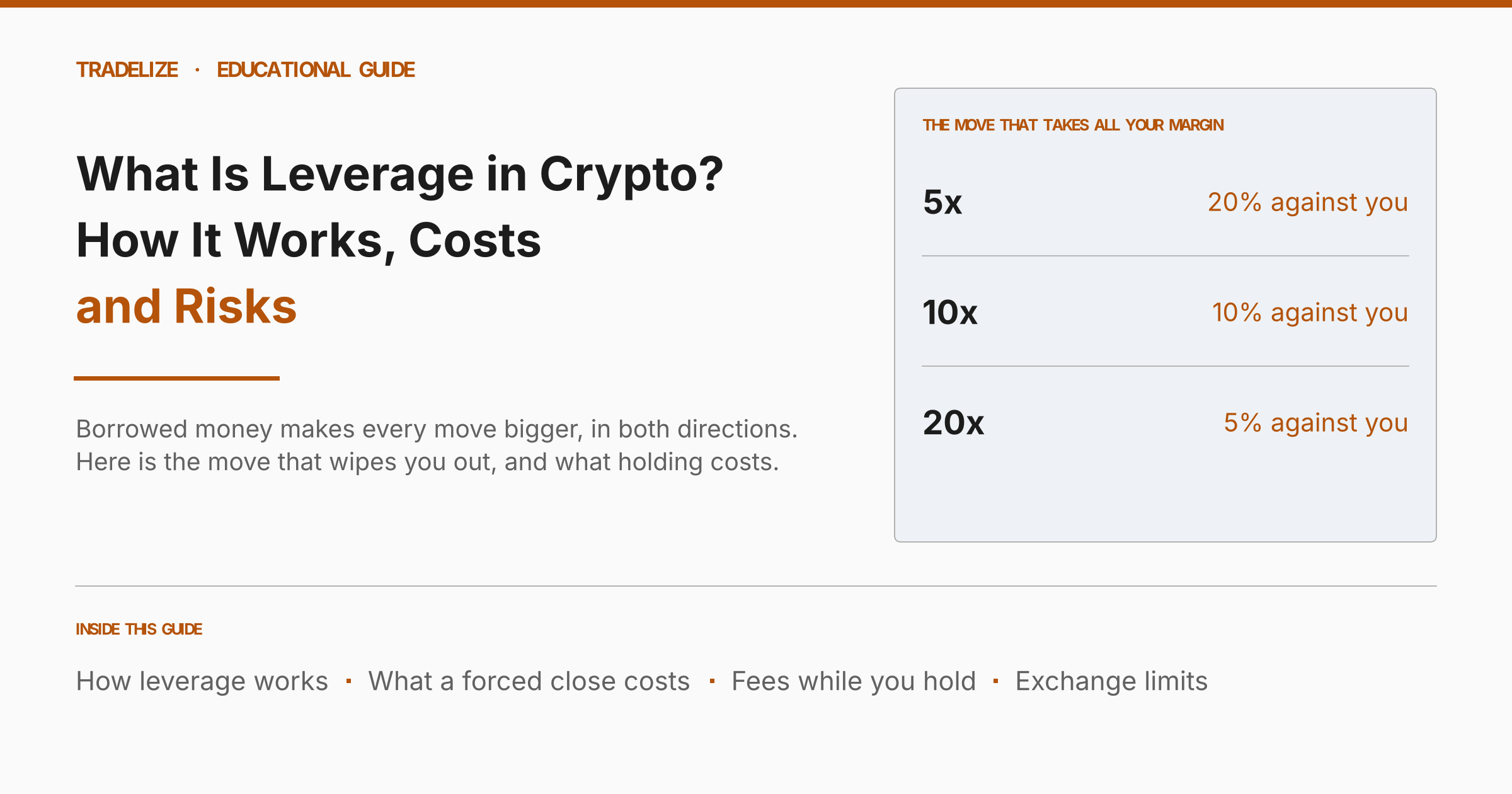
Leverage in crypto means borrowing from a trading platform so your position is worth several times your own deposit. A 10x position moves ten times as fast in both directions, so a 10% move against you can wipe out your stake.
This guide covers how it works, what a forced close costs, and the fees that run while a trade stays open.
| Key takeaways 1. Leverage lets you open a position worth more than your deposit, and the borrowed part magnifies losses as fast as gains. 2. Divide 100 by your leverage ratio for the move that wipes out your margin: 20% at 5x, 5% at 20x. 3. Platforms force a close before that point, and once the process starts, it cannot be stopped. 4. You pay a trading fee, a borrowing or funding charge for every hour the trade stays open, and a penalty fee if the platform closes it. |
What is leverage in crypto?
Leverage in crypto is trading with money the platform lends you. At 10x, Bybit’s help centre shows 10 USDT controlling an asset worth 100 USDT, with the other 90 USDT borrowed.
Your own share is the margin. Kraken calls the set-aside amount used margin, and it serves as collateral: the platform holds it against the loan and releases it when you close the trade.
Kraken’s margin guide works through a $10,000 short, a bet that the price falls. It needs $2,000 of margin at 5x and $1,000 at 10x. Kraken allows up to 20x in eligible regions, which would need $500.
How does leverage magnify gains and losses?
Your margin takes the move of the whole position, not of your share in it. Coinbase International Exchange’s leverage policy shows a 10% rise at 5x as a 50% gain on the margin, and a 10% fall as a 50% loss. On spot, paid in full, you gain or lose the 10%.
That gives you one sum worth noting. Divide 100 by your leverage ratio for the move that takes all your margin, before fees: 20% at 5x, 10% at 10x, 5% at 20x.
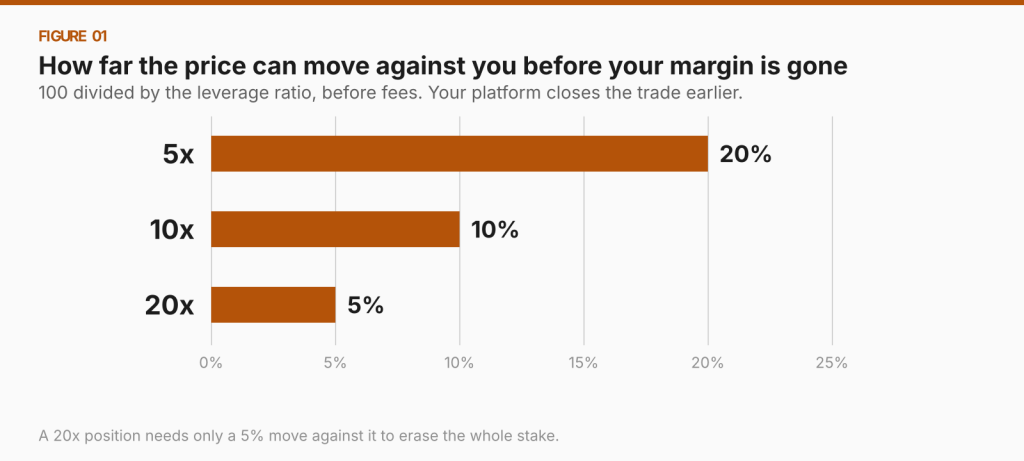
You don’t reach that point because the platform steps in first. A higher ratio makes every gain and loss bigger and brings that intervention closer. It does not improve your odds of being right.
Which crypto products offer leverage?
Crypto leverage trading reaches you through two products. In crypto margin trading, you borrow to buy the coin itself. A future is a contract to buy or sell at a set price later, and the difference decides what you own.
Kraken says assets bought on spot margin are yours and can be withdrawn, as in ordinary crypto trading, though the collateral stays locked until you close. Bybit says a futures buyer holds an agreement rather than the crypto, and its perpetuals never expire. Bybit lists top leverage of 25x to 125x by pair.
Where you live may settle it for you. The UK’s Financial Conduct Authority banned the sale of crypto derivatives to retail consumers in 2020, contracts for difference among them. Germany’s BaFin order of 23 July 2019 bars retail crypto CFDs unless conditions are met, one being 50% initial margin, or 2:1. Singapore went further: the Monetary Authority of Singapore told providers to discourage retail speculation by “not providing financing, margin or leverage transactions”, in measures phased in from mid-2024.
What is liquidation in crypto, and what can you lose?
Liquidation is the platform closing your leveraged trade for you, the same event some platforms call a forced close. It triggers when the margin behind the trade runs too low.
Kraken’s margin levels page, dated 1 October 2026, uses two measures. A margin call, which is only a warning, arrives at roughly 80% margin level, and the exact point shifts with price swings. Liquidation of a spot margin position comes at 40% margin health. Once the process starts, Kraken says, “it is not possible to stop it”.
What you can lose after that depends on the platform.
| PLATFORM AND PRODUCT | WHAT THE PLATFORM SAYS ABOUT A LOSS BEYOND MARGIN |
|---|---|
| Kraken spot margin | Your loss on the position can be larger than the used margin |
| Coinbase International perpetual futures | A negative balance is possible, though Coinbase says it does not pursue you for losses beyond your margin |
| Bybit perpetual and expiry contracts | An insurance fund covers losses beyond a liquidated position’s margin, and if it falls short, auto-deleveraging can cut winning positions instead |
What does holding a leveraged position cost?
A leveraged trade costs you at the open, at the close, and for every hour in between.
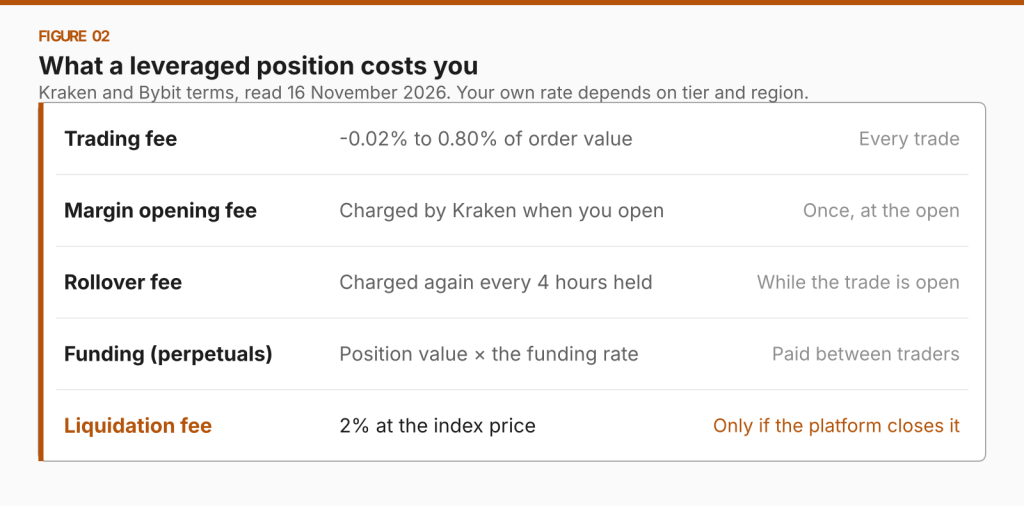
- Trading fee: Kraken’s fee page runs from -0.02% for a maker, which is a rebate rather than a charge, to 0.80% for a taker, as of 30 October 2026.
- Borrowing fee: Kraken charges an opening fee on a margin position, then a rollover fee every four hours it stays open.
- Funding: on perpetual futures, traders pay each other rather than the exchange. The funding rate crypto platforms publish sets the direction, with longs paying shorts when it is positive and shorts paying longs when it is negative.
- Liquidation fee: if Kraken closes the position for you, it charges 2% at the index price in place of the standard trading fee.
Is leverage trading a good idea for beginners?
Learn how forced closes work before you switch leverage on, and use only money you can afford to lose in full.
The best evidence on how that goes belongs to a regulator. The FCA’s 2019 consultation paper examined retail accounts at seven UK firms between June 2017 and December 2018 and found “67% losing money by investing in these products across the full 18-month period”. One caveat the FCA states, and we repeat: that sample also held exchange-traded notes, which carry no leverage.
Kraken’s own advice carries weight, because Kraken is the lender. It suggests setting a stop to limit loss and a profit target on every position, and closing well before a margin call rather than after one. A higher ratio only helps if you resist using it to size up.
The Bottom Line on Leverage in Crypto
Leverage changes how expensive being wrong is, and how fast it gets there.
Before you switch it on, work out the move that takes your margin. Find where your platform forces a close, and whether it will chase you for a negative balance. Then add up what the position costs per day to hold. If any of those is unclear on the platform’s own pages, stay on spot.
Frequently Asked Questions
Can a platform reduce a winning leveraged position?
Yes, on some futures platforms. Bybit’s auto-deleveraging cuts winning positions when its insurance fund cannot cover the losses of liquidated ones. On 10 October 2025, the data firm CoinGlass reported positions closed at prices far from the market. You can be right and still lose the trade.
Can you use leverage in DeFi?
Yes, in a different form. Aave, a lending protocol, says its loans are always over-collateralised, so you post coins worth more than you borrow. Each position carries a Health Factor, its risk score, and can be liquidated if that score falls below 1.
What was the biggest crypto liquidation day?
10 October 2025. CoinGlass counted $19.13 billion in forced closes across roughly 1.6 million traders, its largest single day. CoinGlass added that “the actual total is likely much higher”, because Binance reports only one liquidation order per second. No verified total has been published since.

Our Review Methodology
We evaluate each post based on thorough research, credibility of sources, accuracy of information, and relevance to our readers. Our editorial team follows strict guidelines to ensure all content meets high standards of quality.
Disclaimer
The content in this article is provided for informational purposes only and does not constitute financial, investment, or professional advice. Always do your own research before making any decisions.