Ethereum is usually assumed to be a cryptocurrency. That’s how most introductions get it wrong. So, what is Ethereum actually?
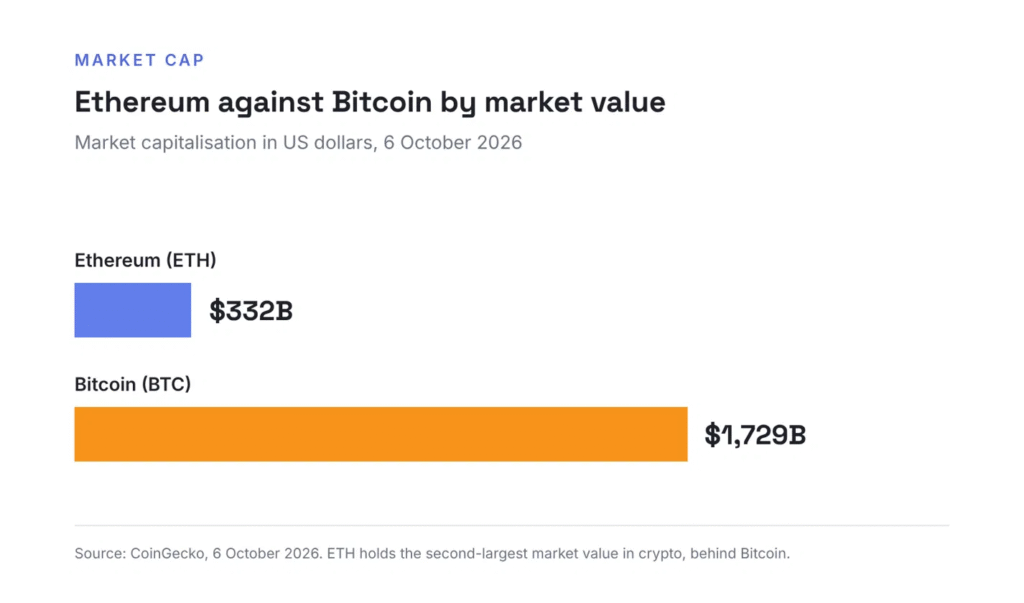
It is a programmable blockchain, one that uses a currency (ETH) to compensate validators for computation. As per the latest data, the network holds a market capitalization of approx. $332 billion (CoinGecko) and settles around 1.5 to 1.8 million transactions daily on mainnet (Etherscan), with Layer-2 scaling networks processing tens of millions more. Ethereum hinges on the programmable layer. Understanding this will help you know what makes it different from other crypto initiatives.
Key Takeaways
- Ethereum is a programmable blockchain. Anyone can deploy code to it and use that code.
- ETH is the currency used to pay for computation on Ethereum. Each transaction and contract call costs gas, which is paid in ETH.
- Smart contracts are its core feature. They run automatically once conditions are met, without any bank or notary in the middle.
- Ethereum settles more than a million transactions daily and holds more than half of all DeFi value locked.
- ETH vs Bitcoin comes down to purpose: Bitcoin is built to store value, while Ethereum is built to run applications.
What Is Ethereum, Exactly?
In 2013, a 19-year-old programmer had one question: what if Bitcoin could run programs? And so, he wrote a whitepaper. The Ethereum project took shape from that idea, and the network launched on July 30, 2015. The core premise has remained the same since then. While Bitcoin works as a distributed ledger tracking asset ownership, Ethereum serves as a global execution engine capable of running arbitrary code. That idea of people owning their own computing still drives the project. In January 2026, Vitalik Buterin, Ethereum’s co-founder, called 2026 the year to “take back lost ground in computing self-sovereignty” and moved his own documents, messaging, and email to open-source, privacy-first tools.
It is run by several thousand nodes (computers) spread across the world, without any organisational or governmental control. So, when you send ETH, interact with a DeFi app, or deploy a smart contract, it is verified by a global network of validators and recorded permanently on the Ethereum blockchain.
Ethereum Explained: The Idea of ‘World Computer’
The conception of Ethereum as a “world computer” stems from the fact that anyone can write and deploy code on it without prior approval from any centralized authority. This permissionless openness makes the entire DeFi ecosystem possible.
How Ethereum Works, Step by Step
Every ~12 seconds, a batch of transactions is bundled into a “block” and added onto the Ethereum chain (Ethereum Foundation, 2026). That’s the rhythm of the network, with thousands of nodes worldwide maintaining a shared database simultaneously. Bitcoin takes 10 minutes per block. At ~12 seconds, Ethereum moves considerably faster, so transactions confirm much sooner.

Maintaining this synchronized state are approximately 8,100 execution-layer nodes globally, as tracked by Ethernodes. In addition to storing historical ledger data, these nodes run the Ethereum Virtual Machine (EVM), a sandboxed execution environment that processes smart contract code, primarily written in Solidity or Vyper.
Proof of Stake and Staking
The next question is: What keeps everyone honest? Since September 2022, Ethereum has utilised a Proof of Stake consensus mechanism, introduced through the network upgrade known as ‘The Merge’. Instead of relying on energy-intensive hardware validation, network state integrity depends on validators locking up capital as collateral. Operating an independent validator node demands a minimal threshold of 32 ETH, with protocol-level slashing penalties enforcing honest node behavior. Total network commitment has evolved to about 43.7 million ETH, accounting for nearly 36% of circulating supply.
Gas Fees
Executing transactions or smart contract code on mainnet entails a gas fee denominated in ETH that goes to validators for processing power. Cost fluctuates strictly based on real-time network demand; high volatility during 2021 market cycles frequently pushed routine contract execution fees above $100 per transaction. Following protocol scaling upgrades and the expansion of Layer-2 execution rollups like Arbitrum and Base, routine transaction costs on secondary layers have dropped to fractions of a cent. This cost differential accelerated the migration of retail execution and smart contract activity toward Layer-2 scaling networks, as tracked by L2BEAT’s Scaling Activity Explorer.
To understand this in detail, Tradelize covers a crypto exchange fees guide, including how exchange fees compare to on-chain gas.
What Is Ether (ETH)?
The basic design of Ethereum is such that you can’t use it without ETH. Every transaction, every smart contract execution, and every NFT mint entails ETH to pay gas fees. Ether is the fuel that runs the network, and you can trade it too.
As per recent data, Ether holds a market capitalization of about $332 billion, with almost 122.1 million ETH in circulation, making it the second-largest digital asset behind Bitcoin (CoinGecko). In contrast to Bitcoin’s fixed 21 million coin ceiling, Ethereum works without a rigid supply limit. Post-Merge monetary mechanics tie net issuance clearly to network utilization, with fee-burning protocols periodically pushing net supply into deflationary contraction during peak transaction activity.
This makes ETH different from a coin with a fixed cap. When the chain is busy, the fees it burns can outpace the new ETH paid to validators, and the supply shrinks temporarily. In practice, ETH has gone deflationary at several points since ‘The Merge’, though supply has been rising again since 2024 as lower fees mean less ETH is burned.
Why ETH Has Value
It’s needed to use the network, which creates demand. Staking ties up supply, thus reducing selling pressure. And Ethereum’s role as the foundation for the DeFi and NFT ecosystems means its utility grows with those markets.
What Are Smart Contracts?
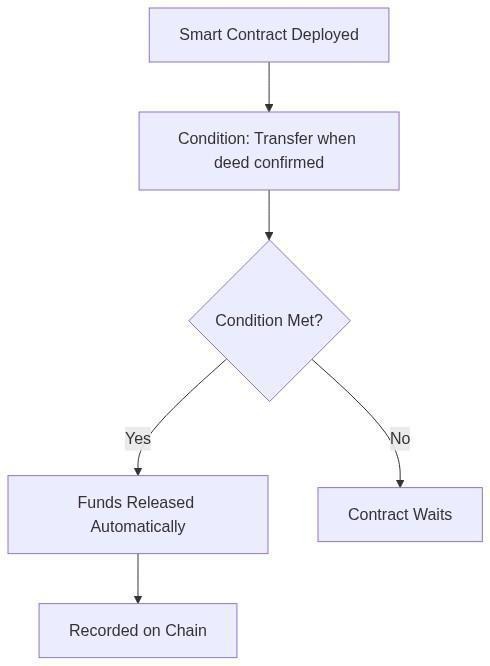
Picture an escrow service where the escrow agent is a piece of code that no one can bribe, delay, or overrule. A smart contract is code, stored on Ethereum, that runs automatically when pre-defined conditions are met. There is no middleman, bank, or notary.
A Smart Contract in Practice
Imagine buying a house without a lawyer holding the funds. With a smart contract, you code the logic once: release payment when deed transfer confirms on-chain. The contract handles it automatically. Neither party can stop it, freeze it, or walk away once conditions are triggered.
That sounds niche until you consider how much of traditional finance runs on “a third party holds funds and releases them based on conditions.” That speaks of every loan, every insurance claim, and every trade settlement. Smart contracts replace the intermediary with code.
Most Ethereum developers write these contracts in Solidity, a language that looks a lot like JavaScript. And then, the code is compiled to EVM bytecode. Once deployed, the contract lives at a fixed Ethereum address forever, and you can’t unpublish it.
How Is Ethereum Different from Bitcoin?
Bitcoin and Ethereum get lumped together constantly, treated as a single monolithic category. But they are built for different things. Conflating them is like comparing email to a spreadsheet because both run on computers.
| Feature | Ethereum (ETH) | Bitcoin (BTC) |
|---|---|---|
| Primary purpose | Programmable platform for dApps, DeFi, NFTs | Store of value / digital currency |
| Consensus | Proof of Stake (since Sep 2022) | Proof of Work (mining) |
| Block time | ~12 seconds | ~10 minutes |
| Supply | ~122.1M, no hard cap | 21M hard cap |
| Smart contracts | Yes (native, Turing-complete) | Limited (no Turing-complete scripting) |
| Energy use | ~0.0026 TWh/year (post-Merge) | ~138 TWh/year |
| Programmability | High: full dApp ecosystem | Low: primarily monetary transactions |
ETH vs Bitcoin: Energy and Purpose
The energy contrast is huge between the two.
Ethereum’s shift to Proof of Stake made it 99.988% more energy-efficient, compared to its earlier Proof of Work model (ethereum.org, citing CCRI). Operating at an annualized footprint of approximately 0.0026 TWh, the network needs only a fraction of the power drawn by legacy architectures. By comparison, Bitcoin’s Proof of Work model requires about 138 TWh annually (Cambridge Bitcoin Electricity Consumption Index, 2026), matching the energy profile of a mid-sized industrial economy.
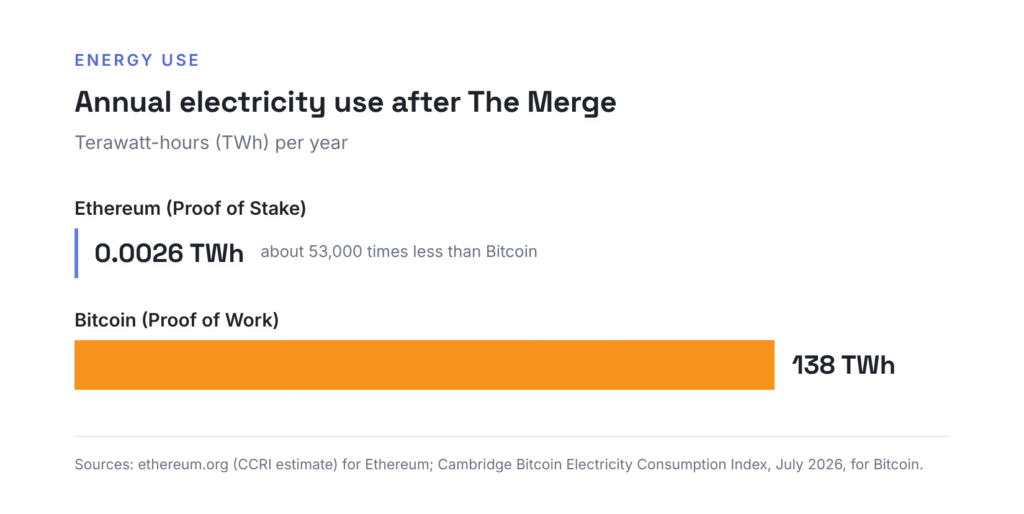
So, if you want a secure and scarce digital asset, Bitcoin is purpose-built for that. But if you want a platform to build financial applications, issue tokens, or run decentralized services, then Ethereum is a better choice.
What Can You Use Ethereum For?
The Ethereum use cases carrying volume today are DeFi, NFTs, stablecoins, enterprise settlement, and Layer 2 networks.
Ethereum Use Cases: DeFi and NFTs
Ethereum has a formidable presence in DeFi, holding around 56% of total value locked across all smart contract platforms (DefiLlama). The network’s liquidity depth is further solidified by foundational protocols, like Uniswap for spot exchange, Aave for credit, and Lido for liquid staking.
Apart from capital markets, non-fungible tokens (NFTs) represent the platform’s most visible consumer application. Ethereum powers nearly 62% of all active NFT smart contracts globally, according to Colexion. Secondary market activity has since pivoted toward sustainable utility, while Ethereum remains the primary settlement layer for digital provenance.
Enterprise, Stablecoins, and Layer 2
Enterprise applications: Both Visa and PayPal have built on Ethereum rails for digital assets and settlement. PayPal’s PYUSD stablecoin runs natively on Ethereum, alongside other chains such as Solana. The UN World Food Programme has used a private blockchain built on Ethereum technology to deliver aid to refugees. In other words, these are live deployments now.
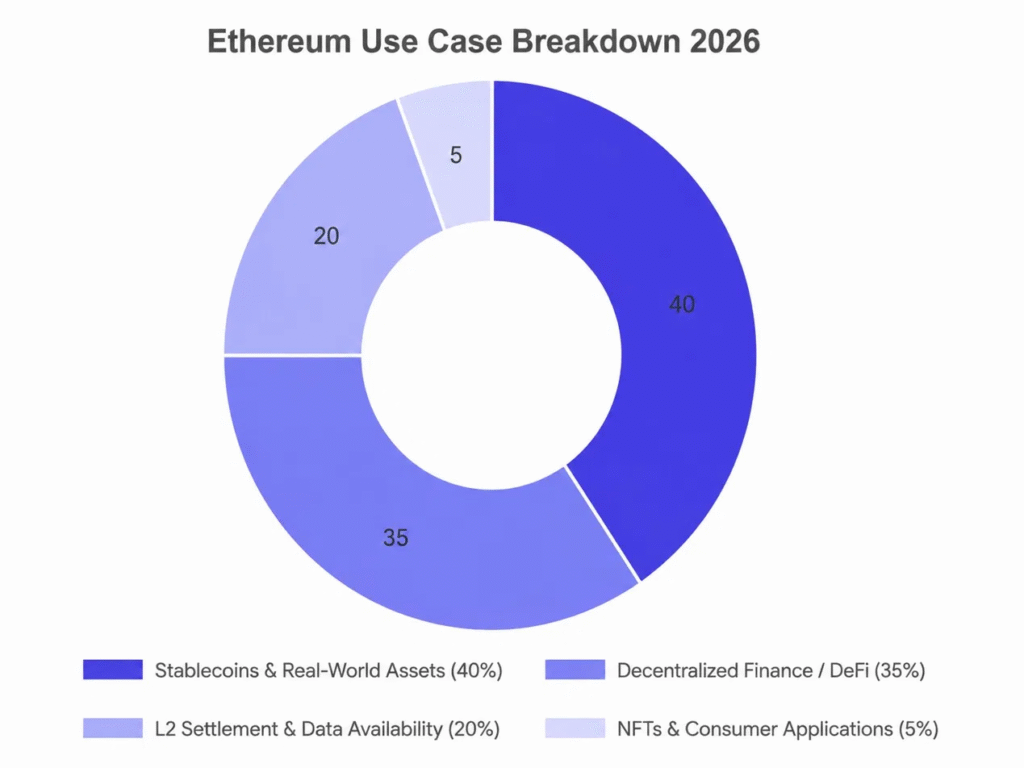
Stablecoins: USDC, backed by cash and short-term US Treasuries, and DAI, overcollateralized by crypto assets, run mainly on Ethereum. This is how billions of dollars in dollar value move on-chain without going through any bank.
Layer 2 networks: By its default design, Ethereum’s base layer prioritizes security and decentralization, irrespective of the value of transactions. The scaling happens on Layer 2 networks like Arbitrum, Optimism, and Base, which batch transactions and settle them on Ethereum. If you’ve used a DeFi app in 2025-2026, you’ve probably been on an L2 without knowing it.
The first time our team set up MetaMask and tried to swap tokens on Uniswap, the interface made sense and the wallet connection was straightforward. Then, a $4.50 gas fee appeared on what was supposed to be a $15 trade. Although it wasn’t exactly the frictionless financial system that the whitepapers promised, L2s fixed most of that. The same swap on Arbitrum now costs us about $0.03.
How to Get Started With Ethereum
The most common entry points:
- Buy ETH on an exchange: Most of the major centralized exchanges list ETH. You can review crypto exchanges on Tradelize or check the list of top crypto exchanges to compare fees, available features, and regional access. Popular choices for ETH are Binance and KuCoin, though availability depends on your country.
- Set up your wallet: With an exchange account, you can hold ETH, but to interact with dApps, DeFi, or NFTs, you’ll need a self-custody wallet. MetaMask is the default choice for browser-based use. For larger holdings, a hardware wallet is preferred as it adds a layer of security. You can check out our hardware wallet guide for options. Tradelize’s crypto wallet reviews and best crypto wallets sections rank commonly used options with ratings.
- Know what you’re buying: ETH witnessed substantial volatility throughout 2025 and 2026. After hitting an all-time high of about $4,950 in August 2025, the asset pulled back sharply and now trades roughly 45% below that peak. Remember, it’s not a savings account. The crypto glossary is a useful starting point if the terminology still feels complex to you.
The Bottom Line on Ethereum
Ethereum is the programmable backbone of the decentralized internet: a blockchain where smart contracts run DeFi protocols, NFT markets, and stablecoin infrastructure at scale. With more than half of global DeFi TVL on it, today it’s not a speculative experiment, but a fully working infrastructure. You can start with the educational guides on Tradelize for a structured path into the ecosystem.
Frequently Asked Questions
Is Ethereum the same as Bitcoin?
No. They are different in purpose. Bitcoin is mainly a store of value, and its supply is capped at 21 million coins. On the other hand, Ethereum is a platform you can build on, and ETH is the coin that pays for the code it runs. Both are blockchain networks.
What is gas on Ethereum?
The cost paid in ETH to carry out transactions or smart contracts on the Ethereum network is called a gas fee. This is the compensation validators receive for the computational work. Gas costs increase and fall with network traffic or demand. For example, they spiked during the 2021 NFT boom. However, they are far less now on Ethereum’s Layer 2 networks like Arbitrum and Base.
Can you stake Ethereum?
Yes. Since The Merge in September 2022, Ethereum runs on Proof of Stake. Running your own validator node requires a minimum of 32 ETH, but you can stake smaller amounts through liquid staking protocols like Lido or Rocket Pool. Total network commitment stands at about 43.7 million ETH according to Beaconcha, representing approximately 36% of total circulating supply.
What was The Merge?
The Merge was the day Ethereum stopped using mining and switched to Proof of Stake. It finished in September 2022. It cut the network’s energy use by 99.988%, ended ETH mining, and put validators in charge of new blocks. It is one of the biggest live upgrades any blockchain has shipped.
Is Ethereum a good investment?
It depends on your risk tolerance and your timeline. ETH is volatile, and fell close to 60% between January 2025 and April 2025, then recovered to a new all-time high in August 2025. It does have use as the fuel for a large financial ecosystem, but it is not a safe place to park cash. Ideally, you shouldn’t put in that money in it, which you need next month.

Our Review Methodology
We evaluate each post based on thorough research, credibility of sources, accuracy of information, and relevance to our readers. Our editorial team follows strict guidelines to ensure all content meets high standards of quality.
Disclaimer
The content in this article is provided for informational purposes only and does not constitute financial, investment, or professional advice. Always do your own research before making any decisions.