You’ve got Bitcoin in a wallet somewhere, you’ve been Muslim your whole life, and you’re starting to wonder whether what you’re holding is actually okay (More like asking yourself directly- “Is Crypto Haram”). Not a comfortable question. And the scholars aren’t making it easier.
Around 1.9 billion Muslims are navigating this, and the debate has been running for nearly a decade without resolution. The Grand Mufti of Egypt says crypto is forbidden (BBC News, 2018). Mufti Faraz Adam — one of the most followed Islamic finance scholars in the West — says established cryptocurrencies are generally permissible. Both are citing the same Shariah principles and arriving at opposite conclusions. So to answer “Is Crypto Haram?” we can’t say, it is to some and not to others.
It’s worth noting that the debate isn’t really about whether digital money can exist in Islam. It’s about whether this kind of digital money, used this way, crosses the three lines that Islamic finance draws around financial activity.
Our Understanding: the coin matters less than the activity. But to understand why that is, you need to understand what those three lines actually are.
The Three Shariah Lines: Riba, Gharar, and Maysir
According to research published in HJBEM, Islamic finance doesn’t prohibit profit — it prohibits profit made through exploitation of uncertainty, interest extraction, or gambling. Three concepts define the framework:
- Riba is interest: earning money from money without a corresponding service or shared risk. Conventional banking runs on it. Islamic banking explicitly doesn’t. For crypto, the riba question surfaces mainly in leveraged trading and certain staking arrangements where you receive fixed-rate returns regardless of network performance.
- Gharar refers to excessive uncertainty built into a transaction — the kind where one party doesn’t genuinely know what they’re getting. Crypto’s price volatility raises gharar flags for many scholars. Not because prices fluctuate (equity markets do that), but because critics argue the underlying value is entirely speculative, anchored to nothing contractual.
- Maysir is gambling. If your profit depends primarily on random price movements rather than genuine economic contribution, you’re in maysir territory. Day trading a coin hoping news moves the price in the next few hours is the textbook example.
Every crypto activity gets measured against these three. The disagreement among scholars isn’t about the principles — it’s about whether crypto characteristics actually trigger them.
The MENA region processed $390 billion in cryptocurrency transactions between mid-2023 and mid-2025, according to Chainalysis — suggesting a significant portion of the Muslim world has already made its own practical judgment while the scholarly debate continues.
About the Haram Camp
The haram camp isn’t fringe. It includes some of the most prominent religious authorities in the Muslim world.
- Shaykh Shawki Allam, the Grand Mufti of Egypt, ruled against Bitcoin on the grounds that it enables fraud, lacks regulatory accountability, and operates entirely outside state oversight — features he argues make it incompatible with Shariah. Turkey’s Diyanet (the state religious authority) followed with a similar ruling, citing excessive speculation.
- Shaykh Haitham al-Haddad, widely followed among British Muslims, argues that Bitcoin is a speculative instrument dressed up as a currency. No underlying real-world asset. No counterparty obligation. Nothing anchoring the value except collective belief. His reading: that pushes it into gharar and maysir territory simultaneously.
The Fatwa Center of Palestine reached the same conclusion, as did scholars across several Gulf states — particularly regarding DeFi products and derivatives.
Having said that, the shared concern isn’t that digital finance is inherently wrong. It’s that crypto, as currently structured, carries too many characteristics that mirror gambling and instability for compliance to be assumed.
Why Other Scholars Say It’s Halal
The halal case is equally well-argued — and, by our reading, more widely adopted among scholars who’ve spent serious time with the technical mechanics.
Mufti Faraz Adam, a UK-based Islamic finance authority who has published extensively on digital assets, classifies Bitcoin and established cryptocurrencies as permissible digital commodities. His reasoning: Shariah money rules don’t require physical backing. What matters is real economic utility and social acceptance as a medium of exchange. Bitcoin demonstrably has both.
Ziyaad Mahomed, Shariah Committee Chairman of HSBC Amanah Malaysia, makes the same argument. “Sharia doesn’t require that a currency have intrinsic value,” he’s noted. “What’s important is that there is social acceptance among people that such currency has value and it is capable of being used in transactions.”
Malaysia’s Securities Commission has issued formal guidance permitting cryptocurrency assets under specific conditions — probably the most significant national-level halal endorsement to date. Several scholars in Indonesia and parts of Southeast Asia have followed similar positions.
The International Islamic Fiqh Academy still hasn’t issued a definitive binding ruling. That absence is itself meaningful: if the haram case were clear-cut, you’d expect a ruling by now.
The Activity Matters More Than the Asset
This is the part most articles on this topic spend too little time on.
The debate over whether “crypto is haram? Or halal?” is largely a proxy question. The real question — the one that matters for your portfolio — is: what are you actually doing with crypto?
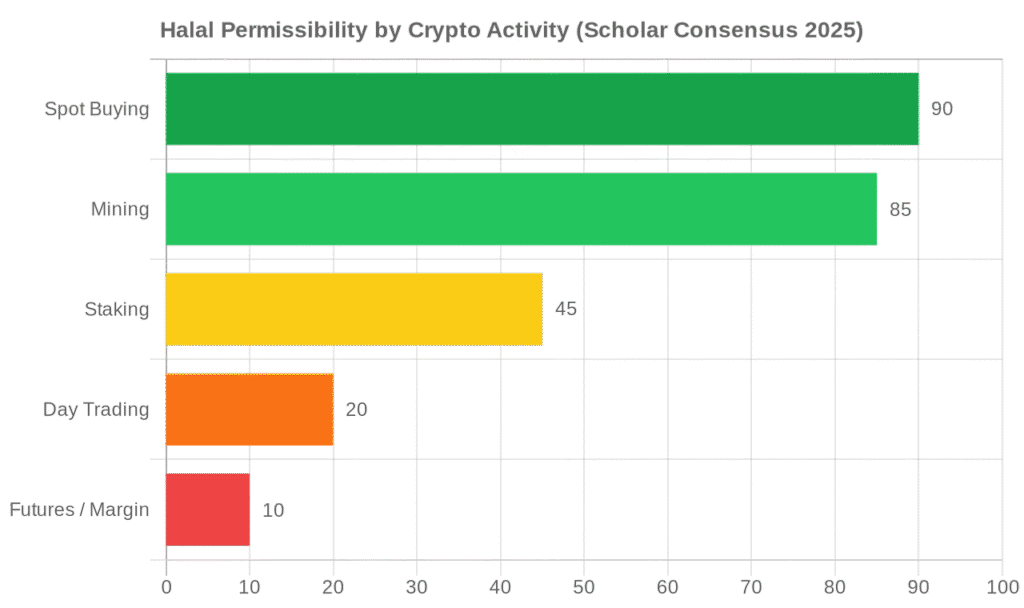
- Spot buying means purchasing an asset and taking real ownership of it. You own it, it sits in your wallet, its value moves. Most scholars who find any crypto permissible are comfortable with this. You’ve taken on genuine economic exposure, not wagered on price ticks.
- Mining gets a similarly clean pass. You provide computational work, secure a network, receive compensation. That’s a legitimate service transaction, and most scholars who engage with the technical details find it permissible.
- Day trading is where it gets complicated. Closing positions within hours based on short-term price movements, with no view on underlying value — most interpretations push that toward maysir. The intent matters as much as the mechanics.
- Futures and leveraged trading are broadly considered haram across the scholarly spectrum. Interest-bearing margin triggers riba. The speculative structure triggers gharar. Stacking both is a double fail.
- Staking is genuinely disputed. Proof-of-stake validation — where you contribute network security and receive a share of fee revenue — is defensible as a profit-sharing arrangement (mudarabah-style) under several scholarly readings. Fixed-yield staking products in DeFi protocols are more likely to be classified as riba-adjacent. The specific mechanism matters, and it’s worth checking before assuming.
| Activity | Typical Scholar View | Key Concern |
|---|---|---|
| Spot Buying | Generally halal | — |
| Mining | Generally halal | Energy use |
| Staking | Disputed | Potential riba |
| Day Trading | Mostly haram | Maysir |
| Futures / Margin | Broadly haram | Riba + Gharar |
| NFTs | Mixed | Asset legitimacy |
Sharia-Compliant Crypto Options
If you want formal certification rather than interpretive guidance, the infrastructure for that is growing.
OneGram (launched 2017) backs each token with at least a gram of physical gold — satisfying scholars who require tangible asset backing for a currency to be Shariah-permissible. Islamic Coin runs on the Haqq blockchain, certified by the Emirates Fatwa Council, with Shariah compliance built into the smart contract architecture.
I held Bitcoin for two years without actually using it, which meant no leverage, no derivatives, just a kind of spot ownership. When I asked my local imam about the same, he said the holding itself wasn’t the concern at all. He asked me how I acquired it (which is valid) and what I intended to do with it.
Platform Perspective
On the platform side, Islamic accounts are increasingly standard at major exchanges after somewhat navigating the debate on is crypto trading halal or haram. These are swap-free structures that eliminate overnight interest charges — the feature that would otherwise create Riba exposure on open positions. Binance, KuCoin, and a number of other exchanges offer them. It’s worth verifying whether the “Islamic account” label comes with a named Shariah board certification, rather than just being a marketing designation.
The Global Islamic Fintech Report 2025/26 values the Islamic fintech market at $198 billion in 2024/25, projected to reach $341 billion by 2029 at an 11.5% CAGR. Shariah-compliant crypto products are a growing slice of that — demand, according to The Islamic Economist’s 2025 report, already exceeds available supply.
Conclusion
The question “is crypto haram?” doesn’t have a single answer and after nearly a decade of scholarly debate, that’s unlikely to change soon for any of us. What the debate has produced is something more useful and that is a framework. The asset matters less than the activity. Spot ownership of established cryptocurrencies sits in broadly permissible territory for a significant body of scholars, again, only to be debated. Leveraged trading, futures, and fixed-yield DeFi products sit in broadly prohibited territory for nearly all of them. Everything else lives in the middle, where your specific mechanism, your specific intent, and your specific scholarly tradition determine the answer.
Frequently Asked Questions
1. Is Bitcoin Haram?
No binding ruling applies universally. Mufti Faraz Adam and scholars aligned with Malaysia’s Securities Commission classify Bitcoin as a permissible digital commodity. The Grand Mufti of Egypt and Shaykh Haitham al-Haddad classify it as haram due to its speculative characteristics and lack of anchored value. The answer depends on which scholarly tradition you follow and — critically — how you’re actually using it.
2. Is Crypto Trading Halal?
Spot trading of established cryptocurrencies (buying, owning, selling) is viewed as permissible by a substantial body of Islamic scholars. Day trading, futures, and leveraged positions are generally considered haram across most interpretive traditions. The transaction type matters more than the underlying coin.
3. Is Staking Haram?
Genuinely disputed. Staking through proof-of-stake validation, where you contribute network security and receive a portion of fee revenue, is defensible as profit-sharing under several scholarly readings. Fixed-yield staking products in DeFi protocols are more likely to be classified as riba. Check the specific mechanism before assuming — and consult a qualified Shariah advisor if it’s material to your holdings.
4. Is Crypto Mining Halal?
Generally yes. Mining involves real computational work in exchange for block rewards — a service relationship most scholars find unproblematic. The energy-use question is an environmental concern rather than a Shariah compliance issue.
5. Is Ethereum Halal?
The same analysis as Bitcoin applies. Spot ownership of ETH is generally viewed as permissible under halal interpretations. ETH staking post-Merge sits in disputed territory — some scholars accept it as profit-sharing for network validation, others remain cautious about the fixed-rate yield element. Check with a Shariah advisor if your ETH staking returns are material.
This article is for informational purposes only and does not constitute religious or financial advice. For personal rulings, consult a qualified Islamic scholar.

Our Review Methodology
We evaluate each post based on thorough research, credibility of sources, accuracy of information, and relevance to our readers. Our editorial team follows strict guidelines to ensure all content meets high standards of quality.
Disclaimer
The content in this article is provided for informational purposes only and does not constitute financial, investment, or professional advice. Always do your own research before making any decisions.