
A smart contract is a program stored on a blockchain that runs by itself when its conditions are met. It doesn’t need a bank, a lawyer, or a clerk to push it along. If the conditions match, the code runs; if they don’t, nothing happens. A DeFi protocol, for example, can use a smart contract to lend to you, hold your collateral, and sell that collateral if its value drops too far, all without any human approval.
| Key Takeaways 1. A smart contract is a program on a blockchain that runs automatically when its conditions are met. 2. Ethereum hosts the largest set of smart contracts, but Layer-2 networks and other chains now process most daily activity. 3. Smart contracts power decentralized exchanges, lending, NFTs, and stablecoins. 4. They cut out intermediaries, but bring code, oracle, and admin-key risks of their own. 5. Audits lower the odds of failures, but can’t remove them completely. |
What is a smart contract, and why does it matter to crypto traders?
Most people have signed a contract. You agree to terms, the other side agrees, and both do as promised. The weak point has always been enforcement: it needs people, and people cost money, make mistakes, and sometimes fail to perform.
Smart contracts move enforcement into code. For anyone trading crypto or using DeFi, that changes what you have to trust and what you need to check.
What you’re trusting
Smart contracts are often said to remove trust. In practice, they just shift it. You don’t rely on a bank to honour written terms; instead, you rely on the code, the blockchain it runs on, and the outside systems it depends on, such as price oracles, website frontends, cross-chain bridges, and whoever holds the admin keys.
Smart contract code is usually public, so anyone can read what a contract will do before using it. This makes checking possible, but it doesn’t make the risk zero.
When our team tested a swap on a decentralized exchange, it executed on exactly the terms we set, without any broker in between. The contract followed its rules, though the rules didn’t promise a good price.
Who invented smart contracts?
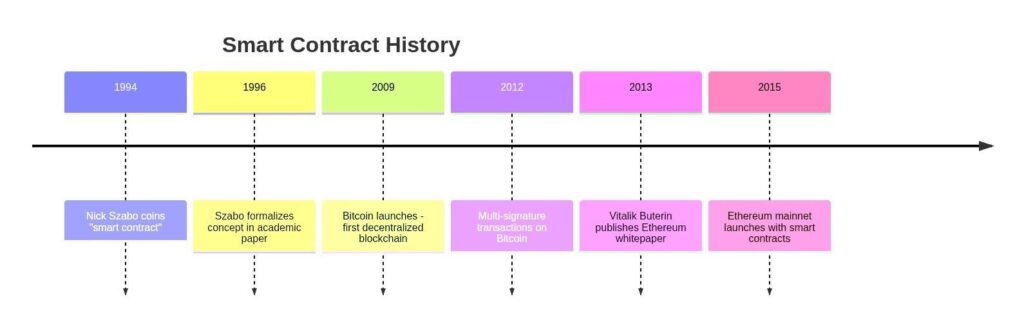
Smart contracts are older than Bitcoin. Computer scientist Nick Szabo introduced the idea in 1994 and set it out more fully in a 1996 paper, more than a decade before any blockchain existed to run it. He compared it to a vending machine, which takes coins and hands over goods through simple mechanical rules. His definition:
“A smart contract is a set of promises, specified in digital form, including protocols within which the parties perform on these promises.”
Nick Szabo, “Smart Contracts: Building Blocks for Digital Markets” (1996, Nakamoto Institute archive)
From theory to Bitcoin and Ethereum
The idea remained unused for years. Bitcoin solved that consensus problem in 2009, but its scripting language was deliberately limited: multi-signature transfers worked, but complex conditional logic didn’t.
In late 2013, Vitalik Buterin circulated a whitepaper for Ethereum, a blockchain with a general-purpose programming language that could run any logic. Ethereum’s mainnet went live on 30 July 2015. From then on, developers could deploy a program to a shared network and have thousands of independent nodes run it the same way.
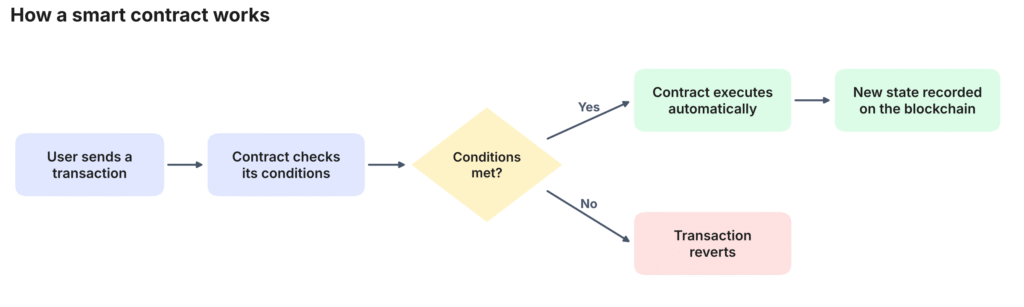
How a smart contract works
A smart contract follows simple if/then logic: if condition A is met, action B happens. Each node on the network checks the result, and the change counts once the network agrees.
A worked example: collateralized lending
DeFi lending shows the pattern clearly. You deposit ETH as collateral and borrow USDC against it, and the contract holds your ETH in escrow. If the value of your collateral falls below the protocol’s liquidation threshold, the protocol can sell some or all of it under its rules. There’s no court order, phone call, or credit officer.
What triggers it is the value of your collateral relative to your debt, so two traders holding the same asset can lie at very different distances from liquidation.
From code to deployment
A developer writes the contract in a programming language, tests it, and submits it to the network inside a transaction. The contract then gets its own public address, like a wallet address, and can hold and move funds as per its rules.
Gas fees and Layer-2 networks
Every interaction with a smart contract on Ethereum costs gas, paid in ETH to the validators who run the network, and the price rises and falls with demand. At the May 2021 peak, the average Ethereum fee hit about $70, and a single token swap could cost over $100 at times. Those costs pushed users towards Layer-2 networks.
Chains such as Arbitrum, Optimism, and Base process transactions away from Ethereum’s main layer and periodically settle bundled data back to it. For users, that means the same smart contract logic at a fraction of mainnet fees. Our crypto exchange reviews show which platforms work with Layer-2 networks.
Smart contract examples: Where they’re used today
Apart from simple token transfers, smart contracts run most decentralized applications.
| USE CASE | WHAT THE CONTRACT DOES | EXAMPLES |
|---|---|---|
| Decentralized exchanges | Holds liquidity pools and executes swaps on-chain with no intermediary | Uniswap, Curve |
| Lending and borrowing | Sets interest rates, collateral ratios, and liquidation rules in code | Aave, Compound |
| Stablecoins | Tracks balances and lets the issuer mint, burn, pause, or freeze tokens | USDT, USDC |
| NFTs | Encodes minting, transfer, and royalty rules (ERC-721 or ERC-1155) | OpenSea listings, creator collections |
| Parametric insurance | Pays out automatically when a verifiable trigger is recorded | Etherisc crop cover with ACRE Africa |
A decentralized exchange has no company-run order book, and there is no platform holding your balance. Liquidity locked in the contract fills your swap when you submit a transaction; our guide to liquidity pools explains how. Uniswap has handled nearly $4 trillion in all-time trading volume across the chains it supports.
Insurance shows the idea extends beyond trading. In Kenya, Etherisc and ACRE Africa have insured smallholder farmers against drought: when satellite rainfall data crosses a set threshold, a smart contract triggers the payout. Stablecoins are smart contracts too, and their issuers keep admin controls over them.
If you’ve swapped tokens on a DEX or borrowed against a position, you’ve already used smart contracts.
Ethereum smart contracts explained
An Ethereum smart contract is code deployed to an Ethereum address, with its own storage and balance. It can hold ETH and ERC-20 tokens and runs whenever another address calls it. Data from The Block shows more than 80 million contracts deployed on Ethereum mainnet since 2015, and Token Terminal counts over 200 million if EVM-compatible Layer-2 networks are included.
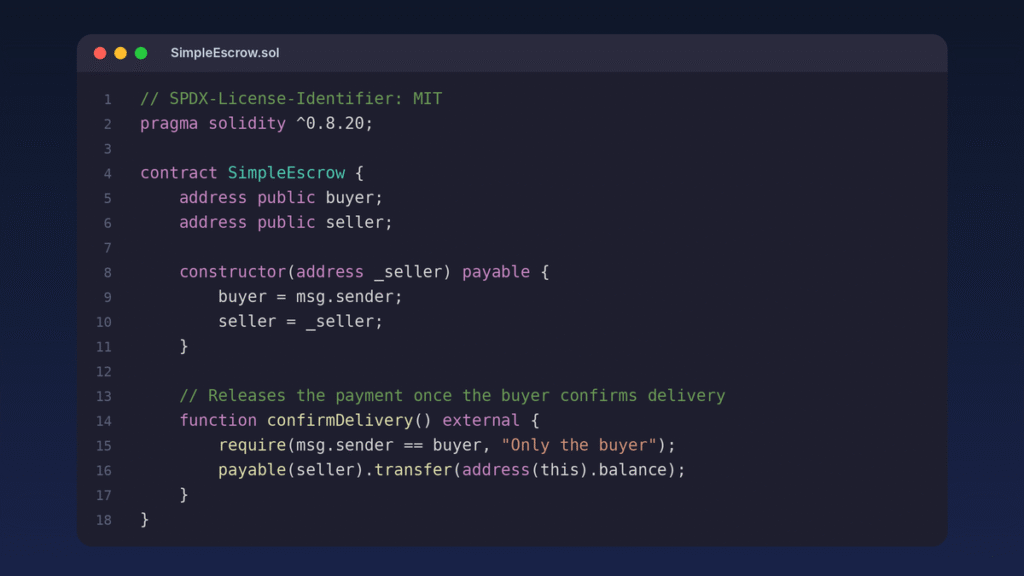
The Ethereum Virtual Machine
Contracts run on the Ethereum Virtual Machine (EVM), a sandboxed runtime on every node. Each node checks the result independently, and the chain updates only when those results match. While Bitcoin checks that an address signed a transfer, Ethereum can check a collateral ratio, sell the collateral, and pay out the proceeds in one transaction.
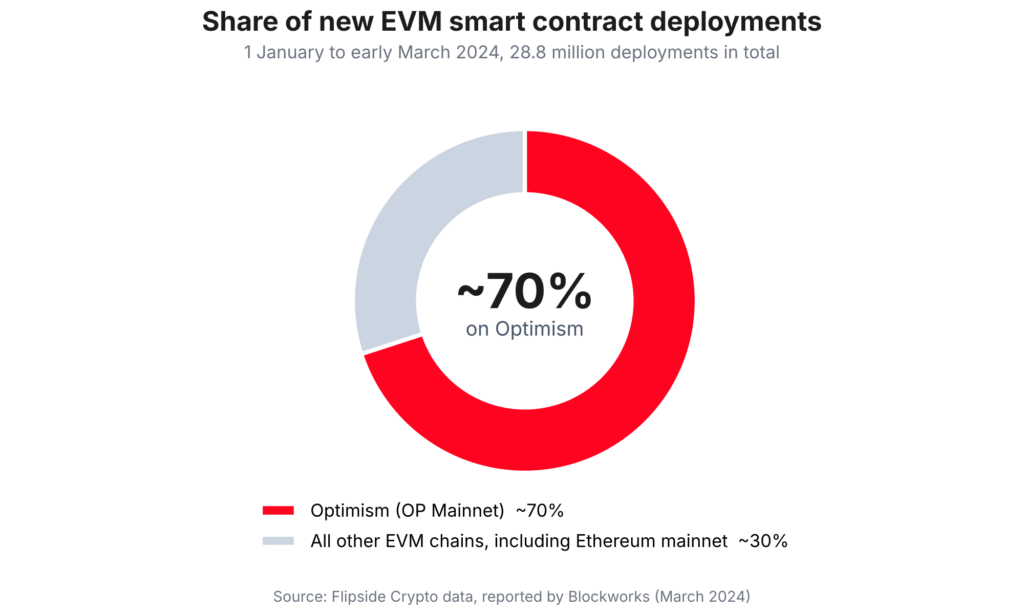
In early 2024, Optimism accounted for about 70% of new EVM smart contract deployments, according to Flipside Crypto data reported by Blockworks.
Smart contract programming languages
| LANGUAGE | MAIN USE | WHAT SETS IT APART |
|---|---|---|
| Solidity | Most EVM smart contracts | Largest developer community and tooling; syntax resembles JavaScript |
| Vyper | Security-focused Ethereum contracts | Python-like syntax built to be easy to audit; leaves out complex features on purpose |
| Yul | Low-level gas optimization | Intermediate language with direct control over memory and EVM operations |
| Rust | Solana programs | Fast and memory-safe; the main language for Solana |
| Plutus | Cardano contracts | Based on Haskell; Cardano developers also use Aiken |
The language affects how a contract behaves in edge cases and how easily auditors can review it.
The Benefits of Smart Contracts
Here’s how smart contracts prove valuable:
| BENEFIT | IN PRACTICE |
|---|---|
| Automatic execution | The contract runs when its conditions are met, and neither side can stall it alone. |
| Speed | Ethereum adds a block about every 12 seconds. Most international bank payments reach the recipient’s bank within an hour, but the final credit can take longer. |
| Fewer intermediaries | No brokers or clearinghouses, though protocol fees and gas replace some of that cost. |
| Auditability | The code is public, so you can read the logic before you send funds. |
| Determinism | The same inputs always produce the same outputs, with no room for interpretation. |
However, smart contracts can’t stop dishonest behaviour. They run the logic they were given, so an attacker who finds a logic error or feeds in false data is acting within the rules that the code allows.
Can smart contracts be hacked?
A smart contract is only as secure as its code. If a transaction meets the contract’s conditions, there’s no appeal against it and no one can reverse it.
The DAO hack
In June 2016, an attacker exploited a reentrancy flaw in The DAO, a smart contract that ran a decentralized investment fund on Ethereum, and moved about 3.6 million ETH, worth roughly $50 to $60 million at the time, into a ‘child DAO’. A withdrawal delay gave the community time to debate a hard fork that returned the funds. The fork split the chain into Ethereum (ETH) and Ethereum Classic (ETC). Ethereum itself was never broken: the contract did exactly what its flawed code said.
The same feature that makes smart contracts predictable and run automatically, makes bugs hard to fix once a contract is live.
Common vulnerabilities
| VULNERABILITY | HOW IT WORKS |
|---|---|
| Reentrancy | A malicious contract calls back into the target before its first update finishes, draining funds in a loop. |
| Overflow and underflow | Numbers wrap around their limits. Solidity 0.8 and later blocks this by default; older contracts can still be exposed. |
| Access control failures | Badly set permissions let unauthorized addresses call admin functions. |
| Oracle manipulation | An attacker uses a flash loan to distort the price feed a contract relies on. |
Can a smart contract be changed?
A standard contract can’t be modified once it’s on the blockchain. Many protocols, though, use upgradeable proxies: your transaction goes to a proxy contract that points to a separate logic contract. Whoever controls the proxy’s admin key can point it at new code and change how the protocol behaves. Mature protocols put those keys behind multi-signature wallets or time delays.
How to check a smart contract before you use it
Firms such as Trail of Bits, OpenZeppelin, and CertiK review contract code before launch. An audit lowers the risk, but doesn’t remove it.
Before you commit money, run through these checks:
- Audit: Has a reputable firm audited this version of the contract, and does the report cover the address you’re about to use?
- Admin keys: Is the contract upgradeable, who holds the keys, and is there a pause function?
- Oracle: Does it depend on a single or centralized price feed?
- Approval amount: When your wallet asks you to approve a token, approve only what this transaction needs. An approval lets the contract keep spending up to that amount until you revoke it.
- Gas: Keep some ETH for fees. A transaction that fails on way still uses up its gas, and revoking an old approval costs a fee too.
The admin key is the check that people skip the most. An audit badge shows that one version of the code was reviewed at one point in time. But it says nothing about who can replace that code later.
Are smart contracts legally binding?
It depends on where you are. Under common law, an enforceable agreement needs an offer, acceptance, consideration, an intention to create legal relations, capacity, and certain terms; other systems set their own tests.
Pseudonymous addresses don’t stop an agreement from being binding, but they make it difficult to identify the parties, choose the jurisdiction, and get a remedy.
| JURISDICTION | POSITION | NOTE |
|---|---|---|
| Arizona, US | HB 2417 (2017) recognizes blockchain signatures, records, and smart contract terms under state electronic-transactions law. | A contract can’t be denied legal effect just because it contains a smart contract term. |
| United Kingdom | The Law Commission advised in 2021 that smart legal contracts can be binding under English and Welsh law. | Existing contract law applies; no new legislation is needed. |
| European Union | MiCA’s stablecoin rules applied from June 2024 and most other rules from December 2024; the main transition for service providers ended on 1 July 2026. | MiCA regulates crypto services; enforcement of code still depends on national contract law. |
If a contract runs as written and you lose money through a bug or a misunderstanding, a court may still order restitution or damages, depending on the jurisdiction and the facts. Reversing the on-chain transaction itself is usually impossible.
The Bottom Line on Smart Contracts
A smart contract is code on a blockchain that carries out an agreement without a middleman. It already settles billions of dollars a day across Ethereum, Layer-2 networks, and other chains.
Before you use any protocol, confirm who audited its code, who holds the admin keys, and whether the contract can be upgraded, and approve only what each transaction needs. For quick definitions of the terms used here, see our crypto glossary.
Frequently Asked Questions
What is the difference between a regular contract and a smart contract?
A regular contract is a legal document in plain language, enforced by courts that can weigh what the parties meant. A smart contract is code on a blockchain that executes as written when its conditions are met.
Which blockchains support smart contracts?
Ethereum is the largest, along with EVM-compatible networks such as Arbitrum, Optimism, Base, and BNB Chain. Solana and Cardano also run smart contracts, written in different languages.
Do I need to know how to code to use a smart contract?
No. You use one whenever you swap, lend, or approve a token through a wallet or a decentralized app. Reading the code helps, but the checks above need no programming.
What happens when a smart contract has a bug?
Transactions that run through the bug usually can’t be reversed. The main defences are audits, bug bounties, staged rollouts and formal verification.
Are smart contracts safe to use?
They remove the risk of a middleman failing you, but add technical risks. The level of safety depends on its code, its oracles, its audits, and who controls its admin keys.

Our Review Methodology
We evaluate each post based on thorough research, credibility of sources, accuracy of information, and relevance to our readers. Our editorial team follows strict guidelines to ensure all content meets high standards of quality.
Disclaimer
The content in this article is provided for informational purposes only and does not constitute financial, investment, or professional advice. Always do your own research before making any decisions.