Quick Verdict
Binance is the world’s largest crypto exchange. It lists about 500 coins, charges 0.1% on spot trades, and backs users with a $1 billion protection fund. Regulation is its weak spot, and it depends on where you live. The global platform won an Abu Dhabi license in December 2025, but Binance has no MiCA license in the EU, has restricted trading for users in several EU countries, and is not authorized in the UK. US residents can’t use it at all. If Binance serves your country, it’s a strong, low-cost choice. If you live in the EU, the UK, or the US, check availability before you deposit anything.
Key Takeaways
- Safety: Binance publishes proof of reserves and keeps a $1 billion SAFU fund. We found no hack of customer funds since 2019.
- Regulation: The global platform is licensed in Abu Dhabi, but Binance holds no MiCA license in the EU and no FCA authorization in the UK.
- Fees: Spot trades cost 0.1%, or 0.075% when you pay fees in BNB. Futures cost 0.02% for makers and 0.05% for takers.
- Coins: About 500 coins and nearly 1,400 trading pairs, with fewer in some countries.
- Drawbacks: 82% of Trustpilot reviews give one star, mostly over frozen accounts and slow support.
Pros
- Spot fees of 0.1%, or 0.075% with BNB
- About 500 coins and nearly 1,400 trading pairs
- $1 billion SAFU fund and published proof of reserves
- Spot, futures, margin, Earn, P2P, and Convert in one account
- Global platform authorized by Abu Dhabi’s FSRA
Cons
- No MiCA license, and trading restricted in France, Italy, Poland, and Spain
- Not available to US residents and not authorized in the UK
- A $4.3 billion US settlement in 2023, and a reported US sanctions probe that Binance disputes
- Trustpilot reviews dominated by account freezes and support complaints
- Too many products for beginners to absorb at once
Binance Overview
| Parameter | Details |
|---|---|
| Exchange Name | Binance |
| Year Established | 2017 |
| Headquarters Location | Global; regulated entities in Abu Dhabi, UAE (ADGM) |
| Regulatory Compliance | ADGM FSRA for the global platform; no MiCA license in the EU |
| Available Cryptocurrencies | About 500 (511 on CoinGecko); varies by country |
| Fiat Currency Support | Varies by country and payment method |
| Native Token (if any) | BNB (Build and Build) |
| Maker Fees | 0.10% base spot (0.075% with BNB); 0.02% futures |
| Taker Fees | 0.10% base spot (0.075% with BNB); 0.05% futures |
| KYC Required | Yes |
| Deposit Methods | Crypto transfer, P2P, bank transfer, and card, depending on country |
| Withdrawal Methods | Crypto transfer, P2P, and bank transfer where supported |
| Mobile App Availability | iOS and Android (Lite and Pro modes) |
| Support Channels | Chatbot, live chat, support tickets, Help Center, and Binance Academy |
| Support Availability | 24/7 |
Introduction
Binance launched in July 2017, after an initial coin offering raised about $15 million for its BNB token. Changpeng Zhao, known as CZ, founded it with Yi He, and it became the largest exchange by trading volume within its first year. Binance says it now has 323 million registered users.
Its history has two sides. In November 2023, Binance pleaded guilty to US charges over anti-money-laundering failures and paid $4.3 billion. Zhao stepped down as CEO, served a four-month prison sentence, and received a US presidential pardon in October 2025. Richard Teng took over as CEO, and Yi He joined him as co-CEO in December 2025.
This Binance review covers what matters most: how safe your money is, what you’ll pay, and whether Binance can legally serve you. The last question changed more in 2026 than in any year before.
Is Binance Safe?
Binance is safe in how it protects your assets, but its legal standing differs from country to country. See those as two separate questions.
Regulatory Compliance
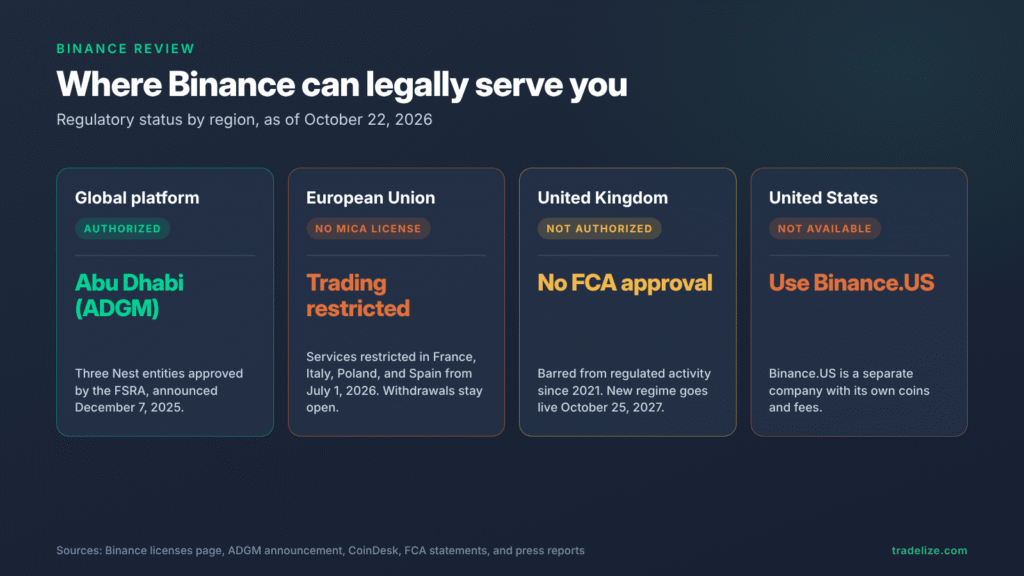
Binance has no single global regulator. Each country decides whether it can serve its residents. The list below shows where it stands in the main markets as of October 22, 2026.
- Global platform: On December 7, 2025, Binance announced approval from the Financial Services Regulatory Authority (FSRA) of Abu Dhabi Global Market (ADGM). The approval covers three entities: Nest Exchange Limited, Nest Clearing and Custody Limited, and Nest Trading Limited. Binance’s licenses page lists only these three. It “provides regulatory clarity and legitimacy,” said Richard Teng, Binance co-CEO. An Abu Dhabi license doesn’t replace approval in your own country, as the EU shows.
- European Union: Binance holds no MiCA license. It withdrew its Greek application in June 2026 and told users in France, Italy, Poland, and Spain that services would be restricted from July 1, when MiCA’s transition period ended. Withdrawals stayed open. Binance says it will apply in another member state, and France is reportedly the target. A report in August said Binance was still onboarding some EU customers, and in October, ESMA and authorities in France, Germany, and Greece were reportedly examining whether it can rely on the “reverse solicitation” exemption to do so.
- United Kingdom: The FCA barred Binance’s UK arm from regulated activity in 2021, and Binance stopped onboarding new UK users in 2023 after the financial promotion rules tightened. The FCA’s new crypto regime opens for applications on September 30, 2026 and goes live on October 25, 2027. The Telegraph reported in August that Binance plans to apply, and Binance declined to comment. We found no confirmation that it has filed.
- United States: Binance.com isn’t open to US residents, who use Binance.US, a separate company. The SEC dropped its civil case in May 2025. The 2023 settlement also placed Binance under outside compliance monitoring, and Binance has reportedly sought to end it early. In March 2026, The Wall Street Journal reported that the US Department of Justice is investigating whether Iran used Binance to evade sanctions, and Bloomberg reported on September 22 that federal prosecutors in Manhattan are examining whether Binance let sanctioned trading proceed. Binance says it has a zero-tolerance policy on sanctions violations and cooperates with law enforcement. No charges have been reported.
- India: Binance registered with the Financial Intelligence Unit (FIU-IND) and returned to Indian users on August 15, 2024, after a seven-month block.
Other countries restrict Binance entirely. Check the Help Center for the current list of unsupported countries before you register.
Security Features
- Cold storage: Binance keeps most client assets in multi-signature cold storage.
- SAFU fund: The Secure Asset Fund for Users holds $1 billion. In January 2026, Binance announced it would move it from stablecoins into Bitcoin and promised to top it back up to $1 billion if its value falls below $800 million. Because it’s held in Bitcoin, its value moves with the market.
- Proof of reserves: Binance publishes reports that let you confirm your balance is included in the total, using Merkle trees and zk-SNARK proofs. Its page names no outside auditor, so treat it as a company-run check, not an audit.
- Account protection: Two-factor authentication (authenticator app, SMS, or hardware key), an anti-phishing code, withdrawal address whitelisting, and device management.
Privacy Practices
Binance requires identity verification before you can trade. Expect to upload an ID and a selfie, and possibly proof of address. Binance says it shares data with authorities when the law requires it. Our guide to KYC crypto exchanges explains what to prepare.
Security Incidents
| DATE | INCIDENT | OUTCOME |
|---|---|---|
| May 2019 | Hackers took about 7,000 BTC from a hot wallet | Binance covered the losses from SAFU |
| October 2022 | An exploit on the BNB Chain bridge minted about 2 million BNB | The chain was paused; exchange balances weren’t affected |
| October 10, 2025 | A market crash depegged USDe, wBETH, and BNSOL on Binance and triggered liquidations | Binance paid about $283 million in compensation to affected users |
Reputation and User Feedback
User Reviews
When we checked Trustpilot on October 22, 2026, it showed no overall TrustScore for Binance, citing a breach of its guidelines, and said it had removed fake reviews. Of 6,207 reviews, 82% gave one star and 6% gave five.
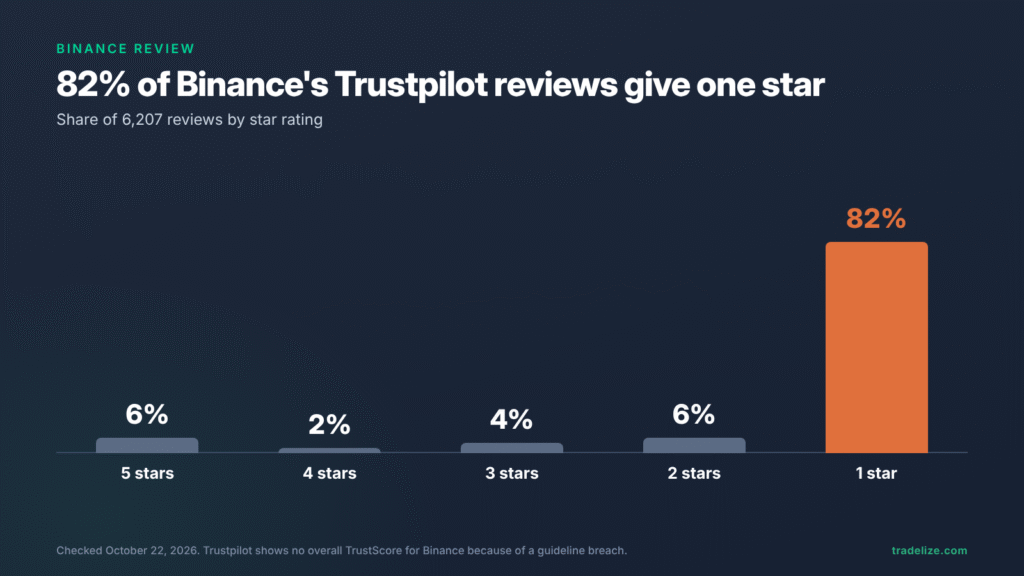
The complaints repeat the same themes, listed below.
Common Complaints and Praise
Top Complaints:
- Withdrawals put on hold or delayed for days
- Accounts restricted or closed during reviews, often without a clear reason
- Generic replies and trouble reaching a human agent
- Losses in P2P trades that Binance didn’t recover
Top Praise:
- Low trading fees
- Deep liquidity on major pairs
- A wide choice of coins and products
- A mobile app with both Lite and Pro modes
Supported Cryptocurrencies
Available Coins and Pairs
CoinGecko lists 511 coins and 1,376 trading pairs on Binance. Bitcoin, Ethereum, BNB, XRP, and Solana are there, along with stablecoins such as USDT and USDC. The list shrinks in some countries, so check yours in the app. Binance lists new tokens quickly, and Launchpool lets users earn some of them by staking.
USDT is the main quote currency, and BTC, BNB, and fiat pairs are also available, depending on your region.
BNB
BNB is Binance’s own token. Paying fees with it cuts spot fees by 25%, and it pays the gas fees on BNB Chain. You don’t need it to trade, but it lowers your costs.
Account Types and Limits
Most users get one standard account, and everyone must verify their identity to trade. Withdrawal limits depend on your verification level and region.
High-volume traders can move up the VIP tiers. VIP 1 needs $1 million in 30-day spot volume plus 5 BNB, and VIP 9 needs $4 billion plus 5,500 BNB. Binance also runs institutional accounts with sub-accounts.
Binance Fees
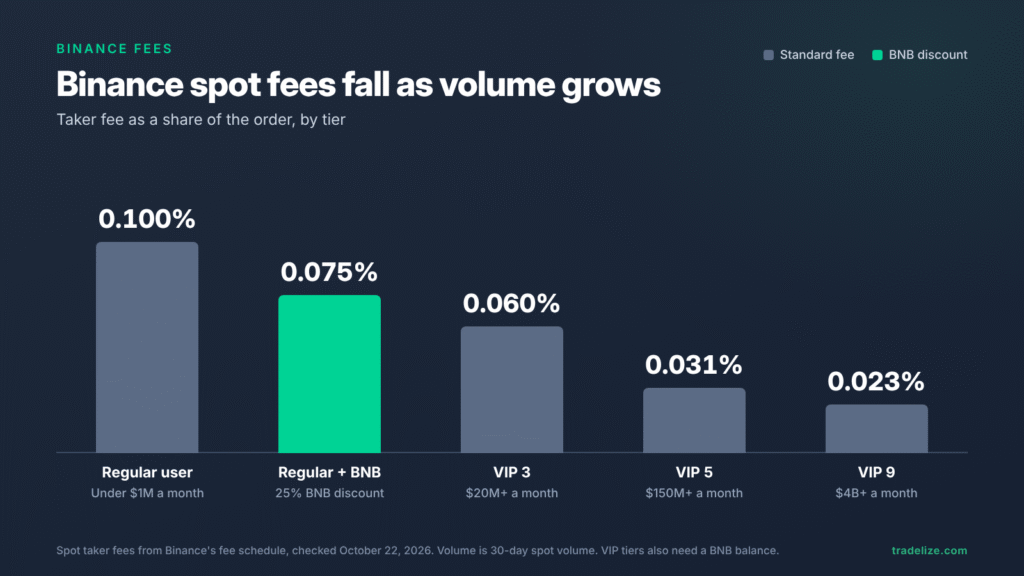
Binance’s standard spot fee is 0.1%, and it falls further with trading volume or BNB. We checked the spot fee schedule on October 22, 2026. Futures rates are the base rates for regular users.
Trading Fees
- Spot: 0.1% for makers and takers, or 0.075% when you pay with BNB
- VIP spot: VIP 9 pays 0.011% as a maker and 0.023% as a taker
- Futures (USD-margined): 0.02% for makers and 0.05% for takers, with 10% off when you pay in BNB
- Margin: spot fees plus interest on what you borrow
A $1,000 spot buy costs $1.00, or $0.75 with BNB.
Deposit and Withdrawal Fees
Crypto deposits are free on supported networks. Crypto withdrawals carry a flat network fee that varies by coin and rises when the network is busy. Fiat costs depend on your country and payment method: bank transfers are usually cheapest, and cards cost the most. See our guide to crypto exchange fees for how these add up.
Other Fees
- Convert: the price includes a spread instead of a separate fee
- P2P: no Binance fee, but merchants build a spread into their prices
- Futures funding rates and margin interest apply while a position stays open
Binance Features and Products
- Spot trading: Market, limit, stop-limit, and OCO orders, plus Convert for one-click swaps
- Futures and margin: Futures leverage up to 125x on select contracts and margin up to 5x, where available. Leverage magnifies losses, so read our guide to spot vs margin trading first.
- Earn: Flexible and locked savings, staking with liquid tokens such as WBETH and BNSOL, Dual Investment, and crypto loans
- P2P: Buy and sell with other users in local currencies
- Trading tools: Trading bots, copy trading, and an API
- Stocks: Binance added stock trading in 2026 for eligible customers outside the US
Many of these products aren’t available in every country, so check what your account shows.
Customer Support
Binance says support runs 24/7 in 40 languages through a chatbot, live chat, and support tickets. Reviews describe generic or automated replies and trouble reaching a human, especially during account reviews. VIP and institutional clients get dedicated account managers. Scammers often pose as Binance support, so use only the in-app channels. Binance Academy offers free courses and guides.
How to Use Binance: Step-by-Step Guide
- Confirm that Binance supports your country, then sign up with your email or phone number.
- Complete identity verification with your ID and a selfie.
- Turn on two-factor authentication and set an anti-phishing code.
- Deposit by crypto transfer, P2P, bank transfer, or card, depending on your country.
- Place your first trade. Convert is simplest, and the Spot screen has lower fees.
- Withdraw coins you won’t trade to your own wallet. Our guides cover how to withdraw crypto and cold wallets.
Who Is Binance Best For?
- Active traders in supported countries who want low fees and deep liquidity
- Altcoin traders who want about 500 coins in one place
- Users who want trading, Earn, and P2P in one account
- High-volume traders who can reach the VIP tiers
It’s a weaker fit for residents of France, Italy, Poland, and Spain, who saw services restricted in July 2026, for US residents, who can’t use the global platform, and for UK residents, where Binance has no FCA authorization. It also isn’t ideal for beginners who feel overwhelmed by its many products. Compare the OKX and KuCoin reviews, or see our list of top crypto exchanges.
Final Verdict
Binance offers low fees, deep liquidity, and a strong custody record, with no hack of customer funds since 2019. Its regulatory position is the risk. The Abu Dhabi license is a real step forward, but the EU restrictions, the missing UK authorization, and the 2023 US settlement mean your protection depends on where you live. If Binance serves your country, it’s a safe and versatile exchange for active traders. Even then, keep only what you plan to trade on any exchange, and move the rest to a wallet you control. Our guide on how to tell if an exchange is safe shows how.
Frequently Asked Questions
- Is Binance safe to use?
Yes, in terms of custody and security. Binance holds most assets in cold storage, publishes proof of reserves, and keeps a $1 billion SAFU fund. Its legal standing depends on your country.
- Is Binance regulated?
Partly. The global platform is authorized by Abu Dhabi’s FSRA, but Binance has no MiCA license in the EU and no FCA authorization in the UK.
- Can you use Binance in the EU?
Only in limited ways. Binance restricted services for users in France, Italy, Poland, and Spain from July 1, 2026, and withdrawals remain open. Availability elsewhere in the EU is unclear, and regulators are examining it, so check the app before you deposit.
- Can US and UK residents use Binance?
US residents can’t use Binance.com. They use Binance.US, a separate company. UK access is limited: Binance has no FCA authorization and stopped onboarding new UK users in 2023, so confirm it accepts you before you sign up.
- What fees does Binance charge?
Binance charges 0.1% on spot trades, or 0.075% when you pay with BNB. Futures cost 0.02% for makers and 0.05% for takers, and crypto deposits are free.
- Is Binance good for beginners?
Only in part. Convert and Lite mode make a first trade simple, but the number of products can overwhelm a new user, and support can be slow.

Our Review Methodology
At Tradelize, we follow strict editorial standards to ensure all content is accurate, unbiased, and thoroughly researched. Our reviews, guides, and articles are fact-checked by a team of experienced cryptocurrency and finance professionals, and are not influenced by advertisers or affiliate relationships. Our Trust Score methodology combines direct data scraping from official broker, exchange, and wallet websites with sentiment analysis of up to 1000 verified user reviews. This dual-source approach enables us to objectively evaluate platform features, fees, regulations, security, and customer satisfaction. We then compile comprehensive, specification-based reviews that reflect both technical details and real user experience.
Disclaimer
Trading cryptocurrencies, forex, CFDs, and other derivatives involves significant risk and may not be suitable for all investors. Leverage can amplify both gains and losses. Past performance is not indicative of future results. The content on Tradelize is for informational purposes only and does not constitute financial or investment advice. Always seek professional guidance before making financial decisions. For full risk disclosures, click here.