Trading crypto derivatives in India has always been complicated. Most global exchanges operate in a grey zone — SEBI doesn’t regulate crypto, so technically anyone can offer services to Indian users, but enforcement is patchy and many platforms quietly restrict India-based accounts when regulators start paying attention.
Delta Exchange took a different approach. It registered with India’s Financial Intelligence Unit (FIU-IND) under the PMLA, built an INR-settlement workflow specifically for Indian traders, and positioned itself as the derivatives-first exchange for the Indian market.
Whether that makes it the right platform for you depends on what you’re actually trying to do. If you want spot trading — buying and holding BTC or ETH — Delta Exchange is the wrong place. The spot market has just six pairs. But if you want futures, perpetuals, options, or the oddly fascinating MOVE contracts that barely any other exchange offers, things get interesting.
We tested the demo environment, ran the numbers on fees (including the 18% GST that tends to surprise people), and dug into the security setup in detail. Here’s the full picture.
Delta Exchange Review: Quick Verdict
Rating: 7.6/10
Delta Exchange is India’s most focused INR-settled crypto derivatives platform — registered with FIU India (ID: VA00041101) and operating legally for Indian derivatives traders. Futures fees of 0.02%/0.05% (maker/taker) match Binance and Bybit. The platform excels on product depth but falls short on transparency: no Proof of Reserves published, only 6 spot pairs, and an app that struggles during volatile sessions. Best for experienced Indian traders focused on futures and options.
Quick Facts
| Detail | Value |
|---|---|
| Founded | 2017 |
| Headquarters | Singapore (registered: St. Vincent & the Grenadines) |
| Supported Cryptocurrencies | 100+ (derivatives); 6 (spot) |
| Trading Pairs | 76+ futures pairs |
| Trading Products | Spot (6 pairs), Futures, Perpetuals, Options, MOVE Contracts, Spread Contracts, Interest Rate Swaps |
| Spot Fee (Maker/Taker) | 0% (buy) / 0.1% (sell) |
| Futures Fee (Maker/Taker) | 0.02% / 0.05% |
| Native Token | DETO — 25% trading fee discount |
| Fiat Support | INR (derivatives settlement, India only) |
| Mobile App | iOS: 4.6/5 · Android: 4.2/5 |
| KYC Required | Yes — mandatory for all tiers |
| Proof of Reserves | Not published |
Data sourced from delta.exchange/fees and official support documentation, June 2026
How We Scored Delta Exchange
We evaluated Delta Exchange across six weighted categories using data from the platform’s official fee page, support documentation, FIU registration records, and third-party app store listings. We also ran test trades in the demo environment to assess the interface and order execution logic.
| Category | Score | Key Justification |
|---|---|---|
| Security | 18/25 | Multi-sig cold storage (claimed 95%), no known hacks since 2018, insurance fund — no Proof of Reserves published |
| Fees | 16/20 | Competitive futures rates, DETO discount available — 18% GST adds material cost for Indian users |
| UX & Mobile | 11/15 | iOS 4.6/5 rating, TradingView integration, full demo environment — app freezes documented during volatile periods |
| Liquidity | 11/15 | $2.5–4B daily derivatives volume (Analytics Insight, May 2025) — severely limited spot depth |
| Features | 13/15 | Comprehensive derivatives suite, MOVE contracts, Robo Trading, interest rate swaps — spot market minimal |
| Support | 7/10 | Email/ticket and Telegram, manual withdrawal processing once daily — no live chat |
| Overall | 76/100 (7.6/10) |
What’s New at Delta Exchange (2026)
- May 2026: Exhibited at Market Sangam 3.0 in New Delhi — a major trading and finance summit that included a crypto perpetual trading championship. First large-scale public event appearance from the platform in 2026.
- April 2025: Peak daily trading volume reached $4 billion, confirmed by CEO Pankaj Balani in an Analytics Insight interview. Monthly average for Q2 2025 held around $2.5 billion.
- February 2026: India’s Union Budget 2026 introduced penalties under Section 446 of the Income Tax Act 2025 for crypto platforms that fail to file accurate transaction statements — up to INR 200 per day. Delta Exchange confirmed compliance with the new reporting obligations.
- 2024: Full INR settlement workflow launched with Indian-specific KYC (PAN + Aadhar), replacing the earlier USDT-based settlement process that made the Indian experience clunkier.
Pros and Cons
Pros
- FIU India registered (ID: VA00041101) — legally compliant for Indian derivatives trading, registered as a reporting entity under PMLA. One of the few crypto derivatives platforms with formal FIU status in India.
- Competitive derivatives fees: 0.02% maker / 0.05% taker — on par with Binance and Bybit for futures. Options fees even lower at 0.01%/0.03%, capped at 3.5% of option premium.
- MOVE contracts — genuinely unique product — contracts that pay based on the magnitude of price movement regardless of direction. Practically no other Indian exchange offers this. For volatility traders, it’s a significant differentiator.
- Full demo environment at demo.delta.exchange — virtual funds on real market data, covering all products. One of the better-implemented practice environments in crypto, and it doesn’t expire.
- Eight-plus years without a confirmed security breach — since the 2018 launch. In an industry that loses billions to exploits annually, a clean incident record matters, even without PoR to back it up.
Cons
- No Proof of Reserves published — Delta Exchange doesn’t offer on-chain verification of user funds. Post-FTX, this is a legitimate concern. You’re trusting the platform’s cold storage claims without independent verification.
- Spot market is effectively vestigial: only 6 pairs — BTC, ETH, SOL, DETO, XRP, and BNS against USDT. If you want to buy and hold altcoins, this isn’t the platform. Rivals like Binance carry 600+ spot pairs.
- 18% GST on trading fees for India — a government-mandated charge, but it adds up. A taker fee of 0.05% becomes effectively 0.059% after GST. On high volume, the difference is meaningful.
- App instability during volatility — user reports from April 2026 describe five-minute freezes during high-activity sessions. For a leveraged derivatives trader with an open position, that’s not just annoying — it’s an operational risk.
- Manual withdrawal processing, once daily — all withdrawals go through manual review before processing. Submit a request at 3pm; it may not clear until the next day’s processing batch.
- US, UK, and Canada restricted — along with Iran, North Korea, Syria, Cuba, Afghanistan, Cambodia, Pakistan, and Crimea. No workarounds here.
Security Assessment
Delta Exchange handles security reasonably well for a mid-tier derivatives exchange. The gap in transparency, though, is hard to ignore.
Proof of Reserves
Delta Exchange does not publish Proof of Reserves. No Merkle tree verification, no audited reserve ratio for BTC, ETH, or stablecoins, no public dashboard. After Celsius, BlockFi, and FTX — all of which assured users that funds were “safe” before collapsing — the absence of on-chain verification should factor into your risk assessment.
This is the single biggest security limitation we found. Worth being direct about it.
Cold Storage and Fund Security
The platform claims 95% of user funds are held in multi-signature cold wallets. Cold storage means private keys are held offline, inaccessible to remote attacks; multi-sig requires multiple keys to authorize a transaction, reducing single-point-of-failure risk. Standard practices for exchanges of this size — but without an independent audit confirming the figures, the 95% claim is the company’s own assertion.
Insurance Fund
Delta Exchange maintains an insurance fund that covers shortfalls when a leveraged position is liquidated at a loss (a situation called auto-deleveraging, or ADL). The fund activates before ADL kicks in, protecting profitable counterparties. The fund’s current size isn’t published, which is unusual — Binance publishes its SAFU fund balance in real time. The insurance fund exists, but it’s unverified.
Account Security Features
- Two-factor authentication (2FA): TOTP (Google Authenticator / Authy) supported
- Anti-phishing codes: email-based verification to prevent phishing attacks
- Manual withdrawal review: all withdrawals undergo human review before processing (adds 24h delay, reduces unauthorized withdrawal risk)
- Withdrawal address whitelisting: available for added account security
No known security breaches since launch in 2018. Eight years of clean incident history is genuinely good — most exchanges of this size have at least one reported incident. Having said that, absence of evidence isn’t evidence of absence, and the lack of PoR means you can’t independently verify fund safety.
Fee Structure — What You’re Actually Paying
Delta Exchange’s derivatives fees are competitive with the major global exchanges. Spot fees are minimal but largely irrelevant given the six-pair market.
| Fee Type | Rate | Notes |
|---|---|---|
| Spot (Buy / Maker) | 0% | Applies to all 6 spot pairs |
| Spot (Sell / Taker) | 0.1% | |
| Futures (Maker) | 0.02% | Base rate — competitive with Binance and Bybit |
| Futures (Taker) | 0.05% | Base rate |
| Options (Maker) | 0.01% | Capped at 3.5% of option premium |
| Options (Taker) | 0.03% | Capped at 3.5% of option premium |
| DETO Token Discount | -25% | Applies per trade when DETO held and auto-deduct enabled |
| Crypto Deposit | Free | Network fees only |
| Crypto Withdrawal | Varies | Network-dependent |
| Inactivity Fee | None |
Source: delta.exchange/fees, June 2026
Indian users pay 18% GST on all trading fees — a government-mandated charge that effectively raises the taker rate from 0.05% to 0.059%. Over high volume, that matters.
Competitor Fee Comparison
| Exchange | Spot Maker | Spot Taker | Futures Maker | Futures Taker | Token Discount |
|---|---|---|---|---|---|
| Delta Exchange | 0% | 0.1% | 0.02% | 0.05% | -25% (DETO) |
| Binance | 0.10% | 0.10% | 0.02% | 0.05% | -25% (BNB) |
| Bybit | 0.10% | 0.10% | 0.02% | 0.05% | None standard |
| OKX | 0.08% | 0.10% | 0.02% | 0.05% | -20% (OKB) |
Source: Official fee pages for each exchange, June 2026
Futures fees are essentially identical across all four. Delta Exchange’s zero-fee spot buy orders are a genuine differentiator — but with only 6 spot pairs, it barely matters in practice.
DETO: Delta Exchange’s Native Token
The DETO token provides a 25% discount on all trading fees when you hold it and enable auto-deduct in account settings. Same mechanic as BNB on Binance or OKB on OKX — hold the native token, pay reduced fees per trade.
For a trader paying 0.05% taker on futures, the DETO-discounted rate is 0.0375%. In a market where basis points accumulate over volume, it’s a meaningful reduction. With Indian GST applied, the DETO-discounted effective rate works out to approximately 0.0443% — still below the undiscounted base.
DETO is also tradeable as one of the six spot pairs on the platform (DETO/USDT). Buy it, enable auto-deduct, and the fee discount applies immediately. Worth noting: DETO has minimal presence on major external exchanges, which limits your exit options. Treat it as a utility token for fee savings — not as an investment thesis.
Supported Assets and Chains
Spot trading (6 pairs only): BTC/USDT, ETH/USDT, SOL/USDT, XRP/USDT, DETO/USDT, BNS/USDT.
That’s it. MATIC, AVAX, DOGE, or the hundreds of altcoins available on Binance — none of them are on Delta Exchange’s spot market. The clearest sign that the platform’s focus is derivatives, not retail spot accumulation.
Derivatives (100+ cryptocurrencies): Futures and perpetuals cover Bitcoin, Ethereum, XRP, Solana, and 80+ DeFi and altcoin contracts. The derivatives lineup is genuinely broad and includes assets not found on all exchanges.
Deposit and withdrawal chains:
| Asset | Chain | Withdrawal Fee | Notes |
|---|---|---|---|
| USDT | ERC-20 | Variable | Higher gas cost — avoid for small amounts |
| USDT | TRC-20 | ~1 USDT | Most economical option for USDT transfers |
| BTC | Bitcoin | Variable | Network-dependent |
| ETH | Ethereum | Variable | Network-dependent |
Source: delta.exchange, June 2026. Fees vary with network congestion.
Trading Products and Features
Delta Exchange’s product range is where it actually differentiates from mainstream exchanges. The standard stuff is fine; the unusual stuff is genuinely interesting.
Futures and Perpetuals
Standard crypto futures with up to 100x leverage on major pairs (200x on select contracts). Contract types include perpetual swaps (no expiry, funding rate mechanism), fixed-maturity futures (weekly, monthly, quarterly), and cross-margin or isolated-margin configurations. Settlement in USDT, BTC, or ETH.
Comparable to Binance and Bybit at the product level. Not a differentiator, but solid execution.
Options Trading
European-style options with daily to annual expiration dates. The 0.01%/0.03% maker/taker fees — capped at 3.5% of option premium — make this genuinely competitive. The options interface runs through a web-based options chain with full Greek display (delta, gamma, theta, vega). Advanced options traders will feel at home; beginners should stick to the demo first.
One limitation: the full options chain is web-only. The mobile app doesn’t support it.
MOVE Contracts — Delta’s Signature Product
MOVE contracts pay out based on the absolute magnitude of price movement, not the direction. Long MOVE profits if the asset moves significantly in either direction; short MOVE profits if the market stays flat. Volatility plays, essentially — packaged as a simple contract without the complexity of managing an options position.
Popular with traders ahead of event-driven periods: central bank announcements, ETF decisions, major macro data releases. The outcome is a function of realized volatility, not direction. For experienced options traders who understand vega, this is a familiar concept in a simplified wrapper.
Practically no other Indian exchange offers this product category. That’s a real competitive gap.
Robo Trading
Three automated strategies — momentum, arbitrage, and liquidity provision — configurable through the platform interface without coding. Bots execute on the standard maker/taker fee structure; no separate bot fee tier. Useful for systematic traders who want to run rule-based strategies without building custom API integrations.
Delta Exchange Demo Account
The demo environment is available at demo.delta.exchange (India) or demo-global.delta.exchange (global). Separate registration from your live account — different credentials, different session. Virtual funds on real market data. Every product available on the live platform is accessible in demo: futures, perpetuals, options, MOVE contracts, spread contracts, interest rate swaps. Leverage up to 100x. No expiry.
We’d recommend starting here even if you’re an experienced trader. MOVE contracts and interest rate swaps have specific settlement mechanics that take some getting used to before you put real money behind them. The demo isn’t a neutered simulation — it’s the full platform with practice funds.
Mobile App and Web Platform
iOS App Store: 4.6/5 · Google Play: 4.2/5
(Sourced from Apple App Store and Google Play, June 2026)
The mobile app handles standard trading well under normal conditions. Order placement, position monitoring, basic charting, and account management are logically organized — no ten-minute hunt for the withdrawal button. The interface has a clean Lite mode for beginners alongside a more capable standard view.
The problem is volatility. User reports from April 2026 describe the app freezing for up to five minutes during periods of high market activity. For a spot trader, a five-minute freeze is annoying. For a leveraged derivatives trader with an open position and no stop-loss on a fast-moving contract, it can mean liquidation. This isn’t an isolated complaint — it’s a documented pattern.
The web platform is substantially more reliable and feature-complete. TradingView charting integration, the full options chain, advanced order types, Robo Trading configuration, and interest rate swap management are all web-only or significantly better on web. If you’re doing anything beyond standard futures entry/exit, use the desktop interface.
The platform has proper Lite and Pro modes on web, giving it accessibility across experience levels. Mobile is effectively Lite-only, which limits serious derivatives work on the app.
Earn and Staking
Delta Exchange India does not currently offer earn or staking products for Indian users. This appears to be a regulatory decision — the earn product category sits in a grey zone under current Indian crypto regulation.
The global platform has some yield products available for non-Indian users, but if you’re accessing Delta Exchange as an Indian user through the India-specific platform, earn and staking aren’t available to you.
This is a competitive disadvantage against global exchanges like Binance and Bybit, which offer substantial staking and yield products even for Indian users through their global platforms. If earn products are a priority, Delta Exchange doesn’t satisfy that requirement.
KYC Verification Tiers
KYC is mandatory on Delta Exchange. There is no anonymous trading tier — not even for small accounts.
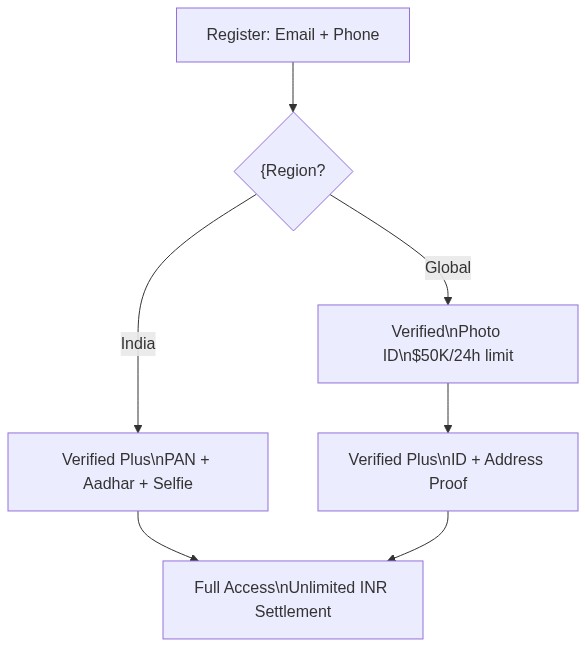
| KYC Level | Requirements | Daily Withdrawal Limit | Features |
|---|---|---|---|
| Basic (Legacy) | Phone only | ~$5,000 | Limited — no new accounts at this tier |
| Verified | Phone + Photo ID | $50,000 | Spot + Futures (global) |
| Verified Plus (India) | PAN + Aadhar + selfie | Unlimited | Full access including INR settlement |
| Verified Plus (Global) | Photo ID + Address proof | Unlimited | Full access |
Source: delta.exchange KYC guidelines, June 2026
Indian users need PAN (Permanent Account Number) and Aadhar card for Verified Plus status. Verification processing takes 1–3 business days. No notification when complete — check account status manually.
For global Verified Plus: government-issued photo ID plus a recent utility bill or bank statement as address proof.
Delta Exchange Login and Account Setup
The delta exchange login is straightforward: email or mobile number, password, 2FA prompt. New account registration takes about five minutes for the basic setup. KYC verification starts immediately after account creation through a separate identity workflow.
For Indian users, the URL is delta.exchange — the India-specific platform. International users go to global.delta.exchange. The demo environment uses separate credentials at demo.delta.exchange.
Setup sequence:
- Enter email and password
- Complete phone verification via OTP
- Enable 2FA immediately — before funding, not after
- Start KYC verification (PAN + Aadhar for India; photo ID for global)
- Fund account via crypto deposit
- Locate DETO auto-deduct toggle in account settings and enable it if you’ve purchased DETO
Is Delta Exchange Legal in India?
Yes. Delta Exchange India is registered with the Financial Intelligence Unit (FIU-IND), Government of India, under the Prevention of Money Laundering Act (PMLA). Registration ID: VA00041101, registered entity type: Reporting Entity.
This means Delta Exchange is legally authorized to operate as a crypto asset service provider for Indian users. It deducts 1% TDS (Tax Deducted at Source) on derivatives trading as required under the Finance Act 2022, and collects 18% GST on trading fees under Indian tax law.
Important distinction: SEBI (Securities and Exchange Board of India) does not regulate cryptocurrency exchanges. The FIU registration falls under the financial intelligence and AML framework — not SEBI. This is the correct regulatory pathway for crypto platforms in India. SEBI oversight would apply only if crypto assets were classified as securities, which they currently are not.
What Indian users CAN do on Delta Exchange:
- Trade futures and perpetual contracts
- Trade options and MOVE contracts
- Use the full demo environment
- Benefit from INR-settled derivatives
What Indian users CANNOT do:
- Trade spot markets (buying actual cryptocurrency for spot delivery is restricted on the India platform)
- Access earn/staking products
Tax treatment: Derivatives trading profits are subject to India’s 30% flat crypto tax (no loss offset), plus 1% TDS per trade, plus 18% GST on trading fees. The Union Budget 2026 introduced new compliance requirements under Section 446 of the Income Tax Act 2025 — platforms must file accurate transaction statements or face penalties up to INR 200 per day.
Learn more: Is Cryptocurrency Legal in India?
Customer Support
Delta Exchange offers email/ticket support and Telegram community channels. There’s no live chat.
What works:
- Support documentation is reasonably comprehensive — most common issues (withdrawal delays, KYC questions, fee calculations) are covered in the help center
- Telegram community has active members with occasional staff presence
- The manual withdrawal review process catches some user errors before funds are lost
What doesn’t work:
- Ticket response times are variable — reviews suggest 24–48 hours is typical, but longer delays have been reported during busy periods
- No live chat means no immediate support during a live trading issue (including the app freeze scenario described in the UX section)
- No phone support
For an exchange with 150,000+ registered Indian users (as of 2025), the support infrastructure feels lean. CoinDCX and Mudrex, which compete for the same Indian user base, have invested more heavily in support resources.
Who Should (and Shouldn’t) Use Delta Exchange
Who Should Use Delta Exchange
- Experienced Indian derivatives traders who want a FIU-registered, INR-compatible platform for futures and options trading. The legal compliance and local settlement make it the most structurally sound option for this use case.
- Volatility traders interested in MOVE contracts — a product with very few Indian equivalents. If volatility plays are part of your strategy, Delta Exchange has the infrastructure competitors don’t.
- Systematic traders who want to run automated strategies without building custom code. The Robo Trading feature handles basic automation without API development.
- New derivatives traders who want a practice environment first — the demo is well-implemented and covers every product category with no expiry.
Who Should NOT Use Delta Exchange
- Spot-only traders — six pairs is not a usable spot market. For proper spot coverage, see KuCoin or check our Top Crypto Exchanges 2026 comparison.
- US, UK, or Canadian traders — restricted jurisdictions, no exceptions.
- Traders who require proof of reserves — if PoR verification is non-negotiable post-FTX, Delta Exchange doesn’t meet that bar.
- Users prioritizing earn/staking — Indian users don’t have access to these features. Mudrex is worth checking if yield products are a priority.
Delta Exchange Alternatives
| Exchange | Best For | Futures Maker | Spot Coverage | Key Difference |
|---|---|---|---|---|
| Delta Exchange | Indian derivatives | 0.02% | 6 pairs | INR settlement, FIU registered, MOVE contracts |
| Binance | Full-service global | 0.02% | 600+ pairs | Scale, PoR published, better mobile |
| Bybit | Derivatives + spot | 0.02% | 600+ pairs | More stable app, larger product suite |
| CoinDCX | Indian spot + basics | 0.05% | 200+ pairs | Indian exchange, better spot, fiat on-ramp |
See also: Explore all reviewed crypto exchanges
Delta Exchange vs Binance
Futures fees are identical at 0.02%/0.05% — on pure trading cost, they’re the same for derivatives. The differences are elsewhere.
Binance carries 600+ spot pairs. Delta Exchange has six. Binance publishes its SAFU insurance fund balance in real time; Delta Exchange doesn’t. Binance’s mobile app is battle-tested at scale; Delta Exchange’s has documented volatility issues.
Where Delta Exchange wins: it’s formally registered in India under the PMLA, offers INR-settled derivatives, and has MOVE contracts that Binance simply doesn’t carry. If you’re trading in India and want a locally compliant experience, Delta Exchange makes structural sense. If you need full-featured global exchange capabilities, Binance wins on nearly every dimension.
Delta Exchange vs Bybit
Bybit offers a better mobile experience — the app is more stable, better-rated on both iOS and Android, and supports more products on mobile. Bybit also has deeper liquidity on major perpetuals and a larger selection of supported assets.
Delta Exchange’s advantage over Bybit is entirely in its India focus: FIU registration, INR settlement, local KYC workflow, and MOVE contracts. If you’re trading from India and want local regulatory compliance, Delta Exchange is the better structural choice. If you’re trading globally and want the most feature-complete derivatives experience, Bybit has the edge on UX.
Delta Exchange vs CoinDCX
CoinDCX is the better choice if you primarily want to spot-trade in India — proper spot market, fiat on-ramp, hundreds of pairs, accessible to beginners.
For derivatives, Delta Exchange is the more advanced platform: better products (MOVE contracts, options, interest rate swaps), lower fees, and a more sophisticated trading infrastructure. CoinDCX’s derivatives offering is functional but shallow.
If you’re past the beginner stage and want serious derivatives trading with Indian regulatory compliance, Delta Exchange is the stronger pick. For everything else, CoinDCX covers the basics better. You might realistically use both — CoinDCX for spot accumulation and fiat on/off-ramp, Delta Exchange for derivatives trading with the crypto you’ve acquired. See more on How to Buy Cryptocurrency in India.
Frequently Asked Questions
1. Is Delta Exchange safe in India?
Delta Exchange is registered with FIU India (ID: VA00041101) under the PMLA, making it legally authorized for Indian users. The platform has no confirmed security breaches since launching in 2018, maintains multi-sig cold wallet storage for a claimed 95% of funds, and operates an insurance fund. The significant gap: no Proof of Reserves is published, so users can’t independently verify fund safety. Regulated, but not fully transparent.
2. Is Delta Exchange legal in India?
Yes — Delta Exchange India holds FIU (Financial Intelligence Unit) registration as a PMLA reporting entity, deducts 1% TDS on derivatives trades, and collects 18% GST on fees. SEBI doesn’t regulate crypto in India; FIU registration is the applicable compliance framework. Note that spot trading is not available for Indian users through the India platform — only derivatives.
3. What are Delta Exchange’s trading fees?
Futures: 0.02% maker, 0.05% taker. Options: 0.01% maker, 0.03% taker (capped at 3.5% of premium). Spot: 0% maker (buy orders), 0.1% taker (sell orders). Indian users pay 18% GST on all fees. DETO token holders receive a 25% discount per trade — reducing the futures taker rate to 0.0375%.
4. Does Delta Exchange have a demo account?
Yes. The delta exchange demo account is available at demo.delta.exchange (India) and demo-global.delta.exchange (global). It requires separate registration from your live account and provides virtual funds on real market data. All products — futures, perpetuals, options, MOVE contracts — are accessible with up to 100x leverage. No expiry on demo accounts.
5. How do I log in to Delta Exchange?
The India platform is at delta.exchange — log in with your email or mobile number and password, then complete 2FA verification. The demo account at demo.delta.exchange uses different credentials. For the global platform, the URL is global.delta.exchange. All three are separate accounts; credentials don’t carry over between them.
6. Is Delta Exchange available in the US?
No. Delta Exchange restricts US residents. Also blocked: UK, Canada, Iran, North Korea, Syria, Cuba, Afghanistan, Cambodia, Pakistan, and Crimea. These restrictions are enforced at account creation — users in these jurisdictions can’t register.
7. What is the maximum leverage on Delta Exchange?
Up to 100x leverage on most futures and perpetual contracts. Select contracts offer up to 200x. The demo account mirrors the same leverage limits as the live platform, so you can practice high-leverage strategies before using real funds.
8. What are MOVE contracts on Delta Exchange?
MOVE contracts pay out based on the absolute magnitude of a crypto asset’s price movement, not its direction. A long MOVE position profits if the asset moves significantly in either direction; a short MOVE position profits if the market stays flat. These are volatility plays — particularly relevant ahead of high-impact events. Very few Indian exchanges offer this product.
9. Does Delta Exchange require KYC?
Yes — KYC is mandatory for all users. Indian users need a PAN card, Aadhar card, and a selfie for Verified Plus status (required for unlimited withdrawals and INR settlement). Global users need government-issued photo ID plus proof of address. Basic (phone-only) tier is no longer available for new registrations.
10. How do I withdraw from Delta Exchange?
Withdrawals are processed through manual review once daily. Submit your request through the account dashboard, select the asset and destination address, and confirm via email verification. Indian users should expect 24–48 hours between submission and receipt. Withdrawals are cryptocurrency only — no direct INR fiat withdrawal via the platform.
Crypto derivatives trading involves substantial risk of loss, amplified by leverage. This review is for informational purposes only and is not financial advice. All fee and product data should be verified directly on delta.exchange before trading. Updated June 2026.

Our Review Methodology
At Tradelize, we follow strict editorial standards to ensure all content is accurate, unbiased, and thoroughly researched. Our reviews, guides, and articles are fact-checked by a team of experienced cryptocurrency and finance professionals, and are not influenced by advertisers or affiliate relationships. Our Trust Score methodology combines direct data scraping from official broker, exchange, and wallet websites with sentiment analysis of up to 1000 verified user reviews. This dual-source approach enables us to objectively evaluate platform features, fees, regulations, security, and customer satisfaction. We then compile comprehensive, specification-based reviews that reflect both technical details and real user experience.
Disclaimer
Trading cryptocurrencies, forex, CFDs, and other derivatives involves significant risk and may not be suitable for all investors. Leverage can amplify both gains and losses. Past performance is not indicative of future results. The content on Tradelize is for informational purposes only and does not constitute financial or investment advice. Always seek professional guidance before making financial decisions. For full risk disclosures, click here.