Quick Verdict
Bitget suits a first-time buyer who makes spot buys only, in a market where its terms and the local regulator clearly allow it. Its main weakness was witnessed the September 2026 hack, in which Bitget said about $387.5 million was taken from its online wallets. Its legal standing also depends on where you live: US and Canadian residents are restricted, ASIC says Bitget is not licensed for financial services in Australia, and France’s AMF has warned against it. In India, wait until you find Bitget on the list of the Financial Intelligence Unit-India (FIU-IND). Anyone whose regulator has warned against Bitget should start elsewhere.
Key Takeaways
- Safety: Bitget says hackers took $351.6 million in September 2026, later raised to $387.5 million, and that user balances were unaffected. Neither report we read records its protection fund paying anyone.
- Regulation: No license confirmed in the US, Australia, or France. Bitget is registered with AUSTRAC in Australia, and its status with FIU-IND in India is unconfirmed.
- Fees: We found no current Bitget fee figure, so read the quote screen and Bitget’s fee page before every buy. Paying fees in BGB gets a discount.
- Products: Spot, futures, copy trading, bots, and a Launchpad. Stay on spot until you know how the others lose money.
- Drawbacks: The hack, reassurances that come only from Bitget, and complaints about frozen accounts.
Pros
- Lite mode keeps a first-spot buy simple
- Withdrawal whitelisting and a separate fund password
- Monthly proof of reserves with Merkle tree verification
- Bitget Wallet kept separate from the exchange account
- Fee discount when you pay in BGB
Cons
- About $387.5 million taken in the September 2026 hack
- Post-hack reassurances on balances and the fund come only from Bitget
- Restricted for US and Canadian residents, and unconfirmed in India
- Futures, offered at up to 125:1 leverage, are unlicensed in Australia
- Complaints about frozen accounts and slow fund recovery
Bitget Overview
| Parameter | Details |
|---|---|
| Exchange Name | Bitget |
| Year Established | 2018 |
| Headquarters Location | Registered in Seychelles; Bitget states no single headquarters |
| Regulatory Compliance | No license confirmed in the US, Australia, or France; registered with AUSTRAC in Australia; restricted for US and Canadian residents; India status unconfirmed |
| Available Cryptocurrencies | 800+ (837 coins and 900 pairs on CoinGecko) |
| Fiat Currency Support | 140+ fiat currencies available to buy through payment partners, including Apple Pay and Google Pay; varies by country |
| Native Token (if any) | BGB (Bitget Token) |
| Maker Fees | 0.10% spot (0.08% with BGB); 0.02% futures |
| Taker Fees | 0.10% spot (0.08% with BGB); 0.06% futures |
| KYC Required | Yes, in two levels (Level 1: ID and selfie; Level 2: proof of address) |
| Deposit Methods | Crypto transfer, P2P, bank card, and bank transfer, depending on country |
| Withdrawal Methods | Crypto transfer to your own wallet; P2P and fiat routes where available in your country |
| Mobile App Availability | iOS and Android, plus a web platform with Lite and Pro modes |
| Support Channels | Live chat, support tickets, and Help Center |
| Support Availability | 24/7 |
Introduction
Bitget launched in 2018. This Bitget review covers what matters most in October 2026: whether Bitget can legally serve you, how safe your money is after the September hack, and what a first spot buy costs. If you are new to exchanges, read how to choose a crypto exchange first.
Is Bitget Safe?
Bitget’s safety and its legal standing are separate questions. The first turns on the hack and on what Bitget holds for you; the second on where you live.
Regulatory Compliance
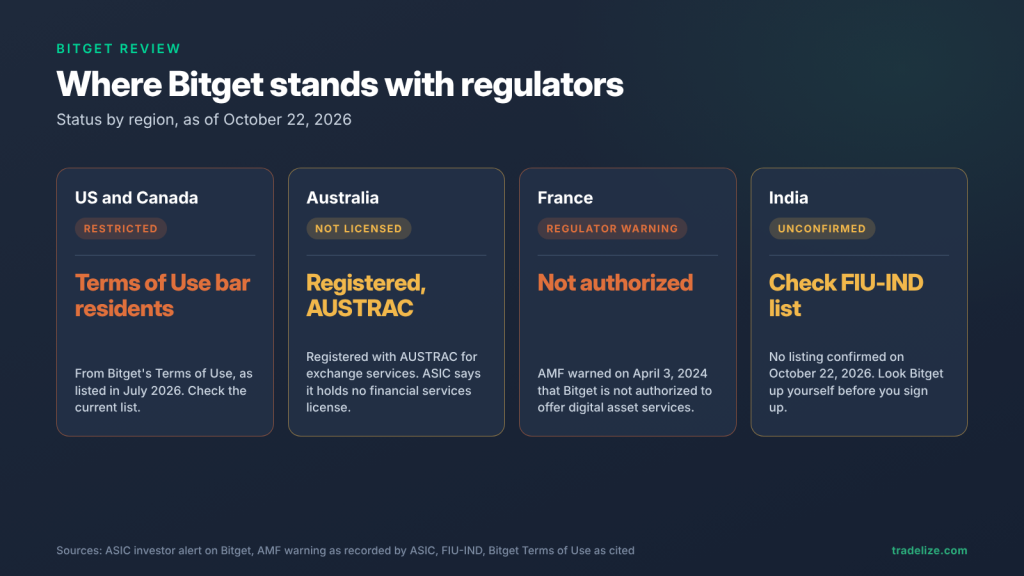
Bitget holds no license in the US, Australia, or France that we could confirm. Treat every “licensed” claim on Bitget’s own list as a registration until your regulator’s register shows a license, and when the two differ, go by the register.
- United States and Canada: Bitget’s Terms of Use restrict US and Canadian residents (July 2026 review). That may not match the current restricted-country list, so read it before you sign up.
- Australia: ASIC’s undated alert “ASIC warns investors of Bitget’s unlicensed crypto asset futures products” (read October 22, 2026) says Bitget is registered with AUSTRAC for exchange services but not licensed to carry on a financial services business there.
- France: The same ASIC alert records that France’s AMF warned on April 3, 2024, that Bitget’s platform was blacklisted and not authorized to provide digital asset services in France.
- India: Bitget’s status with FIU-IND was unconfirmed on October 22, 2026. FIU-IND’s home page links to a notice on registering virtual digital asset service providers as reporting entities. Bitget’s name does not appear on that page, and the page does not show whether Bitget is on the list of reporting entities or may serve users in India. That registration is not a license to operate, and our guide explains whether crypto is legal in India. Open an account only if Bitget appears on FIU-IND’s list and its sign-up page and Terms of Use accept residents of India.
Security Features
- Proof of reserves: Bitget publishes it monthly with Merkle tree verification (July 2026 review). It is Bitget’s own report of the crypto it holds for customers, and Merkle trees are meant to let you check that your balance is in it. It cannot show that Bitget could repay every customer.
- Protection Fund: It does not cover user error, market losses, or self-imposed trading risks (July 2026 review). Read its current terms before you count on it, or on Bitget’s pledge after the hack.
- Account protection: TOTP and SMS two-factor login, anti-phishing codes, withdrawal whitelisting, device management, and a separate fund password (July 2026 review). Confirm that each setting appears in your account.
- Bitget Wallet: A separate self-custodial product. Bitget holds the coins in your exchange account, while you hold Bitget Wallet’s private key.
These settings protect your account, not the coins Bitget stores for you. Keep on Bitget only what you plan to trade soon, and move coins you will hold for months to a wallet whose private key you hold, as our guide on where to store crypto explains. Install the app only from your phone’s official app store, and reach the site by typing its address, never through a bonus or referral link, even one a friend sends.
Security Incidents
| DATE | INCIDENT | OUTCOME |
|---|---|---|
| April 20, 2025 | Abnormal trading on the VOXEL/USDT perpetual futures contract | Suspected accounts paused; Bitget promised to roll back their gains within 24 hours |
| September 2026 | Hackers took $351.6 million, later raised to $387.5 million, from hot and warm wallets | Withdrawals suspended, then reopened by token from September 28; Bitget says balances were unaffected |
The September 2026 hack was a custody event because the stolen crypto sat in storage Bitget controlled: its hot and warm wallets, the storage it keeps online. BleepingComputer reported on September 25, 2026, that Bitget disclosed $351.6 million taken and suspended all withdrawals. Both the figure and the later $387.5 million are Bitget’s own. Bitget said Bitget Wallet was not affected and pledged that its User Protection Fund would cover all losses.
A follow-up on September 28 reported that Bitget resumed Bitcoin withdrawals that day. It scheduled ETH for September 29, USDT for September 30, and other tokens, fiat, and P2P from October 2, and said user balances were unaffected.
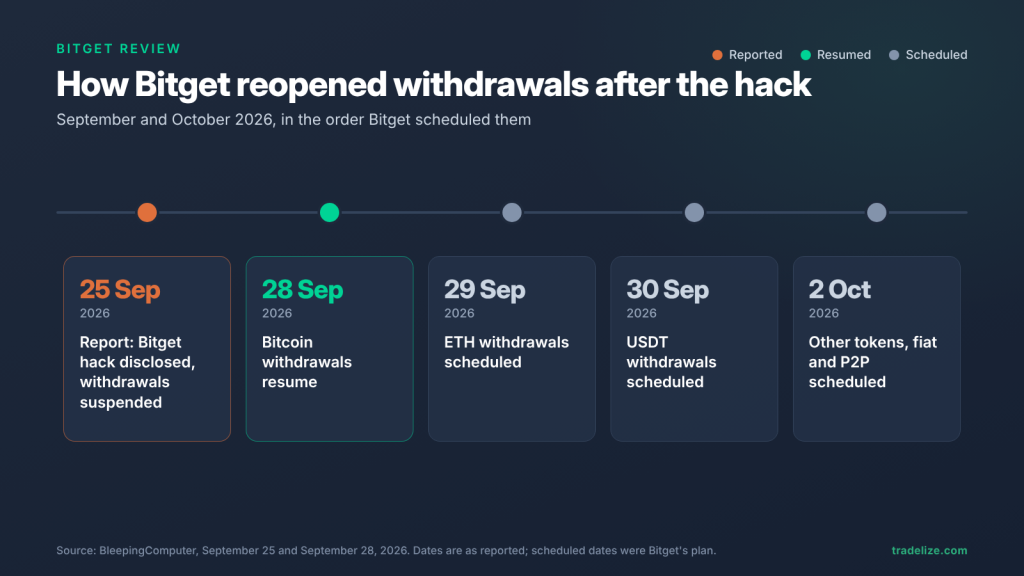
Neither report records the fund paying anyone, so read the fund pledge and the balance claim as Bitget’s word until a record of payment exists. Deposit only if Bitget’s own statements are enough for you. If you need an independent account of the hack, wait.
The April 2025 VOXEL incident, reported by Cointelegraph, was suspected manipulation of a perpetual futures contract, which trades on a token’s price and has no end date. Bitget called it suspected market manipulation. A spot purchase does not use that contract, so it matters most if you plan to trade Bitget futures.
Reputation and User Feedback
Bitget’s user reviews are far weaker on Trustpilot than in the app stores. Trustpilot reviewers are mostly people with a dispute, so read the two together.
User Reviews
When we checked Trustpilot on October 23, 2026, Bitget had a TrustScore of 1.7, labeled “Bad,” from 1,701 reviews. Of those, 75% gave one star and 12% gave five. Trustpilot says it does not fact-check reviews and that Bitget has no recent history of asking for them. Bitget’s profile shows replies to 84% of negative reviews.
The app stores are kinder. Bitget’s iOS app has a 4.6 out of 5 rating from 5.6K ratings. Its Android app has 4.6 from about 324K reviews and more than 10 million downloads.
Common Complaints and Praise
Top Complaints:
- P2P disputes and appeals, with funds locked while the other party stays unresponsive
- Accounts, withdrawals, or funds frozen, sometimes without a clear reason
- Identity verification loops and account-takeover reports
- Slow or automated support replies
- Reward disputes, where users say conditions were disclosed only after they followed the instructions
Top Praise:
- A user-friendly app
- Copy trading and a choice of spot and futures products
- Fast transactions
Supported Cryptocurrencies
Bitget lists more than 800 coins, but most of the trading happens in a few large pairs.
Available Coins and Pairs
CoinGecko lists 837 coins and 900 trading pairs on Bitget, which fits the “800+” in our overview table. The list includes Bitcoin, Ethereum, Solana, DOGE, SHIB, and PEPE, according to Bitget’s own fee guide. Bitget also lists new tokens through its Launchpad. Availability can differ by country, so check your own app before you plan a buy.
USDT is the main quote currency. In the 50 pairs CoinGecko showed, 46 were quoted in USDT and four in USDC. BTC/USDT and ETH/USDT account for about 47% of Bitget’s 24-hour trading volume (30.3% and 16.9%), so liquidity is deepest on those two and thinner on smaller coins.
BGB
BGB is Bitget’s own token. CoinGecko listed it at $1.90, with a market cap of about $1.33 billion and a rank of #66. Paying spot fees in BGB cuts them by 20%, from 0.10% to 0.08%, after you switch the option on in your account. BGB holders also get early access to Launchpad and Launchpool projects, plus staking and VIP perks. You don’t need BGB to trade, but its price swings, which the article already warns about, count as part of any fee savings.
Account Types and Limits
Bitget’s P2P and fiat routes stay closed until you complete identity verification (KYC). The levels below come from the July 2026 review, so confirm them on Bitget’s KYC page before you upload any document.
| LEVEL | DOCUMENTS | WHAT IT OPENS |
|---|---|---|
| Level 1 | Government ID and a selfie | Futures, copy trading, and P2P |
| Level 2 | Proof of address | Fiat routes |
Fiat routes are the ways money moves between your bank account and Bitget. Complete Level 2 before you deposit if you will want money back in your bank later. Stop at Level 1 when P2P covers everything you plan.
Bitget Fees
Bitget’s quote screen shows what you will pay for a first buy. We did not confirm Bitget’s current fee schedule, so read the fee and total on that screen and on Bitget’s fee page on the same day before you confirm.
Trading Fees
For scale only, Bybit’s trading fee page, read October 22, 2026, lists 0.1000% for crypto-to-crypto spot at its base tier. Fiat-to-crypto pairs there cost 0.2000% for a taker order, which fills at once, and 0.1500% for a maker order, which waits until another order matches it. These are Bybit’s rates. They are not Bitget’s, and they cover neither card purchases nor Bitget’s own costs.
Deposit and Withdrawal Fees
Check the fee and the network on Bitget’s withdrawal screen before you send anything, because the fee shown that day is the one you pay.
Other Fees
- BGB: Paying fees in BGB, Bitget’s token, gets a discount but exposes you to BGB’s price swings. Count that swing as part of the fee.
- Buying route: Fund the account first when you can and price a spot order. Compare it with the instant card or Convert quote, and take the instant buy only when its total is a cost you accept.
Bitget Features and Products
- Spot trading: The beginner’s route, because a spot buy gets you the coin itself and borrows nothing.
- Lite and Pro modes: Lite is the simplified web mode, and Pro adds TradingView charts, full order types, and cross-margin management on one screen (July 2026 review). Start in Lite if your screen offers it. Read crypto trading for beginners before you switch to Pro.
- Futures and margin: Futures trade on a coin’s price without you owning it, often with leverage. ASIC’s alert says Bitget’s crypto futures, offered at up to 125:1 leverage, are unlicensed in Australia, and that Australian users lack dispute-resolution and client-money protections. Read our guide to setting a stop-loss before your first futures trade.
- Copy trading: It repeats another trader’s orders in your account, and their past results do not shield your balance from their losses.
- Bots and Launchpad: Grid, DCA, and arbitrage bots, which place orders by rules you set, and a Launchpad for new tokens (July 2026 review).
Stay on spot until you can explain how leverage and a copied trader’s losses would hit your balance.
Customer Support
Bitget says its support team is available 24/7 by live chat or at [email protected], in an undated developer response on its Apple App Store (US) page. That reply gives no response time, and we found no dated response time from a named source. LiquidityFinder’s Bitget review (updated September 10, 2026) names accounts “frozen or locked without explanation” as the most persistent complaint, followed by slow responses on recovering funds. Use live chat for a stuck withdrawal and email when you need a written record. Keep the records and screenshots from your first deposit, so a stuck withdrawal can be traced.
How to Use Bitget: Step-by-Step Guide
- Confirm that Bitget’s Terms of Use accept your country and that your regulator’s register lists Bitget. In India, that register is FIU-IND’s list.
- Complete identity verification. Level 1 needs a government ID and a selfie, and Level 2 adds proof of address.
- Switch on two-factor login, an anti-phishing code, withdrawal whitelisting, and a fund password before your first deposit.
- Deposit by crypto transfer or a fiat route, and only what you plan to trade soon.
- Place your first buy as a spot order, in Lite mode if offered, after reading the fee and total on the quote screen.
- Send a small test amount to any new address first, pick a network your receiving address supports, and hold larger withdrawals until the test arrives. Bitget set the timing of withdrawals after the hack, and its fiat and P2P routes reopened last, from October 2. Our guide on buying crypto through P2P covers that route.
Who Is Bitget Best For?
- Spot buyers in a market where Bitget’s terms and the local regulator clearly allow it
- Buyers who move long-term coins to a wallet whose private key they hold
It is a weaker fit for US and Canadian residents, whom Bitget’s Terms of Use restrict, and for futures traders in Australia, where ASIC says the futures are unlicensed. Beginners in India should wait until FIU-IND lists Bitget. Start with the site’s reviews of CoinSwitch or Delta Exchange, and check each exchange on FIU-IND’s list yourself. Once Bitget appears there and its sign-up page accepts residents of India, it can suit you as a spot buyer.
Final Verdict
Bitget is worth a look for a first spot buy where its terms and your regulator’s register both clearly allow it. The September hack and the regulator warnings limit that verdict to spot buying, and in India you should wait until Bitget appears on FIU-IND’s list. Open an account when both checks pass. If either is unconfirmed, compare the top crypto exchanges first. Then look up your shortlist in the site’s exchange reviews and on your regulator’s register before you deposit.
Frequently Asked Questions
- Is Bitget a scam?
Bitget is an operating exchange, founded in 2018, but it has regulator warnings on record. ASIC says it is registered with AUSTRAC but not licensed for financial services in Australia, and France’s AMF warned in April 2024 that it was not authorized there. Look Bitget up on your own regulator’s register before you open an account.
- Did Bitget users lose money in the September 2026 hack?
Bitget says user balances were unaffected after hackers took $387.5 million from its hot and warm wallets, and it pledged that its User Protection Fund would cover all losses. Neither BleepingComputer report records the fund paying anyone, so keep on Bitget only what you will trade soon.
- Is Bitget Wallet the same as the Bitget exchange?
No. Bitget Wallet is a separate self-custodial product. Bitget holds the coins in your exchange account, while you hold the wallet’s private key. Bitget said the wallet was not affected by the September 2026 hack.
- Does Bitget require KYC?
Yes, in two levels. Level 1 asks for a government ID and a selfie and opens futures, copy trading, and P2P. Level 2 adds proof of address and opens fiat routes. Confirm both levels on Bitget’s KYC page before you upload any document.
- Can you use Bitget in India?
Not confirmed. Bitget’s FIU-IND status was unconfirmed on October 22, 2026, so wait to open an account until you find Bitget on FIU-IND’s list yourself.
- Can US and Canadian residents use Bitget?
No. Bitget’s Terms of Use restrict them (July 2026 review). Check the current restricted-country list, and pick an exchange your own regulator lists.

Our Review Methodology
At Tradelize, we follow strict editorial standards to ensure all content is accurate, unbiased, and thoroughly researched. Our reviews, guides, and articles are fact-checked by a team of experienced cryptocurrency and finance professionals, and are not influenced by advertisers or affiliate relationships. Our Trust Score methodology combines direct data scraping from official broker, exchange, and wallet websites with sentiment analysis of up to 1000 verified user reviews. This dual-source approach enables us to objectively evaluate platform features, fees, regulations, security, and customer satisfaction. We then compile comprehensive, specification-based reviews that reflect both technical details and real user experience.
Disclaimer
Trading cryptocurrencies, forex, CFDs, and other derivatives involves significant risk and may not be suitable for all investors. Leverage can amplify both gains and losses. Past performance is not indicative of future results. The content on Tradelize is for informational purposes only and does not constitute financial or investment advice. Always seek professional guidance before making financial decisions. For full risk disclosures, click here.