You bought ETH at $3,200. It climbed to $3,600, life was good. Then some news dropped: Celsius collapsing, LUNA imploding, a whale dumping. Before you could react, ETH was at $2,800. You didn’t set a Stop Loss. You figured you’d watch it. You didn’t watch it closely enough.
That scenario plays out every single week in crypto. The market doesn’t care about your entry price, your conviction, or your timeline. A Stop Loss in trading doesn’t guarantee profits, but it does guarantee you stay in the game long enough to have more of them.
Here’s what you need to know about Stop Losses: how they actually work, where to place them, and the mistakes that bleed accounts dry.
What Is a Stop Loss Order? (And Why Crypto Makes It Non-Negotiable)
A Stop Loss is an instruction to your exchange: “If this asset drops to X price, sell it automatically.” That’s the whole thing mechanically. The goal is to cap how much a trade takes from you before you’ve emotionally committed to holding through a full drawdown.
When price hits your stop level, the order triggers and executes, either immediately at market price or at a specified limit price, depending on the type. Which type matters a lot in fast markets.
“Every day I assume every position I have is wrong. I know where my stop risk points are going to be. I do that so I can define my maximum drawdown. Hopefully, I spend the rest of the day enjoying positions that are going in my direction. If they are going against me, then I have a game plan for getting out.” — Paul Tudor Jones, founder of Tudor Investment Corporation
What makes Stop Losses especially important in crypto isn’t just the volatility. It’s the kind of volatility. Bitcoin dropped over 30% in a single week during the May 2021 sell-off triggered by Elon Musk’s tweets and China’s mining ban. That’s not a bad earnings call; that’s a complete sentiment reversal in days. Without a Stop Loss, a leveraged position in that environment doesn’t just hurt. It wipes out.

The Three Types of Stop Loss Orders
Not all stops work the same. Getting these wrong in a thin market is a real cost.
- Stop-market order triggers at your stop price and fills immediately at whatever the current market price is. Guarantees execution, but in a fast crash, “market price” might be well below where you set the stop. During the flash crash in May 2021, some traders found that their stop-market orders were executed at prices 5–10% lower than they had intended, primarily due to slippage.
- Stop-limit order triggers at your stop price but only fills at your specified limit price (or better). You control the fill price, but you risk non-execution if the market falls through your limit too quickly. In a genuine panic, this order can sit there unfilled while price keeps falling.
- Trailing stop moves automatically as the price rises, locking in gains while still providing downside protection. You buy BTC at $60,000 and set a 5% trailing stop. If BTC runs to $70,000, your stop trails up to $66,500 automatically. If price reverses, you exit at $66,500 instead of $60,000. The catch? In choppy sideways action, trailing stops get triggered constantly.
How to Set Stop Loss Levels: Four Methods That Actually Work
This is where most guides go abstract. Here’s specific guidance.
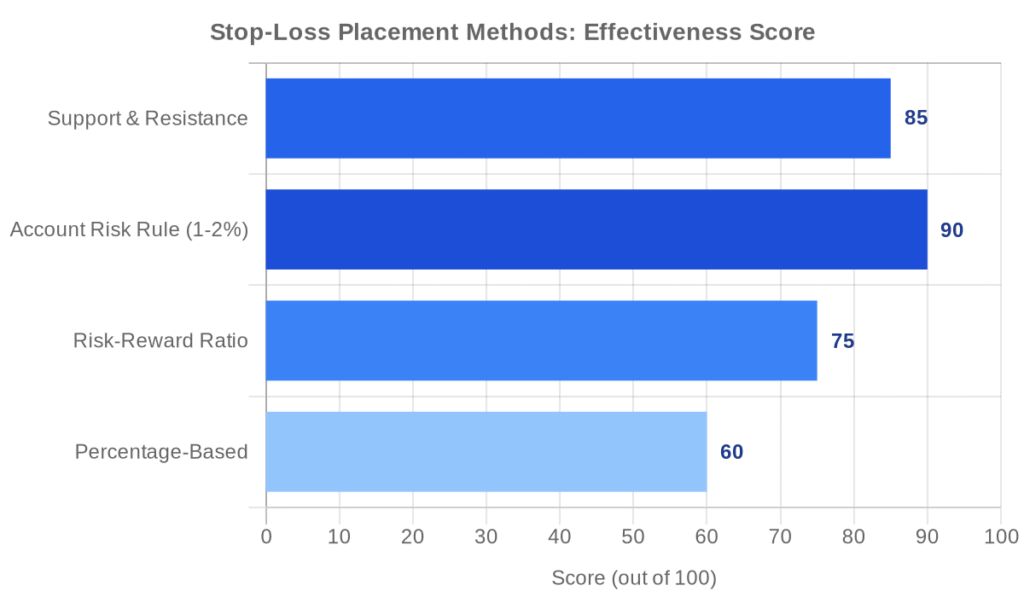
- Support and resistance levels. Look at where price has consistently bounced. A stop placed just below a major support level means: “I believed this support would hold. If it doesn’t, my thesis is wrong, get me out.” If BTC has held $65,000 three times as support, a stop at $64,200 (slightly below to avoid wicks) is technically defensible. Not guaranteed, but logical.
- Percentage-based rule. Day traders often use 1–3% for major coins, 5–10% for higher-volatility altcoins. Simple and consistent, no chart reading needed. The downside is it ignores the actual structure of the asset. On a coin with 20% daily volatility, a 3% stop gets triggered constantly without any real signal breaking.
- The 1–2% account risk rule. This is about position sizing as much as stop placement. The rule: no single trade should risk more than 1–2% of your total trading capital. On a $10,000 account, that’s $100–$200 maximum per trade. If your stop is $500 below entry on a per-coin basis, you’d buy just enough units so the dollar loss is $200 at most, not $500.
Sounds like tiny stakes. Here’s the uncomfortable reality: per CFTC-required broker disclosures, 65–80% of retail traders lose money. Trading coaches who’ve reviewed thousands of blown accounts point to position sizing (not strategy) as the primary cause. The 1–2% rule is what separates traders who last years from those who don’t last one.
- Risk-reward ratio. Before placing a stop, know your target. A 2:1 risk-reward means for every $100 you’re risking (your stop distance), you’re targeting $200 in gains. If you can’t identify a realistic 2:1 setup, the trade probably isn’t worth taking. Traders who ignore this end up right 60% of the time and still lose overall, because the losses are bigger than the wins.
Stop Loss + Take-Profit: Using Both Together
Setting a stop without a take-profit is half a plan. The stop protects the downside; the take-profit locks in the upside before greed takes it back.
Most major exchanges (Binance, Kraken, Bybit) let you set both simultaneously when placing a trade. Worth using every time.
One thing to check: these orders don’t always cancel each other when one fills. If your take-profit triggers and your position closes, the Stop Loss order may stay open as an orphaned sell order. Some platforms cancel it automatically; others don’t. An orphaned stop on a reversed position can accidentally open a short. Check your exchange’s order behavior on this before you need to find out the hard way.
Moving stops in your favour as a trade progresses is entirely legitimate. Traders call it “moving to breakeven”: shifting the stop to your entry price after reaching a partial profit target. Moving stops away from entry to avoid being stopped out is a different story entirely, and we’ll cover that below.
Five Stop Loss Mistakes That Cost Real Money
- Setting stops too tight. In crypto, 2–3% daily swings on major coins are normal. A 1.5% stop on BTC will trigger constantly without any genuine trend break. Use an asset’s average true range (ATR) as a minimum reference for stop distance. If the ATR is 3%, a 1.5% stop is noise, not signal.
“If you can’t take a small loss, sooner or later you will take the mother of all losses.” — Ed Seykota, trend-following pioneer profiled in Market Wizards
- Moving stops to avoid a loss. When price approaches your stop, the instinct is to move it lower, “just to give it more room.” This converts a risk-managed trade into a hope-based one. It’s the single most destructive habit in retail trading, and it works against you every time over the long run.
The first time I moved a stop down to ‘give the trade more room,’ I justified it carefully — the chart looked oversold, the support was still intact, the volume profile was constructive. All true, and none of it mattered. I exited 18% lower than my original stop level would have, after watching the position fall for three days while I told myself the next bounce was coming. The lesson wasn’t about that one trade. It was that ‘giving it more room’ is always a story I’m telling myself. Now my stops are set when I open the position and not touched again — moved up to lock in profit, but never down to avoid a loss.
- Trading with no stop at all. Every justification exists: “I’m a long-term holder,” “I’ll set one later,” “the exchange doesn’t support it.” LUNA lost 99.9% of its value in 72 hours in May 2022. FTX collapsed practically overnight in November 2022. There’s no version of “I’ll watch it carefully” that survives those scenarios.
- Ignoring correlation. Setting identical stop percentages on three altcoins that all move with BTC means when BTC has a bad day, you get stopped out of three positions simultaneously. Factor in correlation when sizing and positioning stops across a portfolio.
- Forgetting about exchange liquidity. Thin altcoin markets have wide bid-ask spreads and low order book depth. A stop-market on a low-liquidity altcoin can execute significantly below your intended stop level. In illiquid conditions, a stop-limit might actually be the safer choice, even with the non-execution risk.
A Quick Real-World Example
You’re buying SOL at $140. You’ve identified $128 as a key support level (previously tested and held twice). You place a stop-market at $126.50, slightly below support to account for wicks.
Your target is $168 (a previous resistance level). That’s a $28 gain vs. a $13.50 risk, roughly a 2:1 risk-reward ratio.
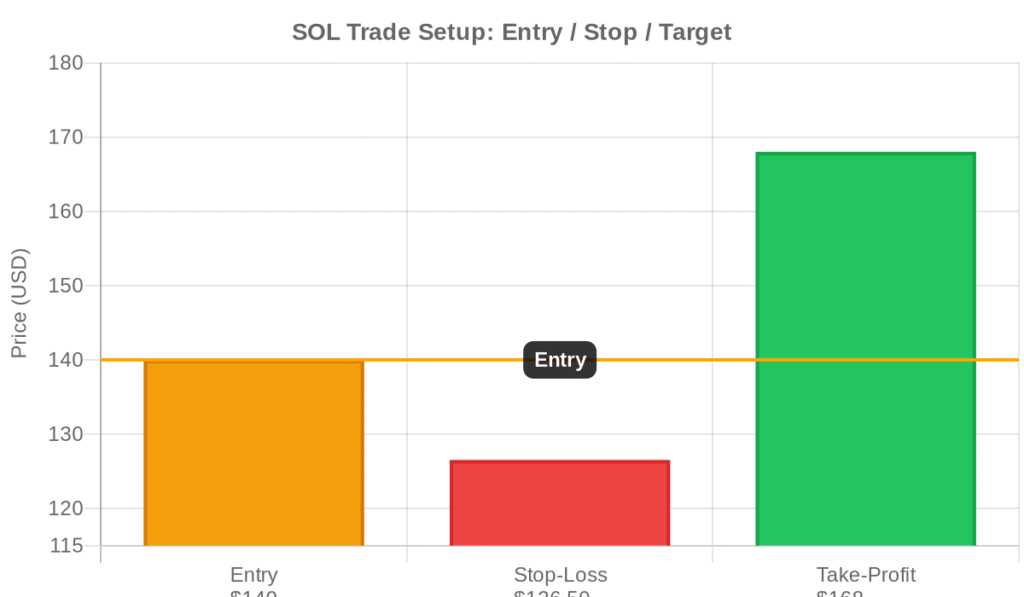
Your account is $5,000. Under the 1–2% rule, you’re risking $50–$100. With a $13.50 stop distance per SOL, you’d buy 7 SOL (risking $94.50, just under 2% of the account).
That’s a complete, sized trade with defined risk. Not a bet.
I run through this exact math now on every trade before I click anything. It feels excessive when you’re starting out — 90 seconds of arithmetic to size a position that takes 3 seconds to execute. The first month I did it, I almost certainly missed two trades I would have entered on instinct. The next month, I avoided four trades whose risk-reward didn’t actually work out, and one of those would have been a catastrophic loss. The math doesn’t tell you which trades will win. It tells you which trades shouldn’t be taken at all.
Conclusion
A Stop Loss in trading isn’t a guarantee against loss — it’s a guarantee that loss has a ceiling. In crypto, where 30% weekly drawdowns aren’t unusual and tokens have lost 99% of their value in three days, that ceiling is the difference between a recoverable mistake and a wiped-out account. Set the stop before you enter the trade, size the position so the dollar risk fits the 1–2% rule, and never move the stop lower to “give it more room.” Pair it with a take-profit target and a defined risk-reward ratio. The discipline isn’t sophisticated. The discipline is the entire edge.
FAQ: Stop Loss in Trading
1. What is a Stop Loss in crypto trading?
A Stop Loss is an order that automatically closes your position once the price hits a level you set. Its main goal is to limit your potential losses on a single trade without needing to keep a constant eye on the market. In the always-open crypto market, a Stop Loss serves as a crucial risk management tool, helping to safeguard your capital against sudden price fluctuations.
2. How do I choose the right Stop Loss percentage for crypto?
The ideal percentage for a Stop Loss really depends on how volatile the asset is and your own risk tolerance. For well-known cryptocurrencies like Bitcoin and Ethereum, traders typically set Stop Loss levels between 3% and 8% for active trades. On the other hand, more volatile altcoins might need wider stops, ranging from 8% to 15%. Many seasoned traders prefer to stick to the 1%–2% account risk rule, adjusting their position sizes to ensure that the amount they risk stays consistent, no matter how volatile the asset is.
3. What’s the difference between a Stop Loss and a stop-limit order in crypto?
A Stop Loss market order becomes a market order once the trigger price is reached, prioritizing execution but not guaranteeing the exact price. A stop-limit order, on the other hand, converts into a limit order when triggered and will only execute at the specified limit price or better. While stop-limit orders offer greater price control, they carry the risk of not being filled during rapid market movements. For many retail traders, stop-market orders are often considered the safer option because they prioritize exiting the position.
4. Should I use a Stop Loss on every trade?
Yes, for active trading strategies such as day trading, swing trading, or leveraged trading, using a Stop Loss on every trade is generally recommended. It helps define risk before entering a position and prevents small losses from becoming significant ones. The main exception is a long-term investment held in cold storage where the investor has consciously accepted short-term market fluctuations and drawdown risk.
5. Can a Stop Loss guarantee I won’t lose more than I planned?
Not completely. A stop-market order can experience slippage during periods of extreme volatility, resulting in an execution price that differs from your stop level. A stop-limit order may not execute at all if the market moves past the limit price too quickly. Additionally, exchange outages or technical issues can occasionally prevent orders from being executed. While a Stop Loss significantly reduces downside risk, it cannot eliminate execution risk entirely.

Our Review Methodology
We evaluate each post based on thorough research, credibility of sources, accuracy of information, and relevance to our readers. Our editorial team follows strict guidelines to ensure all content meets high standards of quality.
Disclaimer
The content in this article is provided for informational purposes only and does not constitute financial, investment, or professional advice. Always do your own research before making any decisions.