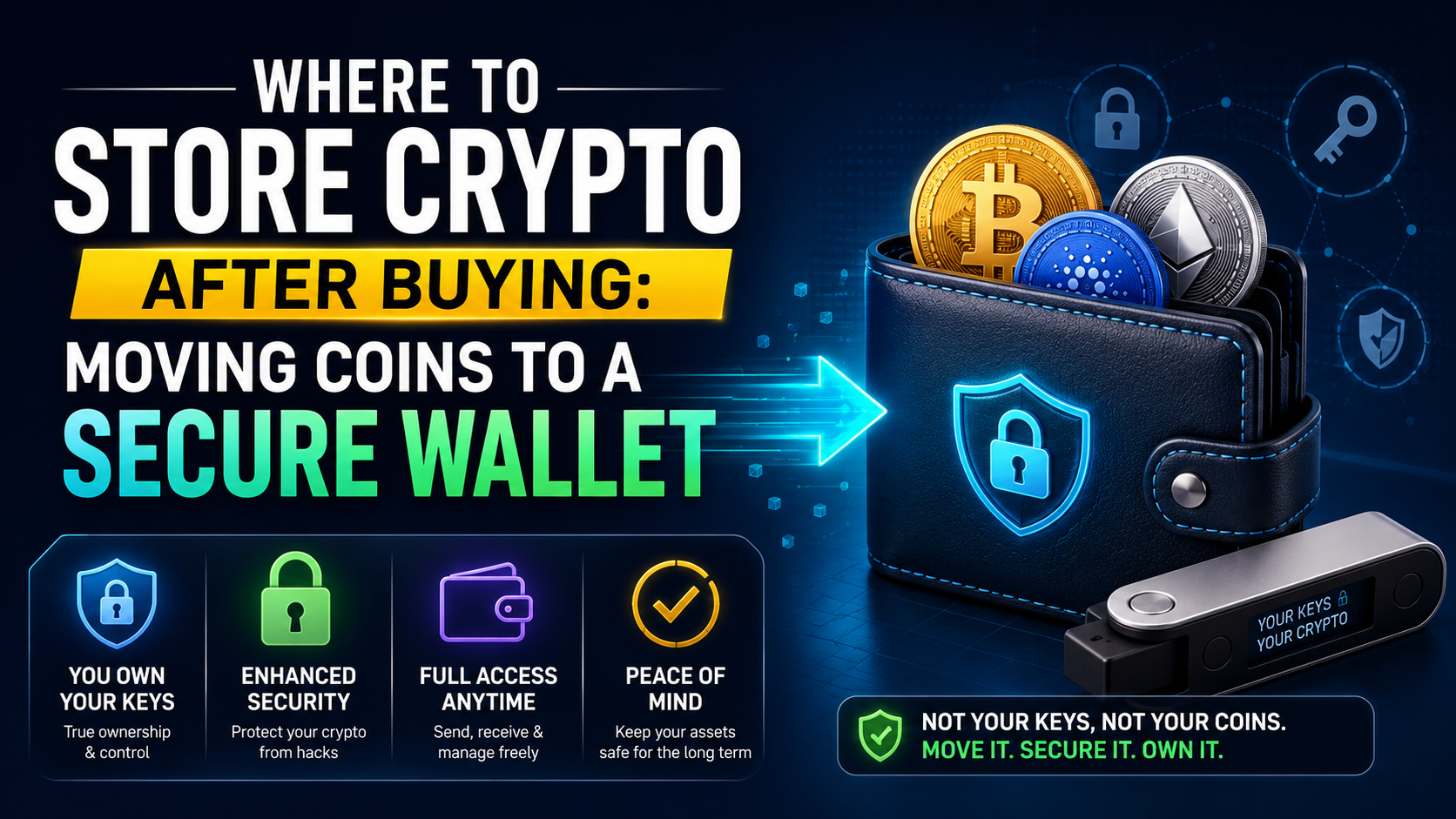
You just bought your first Bitcoin, Ethereum, or another coin. It’s sitting in your Coinbase or Binance account, and right now that probably feels fine — the exchange has two-factor authentication, you’ve got a strong password, and what are the odds anything goes wrong?
Ask the people who had funds on FTX in November 2022. They had accounts too.
Moving your crypto off an exchange and into a wallet you actually control is the single most important security step new buyers skip. Here’s what you need to know.
After buying crypto, the safest move is transferring it to a wallet (answering directly where to store crypto) where you hold the private keys, either a hardware wallet (Ledger, Trezor) for long-term storage or a software wallet for active use. Exchanges hold your keys for you, which means exchange failures like FTX’s $8 billion collapse in 2022 can freeze your funds permanently. Hardware wallets start at $49 (Trezor Model One).
Why Leaving Crypto on an Exchange Is Riskier Than You Think
Crypto hacking hit $2.2 billion in 2024 alone — across 303 incidents tracked by Chainalysis (Chainalysis, 2025). That’s not counting exchange collapses, exit scams, or simple platform failures that lock users out of their funds. Exchanges are the most targeted layer in crypto because they hold enormous concentrations of user assets in hot wallets connected to the internet.
But hacking isn’t even the biggest threat. The bigger one is what happened in November 2022: FTX, then the second-largest crypto exchange in the world, filed for bankruptcy with an $8 billion hole in its accounts. Users couldn’t withdraw. Funds were frozen for years. Many lost everything.
In May 2019, Binance — still one of the safest exchanges operating today — lost 7,000 BTC (worth roughly $40.7 million at the time) in a single hack targeting its hot wallet (CoinDesk, 2019). Binance made users whole, which was admirable. Not every exchange will.
The takeaway isn’t that you should panic. It’s that an exchange account is not the same as owning your crypto.
We reviewed dozens of accounts from users who lost access during the FTX collapse. Most of them knew, in theory, that leaving crypto on an exchange carried risk. They just assumed the risk was someone else’s problem. It wasn’t.
The test transaction step isn’t optional, I learned this with $40 worth of ETH that arrived perfectly. Six minutes later I confidently sent the larger amount and watched it land. The small transaction wasn’t pointless even though it ‘worked’, it confirmed the address parsed correctly, the network was right, and the wallet acknowledged the receive. The $1.20 in gas fees on the test transaction is the single cheapest insurance policy in crypto. I’ve never skipped it since, even for transfers I’ve made dozens of times before.
Hot Wallets vs. Cold Wallets: What’s the Difference?
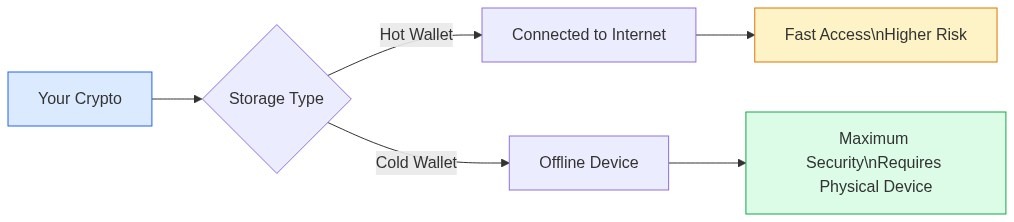
Every crypto storage option falls into one of two categories. Cold wallets store your private keys offline, with no internet connection — the electronic equivalent of cash under a mattress, except actually secure. Hot wallets stay connected to the internet, which makes them convenient but permanently exposed to online attacks.
The distinction matters because most thefts target hot wallets. They’re accessible. Cold wallets can’t be remotely accessed because they’re not online to begin with. A hardware device sitting in a drawer can’t be drained by a hacker in another country.
That said, cold storage isn’t perfect either. Lose the device and the recovery phrase without a backup, and the funds are gone. About 3 million BTC are estimated to be permanently lost, most due to forgotten passwords and lost hardware (Glassnode, 2024). Cold storage demands discipline, not just possession.
Exchange Wallets — What “Not Your Keys, Not Your Coins” Really Means
When you buy crypto on Coinbase or Binance and leave it there, you don’t technically own it. You own an IOU. The exchange controls the private keys — the actual cryptographic proof of ownership — and shows you a balance in your account. If the exchange goes down, disputes your withdrawal, or gets hacked, your ability to access those funds depends entirely on their willingness or capacity to honor it.
“Not your keys, not your coins” isn’t just a crypto Twitter slogan. It’s a description of a real legal and technical situation. FTX users found out the hard way.
“Not your keys, not your coins.” — Andreas M. Antonopoulos, author of Mastering Bitcoin and Mastering Ethereum
Exchange wallets do make sense in some scenarios. If you’re actively trading, moving in and out of positions regularly, you need liquidity that hardware wallets can’t provide efficiently. Small amounts you plan to sell within days? Fine to keep on a reputable exchange. Several thousand dollars you’re holding long-term? That calculus changes completely.
Reputable exchanges (Coinbase, Kraken, Gemini) carry insurance and regulatory oversight that sketchy platforms don’t. Having said that, even regulated exchanges have failed their users. Insurance doesn’t always cover individual account losses the way bank deposit insurance does.
Hardware Wallets: The Closest Thing to a Bank Vault for Crypto
Hardware wallets store your private keys on a physical device that never connects to the internet during normal operation. When you want to sign a transaction, the device does the signing internally — your keys never touch an internet-connected computer. That’s the security model, and it’s robust.
The two main brands are Ledger and Trezor, and both have earned their reputations (though Ledger had a data breach in 2020 exposing customer email addresses — worth knowing, even if it didn’t compromise any funds). Ledger’s entry-level Nano S Plus runs $59–$79. Trezor’s Safe 3 is $79. Trezor’s Model One is still available at $49. On the higher end, the Ledger Nano X ($149) adds Bluetooth; the Ledger Flex ($249) comes with a touchscreen.
The rule of thumb we’d use: if your crypto holdings are worth more than the cost of a hardware wallet, you should probably own one. That’s not a high bar.
Hardware wallets support multiple coins — Ledger supports 5,500+, Trezor covers the major currencies and most ERC-20 tokens. If you’re holding a mix of BTC, ETH, and altcoins, one device handles everything.
The drawbacks? Initial setup takes 30–60 minutes and requires careful handling of your recovery phrase (more on that shortly). Hardware wallets aren’t practical for active trading. They’re built for storage, not speed.
Software Wallets: A Solid Option for Everyday Crypto
What if you’re not holding life-changing sums but still want better security than an exchange? Software wallets — also called hot wallets or mobile wallets — sit in the middle. You control the private keys (unlike an exchange), but the wallet software runs on an internet-connected device.
MetaMask is the standard for Ethereum and ERC-20 tokens; it doubles as a gateway to DeFi apps and NFT platforms. Trust Wallet (owned by Binance, though non-custodial) supports 100+ blockchains and works well as a general-purpose wallet — we’ve reviewed it in depth here. Exodus is popular for its clean interface and built-in swap feature. Phantom is the go-to for Solana.
The honest limitation: software wallets are only as secure as the device running them. A phone with malware, a phishing attack on a browser extension, or even someone physically accessing your unlocked phone can drain a software wallet. They’re meaningfully safer than exchange storage, but they’re not cold storage.
If you’re holding under $500 or need quick access for DeFi or NFT activity, a software wallet is practical and reasonable. For larger amounts you’re not actively using — a hardware wallet is worth the $59.
Where to Store Crypto Keys — and What Not to Do
Your crypto wallet is secured by a seed phrase: a list of 12 or 24 words generated when you create the wallet. This phrase is the master key. Whoever has it controls the wallet, permanently and irrevocably. There’s no “forgot password” option. No customer service line to call.
What not to do with your seed phrase (seriously):
- Don’t take a screenshot. Cloud photo sync (iCloud, Google Photos) can expose it.
- Don’t email it to yourself. Email is compromised constantly.
- Don’t store it in a note-taking app. Notion, Evernote, Apple Notes — all hackable.
- Don’t type it into any website, ever. Legitimate wallets will never ask for it online.
Where to store your crypto keys properly:
Write the phrase on paper and store it somewhere physically secure — a safe, a lockbox, somewhere it won’t be destroyed in a fire or flood. For long-term storage, metal backup products (Cryptosteel, Bilodeau) engrave the phrase onto stainless steel, which survives house fires and water damage. Keep two copies in separate locations.
Some people memorise their seed phrase. We wouldn’t recommend this as your only backup unless you have genuinely exceptional memory. Human recollection fails under stress. A fire doesn’t care about your memory.
How to Move Your Crypto From an Exchange to a Wallet
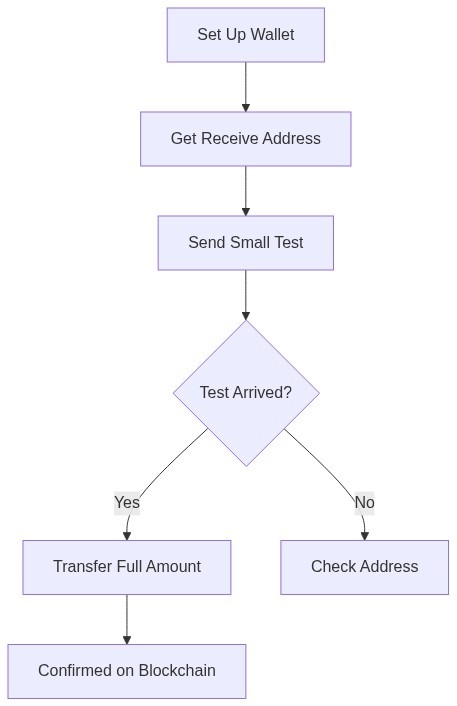
The process is straightforward — but the one mistake beginners make here is skipping the test transaction. Always send a small amount first.
- Set up your wallet. Download your chosen software wallet or unbox your hardware wallet. Complete setup and record your seed phrase offline before loading any funds.
- Get your wallet’s receive address. In your wallet app, find the “Receive” function for the specific coin you’re moving (BTC receive address, ETH receive address — these are different, don’t mix them up).
- Send a small test transaction. Go to your exchange, withdraw a tiny amount — $5 to $10 worth — to your wallet address. Wait for confirmation.
- Verify the test landed. Open your wallet and confirm the small amount arrived. This proves you have the correct address and the transfer works.
- Transfer the rest. Now send the full amount. Double-check the address. Network fees (gas for ETH, network fees for BTC) vary by congestion — sending during low-traffic periods saves money.
One thing to flag: transfers are irreversible. Once sent to the wrong address, crypto is gone. Many exchanges now offer address listing, a setting that only allows withdrawals to pre-approved addresses — which is worth enabling before moving large amounts.
Which Crypto Storage Type Should You Use?
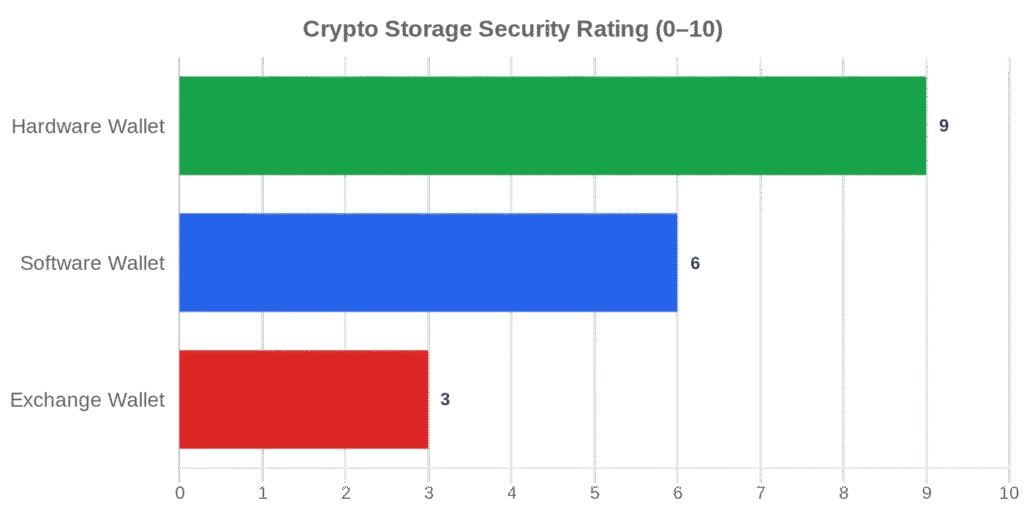
| Storage Type | Security | Control | Convenience | Best For |
|---|---|---|---|---|
| Exchange wallet | Low | None | High | Active traders, small amounts |
| Software wallet | Medium | Full | High | Daily use, DeFi, NFTs |
| Hardware wallet | High | Full | Low | Long-term holdings, significant amounts |
| Paper wallet | High | Full | Very Low | Emergency backup, extreme paranoia |
Our recommendation: most crypto holders should use two layers — a hardware wallet for long-term holdings and a software wallet for active use. Keep what you’re actively using in the software wallet; keep what you’re storing in the hardware wallet.
If you’re new and holding under a few hundred dollars, a reputable exchange plus a software wallet is a reasonable starting point. Just don’t leave large amounts on an exchange indefinitely.
The Bottom Line on Where to Store Your Crypto After Buying
The safest place to store your crypto after buying is a hardware wallet where you hold the private keys — full stop. If your holdings exceed the cost of a Trezor Safe 3 ($79) or Ledger Nano S Plus ($59), the investment pays for itself in security. Exchange wallets remain the most convenient option but expose you to platform risk, as FTX’s $8 billion collapse demonstrated. Software wallets offer a practical middle ground for active use. Whichever option you choose, protect your seed phrase offline — that’s the one thing that can’t be replaced.
Frequently Asked Questions
1. Should I move all my crypto off an exchange right away?
It depends on how much you’re holding and how long you plan to keep it. If you’re actively trading, staying on a reputable exchange is practical. For anything you’re holding long-term—especially amounts that would hurt to lose—transferring to a self-custody wallet (hardware or software) is the safer move. The rule most experienced holders follow is simple: if it’s not worth the effort to move it, it’s probably not worth worrying about. If it is worth worrying about, move it.
2. What’s the difference between a private key and a seed phrase?
Your seed phrase (12 or 24 words) generates all the private keys for your wallet. Think of the seed phrase as the master key—it can recreate the entire wallet. Individual private keys correspond to specific addresses within that wallet. For practical purposes, you only need to safeguard the seed phrase because it controls everything.
3. Can I store different cryptocurrencies in the same wallet?
Yes, most modern wallets are multi-coin. Hardware wallets such as Ledger and Trezor support hundreds of cryptocurrencies from a single device. Software wallets like Exodus and Trust Wallet also support multiple blockchains. However, each cryptocurrency uses its own address format. A Bitcoin address cannot receive Ethereum, and vice versa, so always double-check that you’re using the correct receiving address for the asset you’re transferring.
4. What happens if I lose my hardware wallet?
Nothing happens to your funds as long as you still have your seed phrase. Simply purchase a new wallet, enter the seed phrase during setup, and your funds will be restored. The seed phrase is what gives access to the wallet—not the physical device. That’s why protecting the seed phrase is more important than protecting the hardware wallet itself.
5. Is it safe to buy a hardware wallet from Amazon or eBay?
It’s best to buy directly from the manufacturer or an authorised reseller. Counterfeit hardware wallets have appeared on third-party marketplaces, including tampered devices designed to steal seed phrases during setup. The small savings rarely justify the risk. When it comes to securing crypto assets, purchasing from a trusted source is the safer choice.

Our Review Methodology
We evaluate each post based on thorough research, credibility of sources, accuracy of information, and relevance to our readers. Our editorial team follows strict guidelines to ensure all content meets high standards of quality.
Disclaimer
The content in this article is provided for informational purposes only and does not constitute financial, investment, or professional advice. Always do your own research before making any decisions.