
You open your portfolio app and Bitcoin is down 40% from where it was three months ago. The headlines are grim. Your altcoins look worse. And somewhere in the back of your mind, you’re asking the question most crypto investors eventually ask: is this a bear market, or just a correction? So, let’s understand Crypto Market Cycles- Bull vs Bear Markets and what they mean.
Those two terms — bull market and bear market — get thrown at you constantly in crypto. Most people nod along. Far fewer can say exactly what they mean in practice, or how to tell which one you’re actually in. And that confusion costs real money.
Here’s what they actually look like, what drives them, and where things stand as of the first half of 2026.
In short, a crypto bull market is a sustained period of rising prices (typically 20%+ gains), a period of rising trading volume, and, also, spectrum of market optimism. A bear market is the opposite of this— prices fall 20% or more from recent highs and stay down for months.
Bull vs Bear Market — Side-by-Side
| Factor | Bull Market | Bear Market |
|---|---|---|
| Price direction | Rising 20%+ from recent lows | Falling 20%+ from recent highs |
| Trading volume | High and rising with price | Declining; brief spikes on sell-offs |
| Market sentiment | Greed to Extreme Greed (F&G 60-100) | Fear to Extreme Fear (F&G 0-40) |
| BTC typical drawdown | +100% to +500% from cycle low | -50% to -80% from cycle high |
| Altcoin behavior | Outperform BTC (altseason) | Underperform BTC significantly |
| New project launches | High — IDOs, ICOs, NFT mints surge | Low — projects delay or cancel |
| Recommended approach | Manage risk, take profits, avoid FOMO | Accumulate quality assets, DCA, preserve capital |
| Typical crypto cycle length | 12–24 months | 9–18 months |
The table looks clean and symmetrical. Reality is messier. Bull markets don’t end on a clear date. Bear markets don’t always bottom where the models predict. And “recommended approach” is not the same as “easy to execute when you’re watching your portfolio fall.”
What Is a Crypto Bull Market?
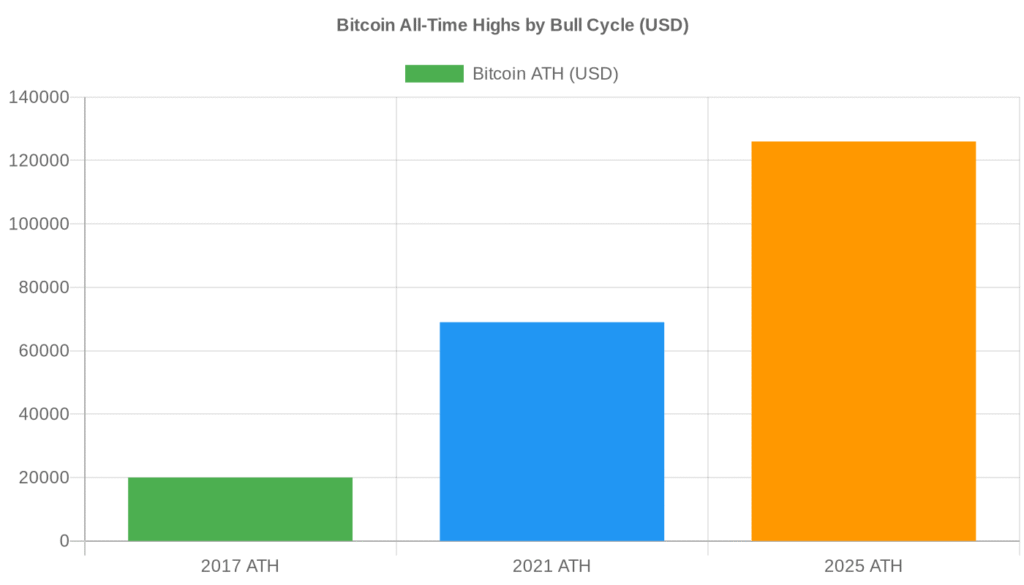
A crypto bull market is a sustained period in which prices rise significantly — most analysts define it as a 20% or greater increase from a recent low — accompanied by growing trading volumes, rising investor confidence, and broad market participation. Bitcoin led the most recent bull cycle to an all-time high of $126k on October 14, 2025 (multiple market reports, 2025), with the cycle beginning after the April 2024 halving event cut Bitcoin’s block reward from 6.25 BTC to 3.125 BTC.
What Does a Bull Run Actually Look Like?
The textbook definition is easy. What’s trickier is what a bull run feels like when you’re inside one — because they don’t announce themselves cleanly.
In the early phase, prices recover steadily from their bear market lows. News coverage is cautiously optimistic. On-chain data shows long-term holders aren’t selling. Then, at some point — usually after Bitcoin breaks a key psychological level — retail interest floods back in. Trading volumes jump. Social media fills with price predictions. Altcoins start making 5x, 10x, 20x moves in weeks.
Late-stage bull markets are something else entirely. FOMO (fear of missing out) takes over from fundamental reasoning. Projects with no users and dubious whitepapers hit billion-dollar valuations. That’s typically when institutional traders start trimming positions — while retail is still buying.
In 2025, Spot Bitcoin ETFs fundamentally changed the texture of the bull run. Institutional inflows (pension funds, family offices, asset managers) bought $1.2 billion in net ETF inflows in January 2026 alone (CoinDCX, 2026), which is a pace retail demand never achieved in previous cycles. This smoothed out some of the blow-off-top dynamics — but didn’t eliminate the eventual pullback.
How Long Do Crypto Bull Markets Last?
Historically, crypto bull markets have run for roughly 12 to 18 months from halving to peak — though the 2020-2021 cycle stretched closer to two years. Traditional stock markets show bull runs lasting a median of 42 months (3.5 years) with an 87% median price increase (Gemini Cryptopedia), but crypto operates on a faster, more volatile clock.
The April 2024 halving followed by the October 2025 ATH fits roughly within the 16-18 month historical window. Whether the cycle is fully over or in a temporary correction is, as of April 2026, still genuinely unclear.
What Is a Crypto Bear Market?
A crypto bear market is a sustained decline — typically 20% or more from recent highs — that persists for months, not days. It’s the point where buying pressure collapses, sentiment turns negative, and most assets bleed value continuously rather than in sharp dips. Crypto bear markets are historically harsher than stock market equivalents: during the 2017-2018 cycle, the average cryptocurrency lost 88.2% of its value from bull market peak to bear market trough (CoinMarketCap Academy).
That’s not a typo. 88.2%.
Signs You’re in a Crypto Bear Market
A few things tend to show up consistently:
- Trading volume dries up. The feverish turnover of bull markets goes quiet. Low volume in a downtrend usually means sellers are still there, but buyers aren’t. Not a great combination.
- Altcoin underperformance deepens. When Bitcoin drops 30%, mid-cap and small-cap altcoins often drop 60-80%. This isn’t coincidence — smaller assets have less liquidity and fewer committed long-term holders to stabilize prices.
- On-chain data turns defensive. Long-term Bitcoin holders (wallets that haven’t moved coins in 6+ months) stop accumulating. Exchange inflows rise, meaning more holders are moving Bitcoin to exchanges — historically a precursor to selling pressure.
- Sentiment stays negative for extended periods. The Crypto Fear & Greed Index — which measures market sentiment on a scale of 0 (Extreme Fear) to 100 (Extreme Greed) — spent most of 2022 in the 10-25 range (Alternative.me). That sustained fear, not a single spike, is the bear market signature.
The 2022 Bear Market — What Really Happened
The 2022-2023 bear market is worth examining specifically, because it wasn’t just a price correction. It was an institutional collapse.
Bitcoin peaked at approximately $69,000 in November 2021. Then the Federal Reserve began hiking interest rates aggressively, pulling risk capital out of speculative assets. Crypto got hit hard. But what turned a correction into a full-blown bear market was a series of failures that compounded each other:
- Terra/Luna collapsed in May 2022, wiping out approximately $45 billion in market value almost overnight
- Three Arrows Capital (3AC) failed in June 2022 after massive leveraged positions across multiple assets
- FTX filed for bankruptcy in November 2022 — one of the largest crypto exchanges in the world, with customer funds missing and the crypto market losing over $200 billion in value within 24 hours of the announcement.
Bitcoin bottomed near $15,500 in November 2022 — a 77% drop from its all-time high (Federal Reserve Bank of Chicago, 2023).
It’s worth sitting with that number. People who bought Bitcoin in November 2021 watched it lose three-quarters of its value over the following year. And that was Bitcoin — the most liquid, most established crypto asset. The types of smaller altcoins people were holding? Most dropped 90%+, and many didn’t come back at all.
What Pushes Crypto Into a Bull or Bear Market?

The Halving Cycle and Its Role in Price
Every approximately four years, the Bitcoin protocol cuts the block reward miners receive in half. This “halving” reduces the rate at which new Bitcoin enters circulation — creating a supply shock when demand stays constant or rises.
The sequence has repeated three times:
- 2016 halving → 2017 bull run to $20,000
- 2020 halving → 2021 bull run to $69,000
- 2024 halving (April 20, 2024) → 2025 bull run to $126,000
Four years. Three halvings. Three bull runs. The timing is too consistent to ignore — and unlike most crypto narratives, there’s an actual mechanism behind it, not just vibes. Bitcoin’s supply side compresses every four years. What happens next depends on demand. That’s the part nobody can predict.
Whether the cycle continues into 2028 remains genuinely open. But the halving is the most reliable structural signal the market has.
That said, the halving alone doesn’t guarantee a bull market. It narrows supply. Demand has to do the rest. That is the trick that holds up bull vs bear market.
“In the short run, the market is a voting machine but in the long run, it is a weighing machine.”
Benjamin Graham — value investing pioneer, Columbia Business School
Macro Factors and Institutional Money
Interest rates matter more than many crypto-native investors want to admit. When the Federal Reserve raises rates, money moves out of risk assets (crypto included) and into bonds and cash equivalents that now offer decent yields. When rates fall, that risk capital looks for better returns — and crypto has historically benefited.
The 2022 bear market wasn’t just about FTX. The Fed raised rates to a 22-year high. Risk assets broadly sold off. Crypto happened to have multiple internal catastrophes on top of that macro pressure.
The entry of spot Bitcoin ETFs in January 2024 added a new dimension: institutional buying that operates on different timelines than retail. Pension funds don’t panic-sell. They also don’t chase altcoins. Their presence has changed how Bitcoin cycles look — smoother uptrends, steadier institutional floors, but possibly less dramatic short-term peaks.
Sentiment: How FOMO and Fear Become Self-Fulfilling
Markets are partly a coordination game. When everyone believes prices will rise, they buy — which makes prices rise. When everyone expects a crash, they sell — which causes one. This isn’t irrational; it’s the nature of markets with many participants operating on expectations.
In crypto specifically, fundamental analysis and on-chain data matter, but sentiment can override fundamentals in both directions for extended periods. The 2021 bull run peaked partly because retail FOMO overwhelmed any valuation concerns. The 2022 bear market deepened because fear and loss of trust compounded the underlying macro issues.
Understanding this dynamic doesn’t give you perfect timing. But it explains why markets can look “wrong” for far longer than seems rational — in both directions.
How Do You Read Where the Market Is Right Now?
No single indicator tells you definitively whether we’re in a bull or bear market. But there are a few gauges worth tracking:
- Fear & Greed Index (Alternative.me) aggregates price momentum, volatility, social media volume, and Bitcoin dominance into a single 0-100 score. During the late-2025 bull run, it consistently sat above 75 (Extreme Greed). As of early 2026, readings have returned to the Fear range — consistent with a post-peak correction, not necessarily a full bear market.
- MVRV Ratio (Market Value to Realized Value) compares Bitcoin’s current market cap to the price at which all coins last moved. When MVRV is high (2.5+), it typically signals that the market is over-extended — holders are sitting on large profits, and distribution risk increases. When it’s low (below 1.0), coins are underwater on average — historically associated with bear market lows and accumulation opportunities. This is one of the metrics analysts at firms like Amberdata watch closely when assessing whether a correction is ending or deepening.
- Bitcoin Dominance (BTC’s share of total crypto market cap) tends to rise in bear markets as capital flees to perceived safety, and fall during bull markets as altcoins outperform. A rising dominance in a downtrend often signals that the wider altcoin market is being hit harder than Bitcoin — which is usually true.
These aren’t perfect signals. We’d point anyone using them to our guide on fundamental crypto analysis for fuller context. But they’re the real gauges — not price predictions from influencers.
Bear Market Crypto Strategy — What Works and What Doesn’t
I bought Bitcoin during the 2022 bear market at various points between $22,000 and $16,500 — not because I knew it would recover, but because DCA (dollar-cost averaging) made the uncertainty manageable. Setting a fixed weekly amount removed the psychological burden of trying to pick an exact bottom. Did I get the low? No. My average was around $18,000. But when BTC crossed $50,000 in late 2023 and then hit $126,000 by October 2025, those positions looked very different from how they felt in November 2022 when everything was burning down.
That’s the core of bear market strategy. Not genius timing. Just discipline.
Dollar-Cost Averaging (DCA)
Rather than trying to buy the exact bottom (nobody does this consistently), DCA involves investing a fixed amount at regular intervals — weekly or monthly — regardless of price. When prices are low, your fixed amount buys more coins. When they’re high, it buys fewer. Over time, this lowers your average cost basis without requiring perfect timing.
For crypto beginners, this is often the right starting point for trading.
Focus on Established Assets
In bear markets, BTC and ETH typically recover faster than mid-cap and small-cap altcoins. Some small-cap projects that peak in bull markets never recover their highs. Concentrating on assets with the deepest liquidity and longest track records reduces — but doesn’t eliminate — the risk of permanent loss.
Stablecoin Positioning
Moving a portion of your portfolio to stablecoins (USDT, USDC, DAI) during confirmed downtrends preserves capital while keeping you in the crypto ecosystem. Some protocols offer yield on stablecoins, though rates tend to decline in bear markets and carry their own risks.
What Doesn’t Work: Buying Every Altcoin Dip
The instinct to “buy the dip” on projects that fell 80% from their highs is understandable — they feel cheap. Some are. But many are also just broken. Projects with poor tokenomics, departing teams, or drying liquidity don’t recover because they look cheap on a chart. This is where bear markets do the most damage to retail portfolios that chase recovery in assets that have no structural reason to recover.
When Is the Next Crypto Bull Run?
Here’s the honest part: nobody knows with certainty.
Bitcoin reached above $126k on October 14, 2025, then corrected approximately 50% to around $65,000 by February 2026 (CoinDCX market data). Whether that constitutes the cycle peak or a mid-cycle correction is the central debate among analysts right now.
Analyst Ali Martinez has flagged the October 2026 window as a potential buying opportunity based on historical cycle timing (IBTimes UK, 2026). Others point to the CoinDesk view that the market needs a fuller reset before the next leg up (CoinDesk, March 2026). The post-halving window that historically drives the next bull run would point to a Q4 2026–Q1 2027 timeframe based on the April 2024 halving.
What to watch:
- Federal Reserve policy — rate cuts tend to push capital into risk assets
- Bitcoin ETF inflows — sustained institutional demand is the new structural driver
- MVRV ratio — if it drops below 1.0, historically a strong accumulation signal
- Bitcoin dominance — when it peaks and begins declining, altseason typically follows
If you want to think about where this could go next, our piece on the future of cryptocurrency covers the broader structural shifts affecting the space.
The next bull run will happen. The timing question — that we can’t answer honestly for you.
The Bottom Line on Crypto Bull vs Bear Markets
Bull and bear markets in crypto are more than price directions. They’re different psychological environments, different risk profiles, and — if you approach them correctly — different opportunity sets. A bull market rewards participation. A bear market rewards patience and preparation.
In April 2026, the market is navigating a post-ATH correction phase after Bitcoin’s peak. Whether that becomes a full bear cycle or a recovery ramp depends on factors that haven’t resolved yet: Fed policy, institutional flows, and whether the broader macro environment turns more favorable.
What you can control is your own approach — the size of your positions, the assets you hold, and whether you’re accumulating or speculating. Those choices matter more than timing the next move. For a fuller look at the pros and cons of cryptocurrency investing, that might be a useful next read.
This article is for educational purposes only and does not constitute financial advice. Cryptocurrency investments carry significant risk, including the risk of losing your entire principal.
Frequently Asked Questions
- What’s the difference between a bull market and a bear market in crypto?
A bull market is a sustained period of rising prices — typically 20% or more from recent lows — with growing trading volume and positive investor sentiment. A bear market is the opposite: prices fall 20% or more from their highs and stay depressed for months. In crypto, these cycles tend to be more extreme than in traditional markets, with bear markets often producing 50-80% declines in Bitcoin and even steeper drops in altcoins.
2. How long does a crypto bear market usually last?
Historical crypto bear markets have averaged around 10 months, though the 2022-2023 cycle lasted roughly 13 months from Bitcoin’s November 2021 peak to its January 2023 low near $16,000. Some market analysts use the period between halvings as a rough framework: accumulation and recovery tend to fill the 18-24 months following a bear market bottom.
3. Is crypto in a bull or bear market right now?
As of April 2026, the market is in a post-peak correction phase. Bitcoin hit a peak in October 2025, then pulled back roughly 50% by February 2026 to approximately $65,000. Many analysts are debating whether this is a mid-cycle correction within a continuing bull market or the early stages of a new bear cycle. The Fear & Greed Index has returned to Fear territory. Nothing is confirmed yet.
4. What should I do during a crypto bear market?
It depends on your timeline and risk tolerance. Many investors use bear markets to accumulate quality assets (BTC, ETH) via dollar-cost averaging rather than trying to time a precise bottom. Preserving capital in stablecoins is another option. What most experienced investors avoid: panic-selling near lows, chasing “cheap” altcoins with weak fundamentals, and making major portfolio decisions based on short-term price action.
5. What are the signs a crypto bull run is starting?
No single green light — it’s more like a cluster of them arriving at once. Bitcoin starts breaking above levels it’s struggled with for months. Volume rises as price rises (not just on bounces). The Fear & Greed Index climbs out of Fear territory and holds there. On-chain data shows long-term holders accumulating rather than distributing. News coverage shifts from “crypto is dead” to cautious optimism. When you’re seeing four or five of those at the same time, the balance of evidence is shifting. Still not a guarantee. But that’s the pattern.

Our Review Methodology
We evaluate each post based on thorough research, credibility of sources, accuracy of information, and relevance to our readers. Our editorial team follows strict guidelines to ensure all content meets high standards of quality.
Disclaimer
The content in this article is provided for informational purposes only and does not constitute financial, investment, or professional advice. Always do your own research before making any decisions.