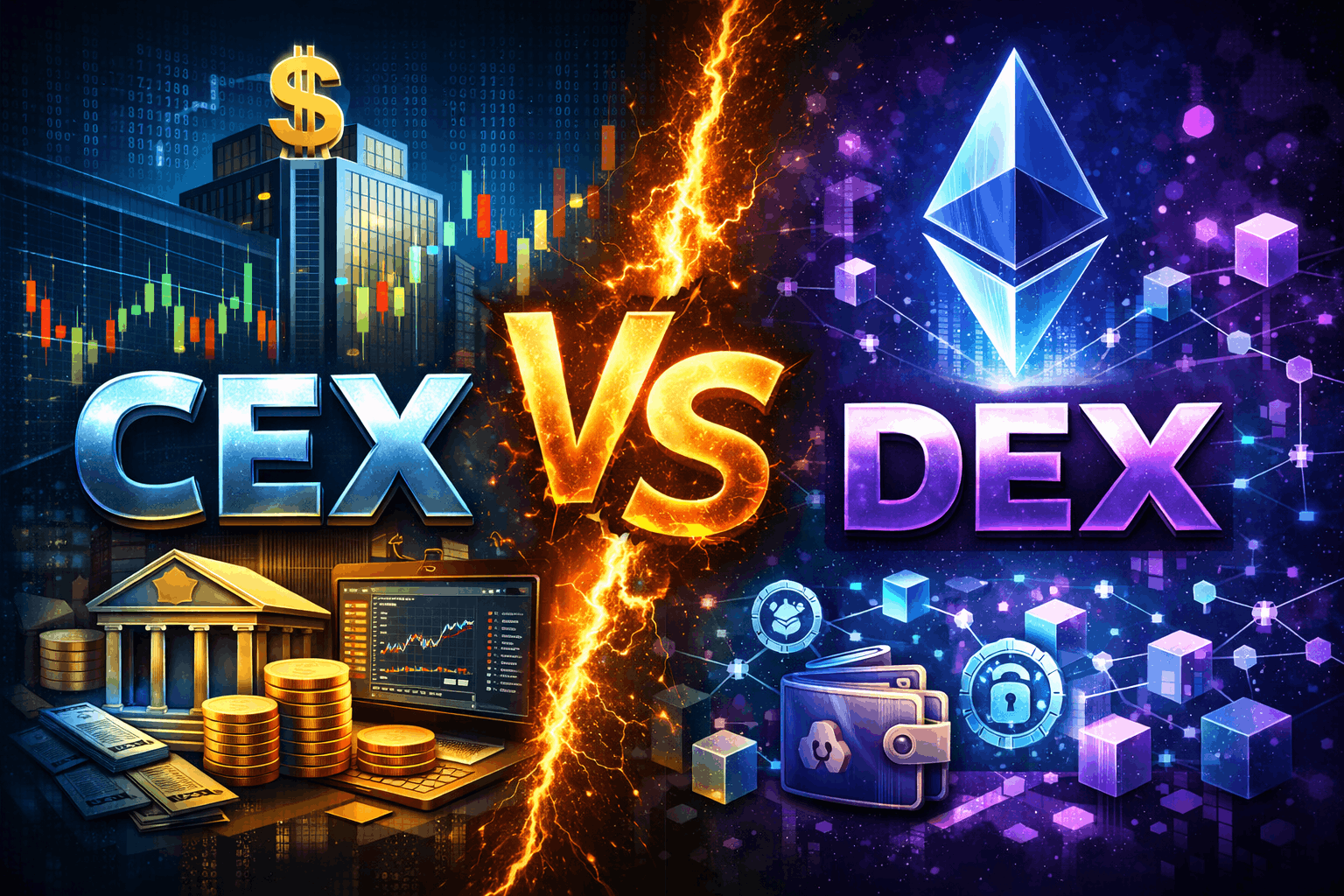
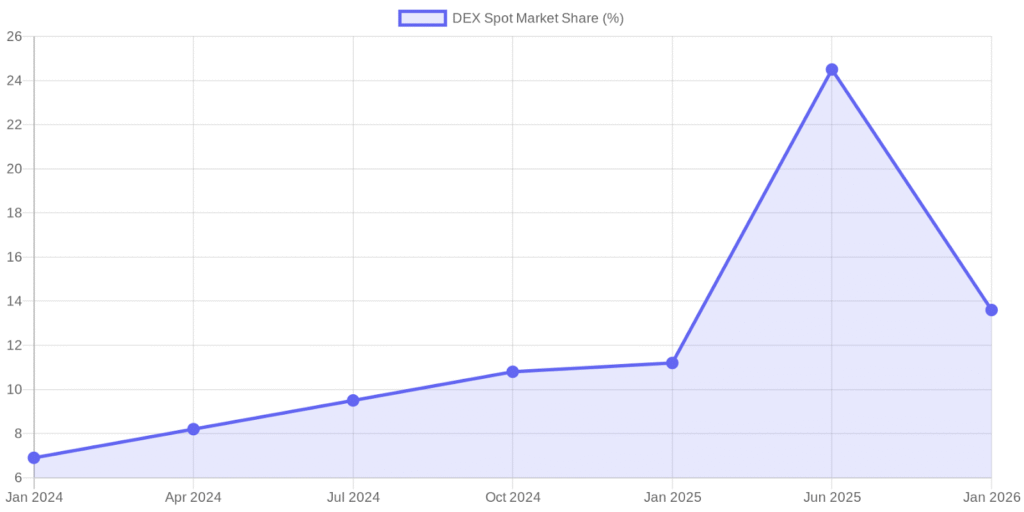
DEX spot market share nearly doubled in two years — climbing from 6.9% in January 2024 to 13.6% in January 2026 (CoinGecko CEX & DEX Report, 2026). That shift matters because most traders still default to a centralized exchange without thinking through what they’re trading away. Both exchange types have real advantages and genuine risks. Which one fits you depends on what you value most.
A CEX (centralized exchange) is run by a company that holds your crypto and matches trades for you — fast, easy, and fiat-friendly. A DEX (decentralized exchange) uses smart contracts so you trade directly from your own wallet, with no middleman and no KYC. DEX spot volume hit $231 billion per month in January 2026 (CoinGecko, 2026), proving this isn’t a niche product anymore. Most experienced traders use both.
What Is a Centralized Exchange (CEX)?
A centralized exchange is a company-operated platform that holds your crypto on your behalf, manages an internal order book off-chain, and acts as the middleman for every trade. Binance’s matching engine processes more than 1.4 million orders per second (Binance Tech Blog, 2024) — that speed is only possible because one organization controls all the infrastructure.
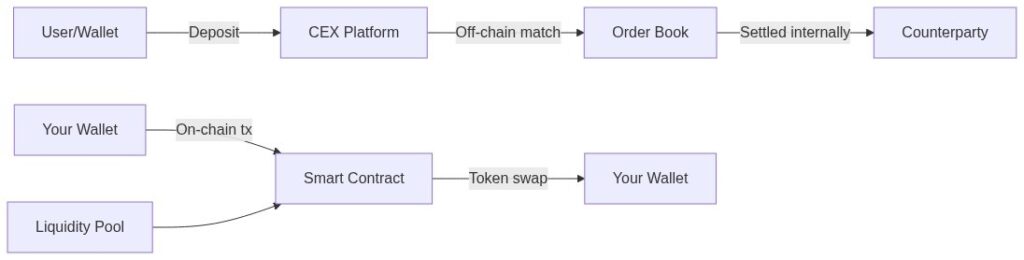
Think of a CEX like a traditional stock brokerage. You deposit funds, the platform holds them, and you place orders through their system. You don’t interact directly with the blockchain for each trade. Everything settles internally, which is why execution feels instant.
The catch? You don’t actually own your crypto until you withdraw it to a personal wallet. The exchange holds the private keys. “Not your keys, not your coins” — that phrase exists because of CEXs.
How Does a CEX Work?
When you buy ETH on a CEX, here’s what actually happens: the exchange matches your buy order with a seller’s order from their internal order book. The funds move between internal accounts — no blockchain transaction occurs. The blockchain only gets involved when you deposit or withdraw.
This off-chain matching is why CEXs are fast. It’s also why they’re custodial. The exchange becomes a trusted third party holding an IOU to you, not actual crypto.
Examples of Centralized Exchanges
The biggest CEXs by trading volume include Binance, Coinbase, OKX, Kraken, and KuCoin. They differ in fee structures, supported assets, and regulatory compliance — but all share the same fundamental model: the company holds your funds.
What Is a Decentralized Exchange (DEX)?
A decentralized exchange uses smart contracts — self-executing code on a blockchain — to enable peer-to-peer trades directly between wallets. No company holds your funds at any point. Monthly DEX spot trading volume surpassed $231 billion in January 2026 (CoinGecko, 2026), up from $95.86 billion in January 2024. This is real scale — not a theoretical concept.
You keep your crypto in your own wallet (MetaMask, Trust Wallet, etc.) and connect it to the DEX interface. When you swap tokens, a smart contract executes the trade, the tokens move between wallets, and the transaction is recorded permanently on-chain. No account needed. No ID verification. No withdrawal wait times.
How Does a DEX Work?
Instead of a traditional order book managed by a company, most DEXs use liquidity pools. Users (called liquidity providers, or LPs) deposit token pairs into these pools and earn a share of trading fees in return. When you swap tokens, you trade against the pool — not against another individual buyer or seller.
The smart contract calculates the exchange rate based on the ratio of assets in the pool, executes the swap, and the transaction confirms on-chain. Everything is transparent and auditable by anyone.
What Is an Automated Market Maker (AMM)?
An automated market maker (AMM) is the pricing algorithm behind most DEXs. The most common version — used by Uniswap — maintains a constant product formula: x × y = k, where x and y are the two token reserves and k stays constant. When someone buys token A, the supply of A decreases and the price rises automatically to maintain the formula.
AMMs replaced traditional order books for DEXs. They work without requiring matched buyers and sellers, which means liquidity is always available — as long as the pool has funds. The trade-off is price impact: large trades can move the price significantly in thin pools, a phenomenon called slippage.
Examples of Decentralized Exchanges
The largest DEXs by volume include Uniswap (Ethereum and multi-chain), PancakeSwap (BNB Chain), Curve Finance (stablecoins), dYdX (perpetuals), and Hyperliquid. Uniswap and PancakeSwap each recorded roughly $550 billion in cumulative spot volume over the six months from August 2025 to January 2026 (CoinGecko, 2026).
CEX vs DEX: Key Differences at a Glance
| Feature | CEX | DEX |
|---|---|---|
| Custody | Exchange holds your funds | You hold your funds (self-custody) |
| KYC / ID verification | Required on most platforms | Not required |
| Transaction speed | Near-instant (off-chain matching) | Slower — depends on blockchain confirmation times |
| Fiat support | Yes — deposit USD, EUR, GBP etc. | Rare — usually crypto-to-crypto only |
| Liquidity | Generally higher | Lower, though growing fast |
| Privacy | Low — full identity verification | High — wallet address only |
| Access to new tokens | Limited — listing process required | Broad — any token with a liquidity pool |
| Customer support | Yes | None |
| Typical fee | 0.1–0.5% trading fee | Gas fee + 0.05–0.3% swap fee |
| Smart contract risk | No | Yes |
What Are the Pros and Cons of a CEX?
CEXs dominate global crypto volume for a reason. They’re designed to be accessible — and they mostly deliver on that promise.
Advantages of Using a CEX
High liquidity. On Binance or Coinbase, you can trade hundreds of millions of dollars without moving the market. Deep order books mean you get fills close to the quoted price. For serious traders executing large positions, this matters.
Fiat on-ramp. You can deposit dollars, euros, or pounds directly from a bank account or card. This is the most practical way for most people to buy their first crypto. DEXs still can’t do this — you need existing crypto to use one.
Fast execution. Off-chain order matching means trades settle in milliseconds. For day traders or anyone doing technical analysis with tight entries, this speed is important.
User-friendly interface. CEXs have invested heavily in UX. You get charts, mobile apps, portfolio tracking, and customer support. For newcomers, this removes a lot of friction.
Advanced trading features. Spot, futures, options, margin trading, staking, copy trading — it’s all on one platform. DEXs are catching up on perpetuals, but CEXs still have a broader product suite.
Drawbacks of Using a CEX
Custody risk. This is the big one. When the exchange holds your private keys, you’re trusting them completely. FTX had millions of users. In November 2022, it filed for bankruptcy and froze all withdrawals — users lost access to roughly $8 billion (Reuters, 2022). That wasn’t a hack. It was mismanagement of funds that customers trusted them with.
KYC and privacy. Every major CEX requires identity verification — passport, driving licence, selfie. Your trading history is tied to your identity and stored by the exchange. For users who value financial privacy, this is a dealbreaker.
Regulatory exposure. Governments can freeze exchange accounts, force withdrawals, or shut down operations entirely. If your CEX operates in a regulated jurisdiction and you’re flagged for any reason, access to your funds can be suspended.
Withdrawal limits and delays. Many CEXs impose withdrawal limits, especially on fiat. Getting large amounts out can involve security checks, delays, and fees.
What Are the Pros and Cons of a DEX?
DEXs give you something a CEX fundamentally cannot: full control of your crypto at all times. That’s powerful. It’s also more demanding.
Advantages of Using a DEX
Self-custody. Your private keys never leave your wallet. No exchange can freeze your funds, go bankrupt, or mismanage your assets. You are the only counterparty risk — which is exactly the point of crypto for many people.
No KYC. Connect a wallet, start trading. No passport upload, no waiting period, no rejected verification. This makes DEXs accessible to anyone with an internet connection, regardless of location.
Access to new and niche tokens. New DeFi projects, memecoins, and early-stage tokens typically launch on DEXs long before they’re listed on centralized exchanges. If you want in before the crowd, a DEX is often your only option.
Transparency. Every trade, every liquidity pool, every smart contract — it’s all on-chain and publicly verifiable. There’s no hidden order book, no internal manipulation, no “we’ll tell you later” about fees.
Drawbacks of Using a DEX
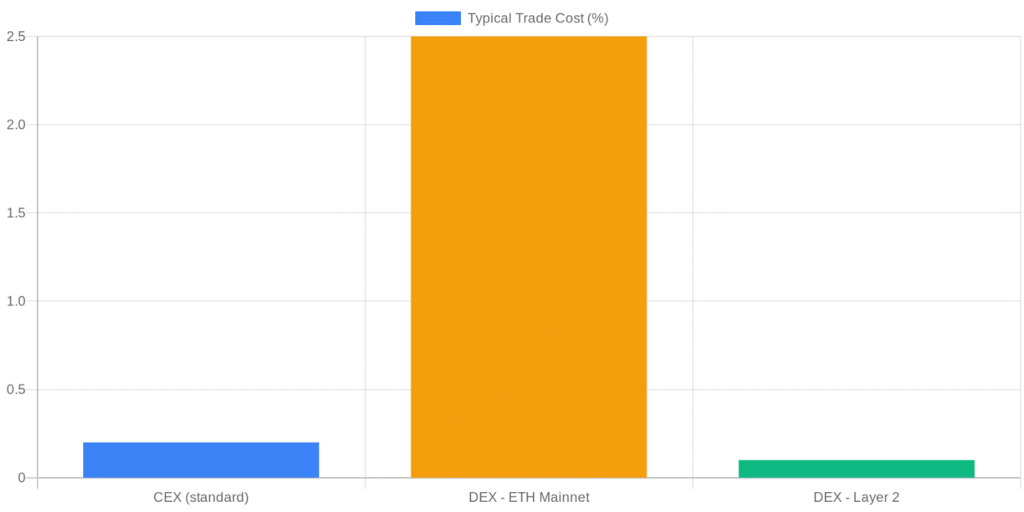
Gas fees. Trading on Ethereum mainnet means paying gas — and during peak congestion, gas can exceed the value of a small trade. Layer 2 networks (Arbitrum, Base, Optimism) have significantly reduced this, but it’s still a consideration.
Slippage on thin pools. Low-liquidity token pairs can have wide slippage — you expect to buy at $1.00 and end up paying $1.08 because the pool is small. You need to set slippage tolerance carefully.
Complexity. Connecting a wallet, approving token contracts, managing gas — this isn’t hard once you’ve done it, but the first time can be confusing. There’s no customer support to call if something goes wrong.
Smart contract risk. A flaw in the DEX’s smart contract code can be exploited by attackers. The 2021 Poly Network hack drained over $600 million (Chainalysis Crypto Crime Report, 2021) — the attacker exploited a logic flaw in cross-chain smart contracts. Audits reduce this risk but don’t eliminate it.
MEV (Maximal Extractable Value). On-chain DEX trades are publicly visible in the mempool before they confirm. Bots can front-run your transaction — inserting their own trade just before yours to profit from the price movement your trade will cause. This is mostly a problem on Ethereum mainnet for large trades.
Which Is Safer — CEX or DEX?
Neither is categorically safer — they have different risk profiles, and which matters more depends on you.
A 2025 academic review of cryptocurrency exchange incidents from 2009 to 2024 found that CEXs have historically been the primary target of large-scale hacks, accounting for the majority of total funds stolen from exchanges (Frontiers in Blockchain, 2025). The reason is simple: centralized custody creates a single target. Compromise the exchange’s hot wallet and you can drain millions of users’ funds in one operation.
DEXs shift that risk. You’re exposed to smart contract vulnerabilities and your own key management — not exchange insolvency or corporate mismanagement. But those risks are real too. Bridge exploits and smart contract bugs have caused hundreds of millions in losses across DeFi protocols.
“The primary risk of CEXs is custodial risk — if the exchange fails or is hacked, users can lose funds they believed were safely held,” notes the FCA’s guidance on crypto asset consumer risks (FCA, 2024). On a DEX, you carry that risk yourself.
The practical takeaway: If you’re holding significant amounts long-term, keeping funds on a CEX is unnecessary risk — move to a hardware wallet or at least a self-custody software wallet. If you’re actively trading small to medium amounts, a reputable CEX with strong security history is a legitimate choice. Check the best crypto wallets if you’re moving toward self-custody.
I learned this distinction the hard way. When I first started buying crypto, I left everything on the exchange because it felt simpler — like leaving money in a savings account. Then a platform I used froze withdrawals during a market panic. Nothing was stolen, the money came back weeks later, but the feeling of not being able to access your own funds is genuinely unsettling. That’s when I started taking self-custody seriously.
Are CEX Fees Higher Than DEX Fees?
It depends on which network you’re using — but on Layer 2 networks, DEX fees are often significantly lower than CEX fees.
On a CEX like Binance, the standard trading fee is 0.1% per trade (lower with BNB discounts or high volume tiers). Coinbase charges 0–0.6% depending on your plan. These are predictable, fixed percentage costs.
On a DEX, your costs have two components: the swap fee (typically 0.05–0.3% depending on the pool) and gas fees. On Ethereum mainnet, gas during peak times can make small trades uneconomic — a $50 trade with $8 in gas isn’t efficient. But on Layer 2 networks like Arbitrum or Base, gas costs have dropped to fractions of a cent, making DEX fees genuinely competitive.
For stable-to-stable swaps on Curve Finance, fees are as low as 0.01–0.04%. That’s cheaper than most CEXs. For less liquid pairs on Uniswap V3, you might pay 0.3% or 1% — plus gas.
So: for common token pairs on Layer 2, DEX fees can beat CEX fees. For Ethereum mainnet trades under $500, the math often favours the CEX.
Should You Use a CEX, a DEX, or Both?
Most serious crypto users end up using both — they just use them for different things.
Use a CEX if:
- You’re buying crypto with fiat for the first time
- You need fiat off-ramps (converting crypto back to your bank account)
- You’re day trading and need fast execution with deep liquidity
- You prefer a simple interface with customer support
- You’re trading BTC, ETH, or major altcoins with plenty of CEX liquidity
Use a DEX if:
- You want self-custody and don’t trust keeping funds on an exchange
- You want access to new tokens before they’re listed on CEXs
- You’re interacting with DeFi protocols (yield farming, lending, liquidity provision)
- Privacy matters to you and you don’t want to complete KYC
- You’re trading on Ethereum Layer 2 where gas fees are low
Use both if:
- You buy with fiat on a CEX, withdraw to a wallet, then trade on DEXs
- You keep a trading float on a CEX for active positions and hold long-term assets in self-custody
- You want the best token access (CEX for majors, DEX for early-stage projects)
If you’re just starting out, a CEX is the right first step. Once you’re comfortable with how wallets work, explore DEXs — even connecting a wallet to Uniswap once gives you a sense of how the self-custody model actually works in practice. Tradelize’s crypto exchange reviews and copy trading guides can help you evaluate platforms before committing funds.
The Bottom Line on CEX vs DEX
CEX and DEX are different tools for different situations, not competing alternatives where one is objectively better. CEXs offer fiat access, deep liquidity, and ease of use at the cost of custody and privacy. DEXs offer self-custody, permissionless access, and transparency at the cost of complexity and gas fees. DEX spot volume hit $231 billion per month in January 2026 (CoinGecko, 2026) — the gap in scale is shrinking fast. Understanding both puts you in a better position to choose the right platform for each trade you make. Start with our exchange reviews to find the right CEX for your needs.
Frequently Asked Questions
Do I need a wallet to use a CEX? No. A CEX creates an internal account for you — you deposit fiat or crypto to the exchange’s wallet, and they manage custody. You only need a personal wallet if you want to withdraw funds to self-custody, which is generally recommended for anything you plan to hold long-term.
Can I buy crypto with fiat on a DEX? Not directly. DEXs operate crypto-to-crypto only — you need to already own some crypto (usually ETH or a stablecoin on the same network) to begin trading. The usual route is to buy on a CEX first, withdraw to a wallet, then connect that wallet to a DEX.
Which is cheaper — CEX or DEX? On Layer 2 networks (Arbitrum, Base, Optimism), DEX total costs (swap fee + gas) can undercut CEX trading fees for medium-to-large trades. On Ethereum mainnet, high gas fees often make CEXs cheaper for small trades. For most new users trading common pairs, CEX fees are more predictable.
Can I use both a CEX and a DEX? Absolutely — and most active crypto users do. A common workflow is buying with fiat on a CEX, withdrawing to a personal wallet, and then trading or earning yield through DEXs and DeFi protocols. The two models complement each other more than they compete.
Is KYC required on a DEX? Currently, no — most DEXs only require a connected wallet. However, regulatory frameworks in the EU and US are evolving, and some jurisdictions are beginning to explore KYC requirements for DEX front-end operators. The underlying smart contracts remain permissionless, but the interfaces may face compliance requirements in the future.

Our Review Methodology
We evaluate each post based on thorough research, credibility of sources, accuracy of information, and relevance to our readers. Our editorial team follows strict guidelines to ensure all content meets high standards of quality.
Disclaimer
The content in this article is provided for informational purposes only and does not constitute financial, investment, or professional advice. Always do your own research before making any decisions.