If you want to buy Bitcoin or trade Ethereum for Solana, you need one thing: a crypto exchange. It’s the gateway — the marketplace that makes every trade possible. But not all exchanges are built the same, and the differences matter more than most beginners realize.
Whether you’re just starting out or trying to understand why your exchange charged you a fee you didn’t expect, this guide covers how crypto exchanges work, the main types, what you should be looking for, and what to watch out for.
A cryptocurrency exchange is an online marketplace where you buy, sell, and trade digital assets. The global market reached $33.42 billion in 2024 (Straits Research, 2025). Centralized exchanges (CEXs) account for 87.4% of trading volume, while decentralized exchanges (DEXs) captured roughly 20% of spot trading by Q3 2025. There are three main types: CEX, DEX, and hybrid — and each comes with different trade-offs on security, privacy, and ease of use.
What Is a Crypto Exchange?
A cryptocurrency exchange is a digital marketplace where buyers and sellers trade cryptocurrencies — either for fiat currencies like USD or EUR, or for other digital assets. The global exchange platform market was valued at $33.42 billion in 2024 and is expected to reach $37.23 billion by the end of 2025 (Straits Research, 2025). More than 580 million people worldwide now use crypto platforms.
Think of it like a stock exchange, but running 24 hours a day, seven days a week, with no central clearing house or single regulator overseeing it all. You create an account, deposit funds, and start trading. The platform handles the matching — you don’t have to go find someone willing to sell you Bitcoin at your price.
The first dedicated crypto exchange — Bitcoin Market — launched on March 17, 2010. Since then, hundreds of platforms have emerged, from household names like Binance and Coinbase to niche exchanges built for specific assets or trading strategies.
How Does a Crypto Exchange Work?
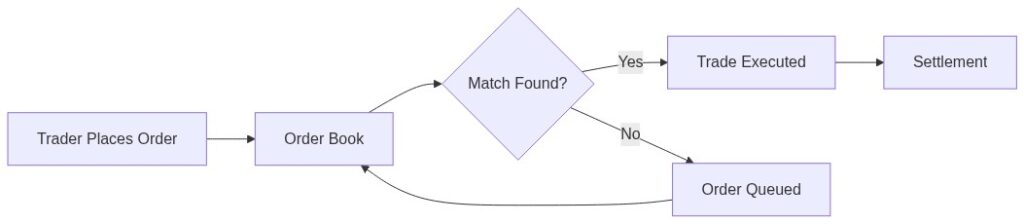
Most crypto exchanges operate on an order book system — a live ledger of every open buy and sell order on the platform. When you place an order, the exchange’s matching engine scans the order book and pairs your trade with the best available counterparty. Average daily spot trading volume across centralized exchanges hovered around $146 billion throughout 2025 (CoinLaw, 2025), which means that matching engine is working hard.
The mechanics are straightforward. You decide what you want to buy or sell, at what price, and in what quantity. The platform either executes your trade immediately or queues it until a match appears. In most cases, this happens in milliseconds.
The Order Book
The order book is the engine under the hood. It lists every open buy order (called “bids”) and every open sell order (called “asks”) sorted by price. When a bid and an ask meet at the same price, a trade executes. The spread — the gap between the highest bid and the lowest ask — tells you how liquid a market is. Tighter spread means more buyers and sellers are active.
On top centralized exchanges, bid-ask spreads for major pairs like BTC/USDT run around 0.04%. On decentralized exchanges, even the best liquidity pools show spreads closer to 0.12% (CoinLaw, 2025). That gap adds up fast for active traders.
Market Orders vs. Limit Orders
Two order types cover most situations. Market orders fill immediately at the best available price — fast, but you get whatever the market offers at that moment. Limit orders let you set your price. You say “I’ll buy 1 ETH at $2,800” and the order sits open until someone sells at that price, or you cancel it.
Limit orders give you control. Market orders give you speed. Most active traders use both depending on the situation.
What Are the Main Types of Crypto Exchanges?
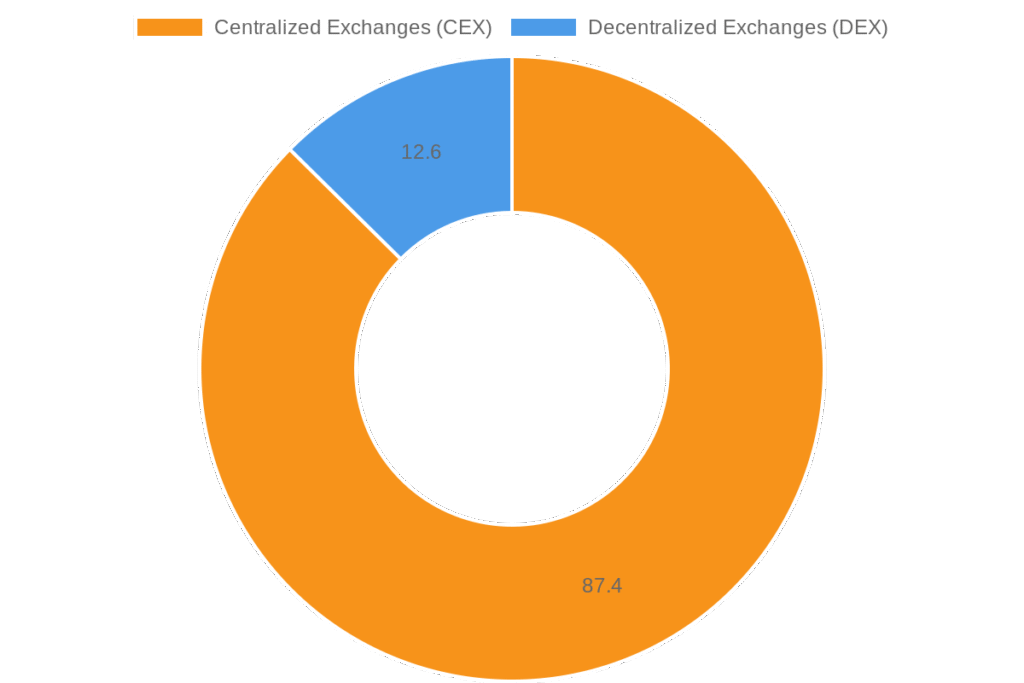
There are three main types: centralized exchanges, decentralized exchanges, and hybrid platforms. CEXs dominate — as of 2025, they hold an estimated 87.4% of total trading volume, with Binance alone accounting for 38.3% of the top 10 CEX market share (CoinLaw, 2025). But DEXs are growing fast, going from roughly 10% of spot trading in 2024 to 20% by Q3 2025.
Centralized Exchanges (CEX)
A centralized exchange is run by a company. That company manages the order book, holds customer funds in custody, handles KYC (Know Your Customer) verification, and provides support if something goes wrong. Binance, Coinbase, Kraken, and Bybit are the biggest names.
CEXs are easier to use, support fiat deposits and withdrawals, and typically offer deeper liquidity. The downside? You’re trusting the exchange with your funds. The collapses of FTX in 2022 and Mt. Gox in 2014 are the starkest reminders of what happens when that trust breaks.
Decentralized Exchanges (DEX)
A decentralized exchange cuts out the intermediary. Trades happen directly between users via smart contracts on a blockchain. No company holds your funds. No KYC required. Uniswap, dYdX, and Curve Finance are the leading examples.
The privacy trade-off is obvious. But DEXs come with real downsides: slower execution, higher gas fees during network congestion, and smart contract vulnerabilities that have cost users hundreds of millions of dollars in exploits. They also don’t support fiat — you need crypto to use one.
Hybrid Exchanges
Hybrid platforms try to combine the best of both. Think: CEX-level user experience with some non-custodial features. It’s a harder problem than it sounds, which is why most hybrids still fall clearly on one side of the spectrum. Some platforms describe themselves as hybrid mainly for marketing reasons.
What Is a Centralized Exchange? A Closer Look
Understanding what a centralized exchange actually does under the hood helps you use one better. When you deposit funds to a CEX, you’re not holding crypto — you’re holding an IOU. The exchange controls the private keys. “Not your keys, not your coins” is the phrase the crypto community uses. It’s blunt, but accurate.
The advantage is speed and features. Centralized exchanges run their own matching engines off-chain, which is why Binance can handle over 1.4 million orders per second. An on-chain DEX transaction has to wait for a block confirmation, which adds seconds — sometimes minutes — to every trade.
CEXs also act as your on-ramp. Want to buy Bitcoin with a credit card or bank transfer? You need a CEX. DEXs don’t accept fiat. That makes CEXs the entry point for most people getting into crypto for the first time.
For traders who want to go beyond basic buying and selling — margin trading, futures, copy trading, staking — centralized platforms generally offer the most options. If you’re exploring copy trading, for example, you’ll find the bulk of copy trading infrastructure on CEXs where trade data is public and replicable.
What Fees Do Crypto Exchanges Charge?
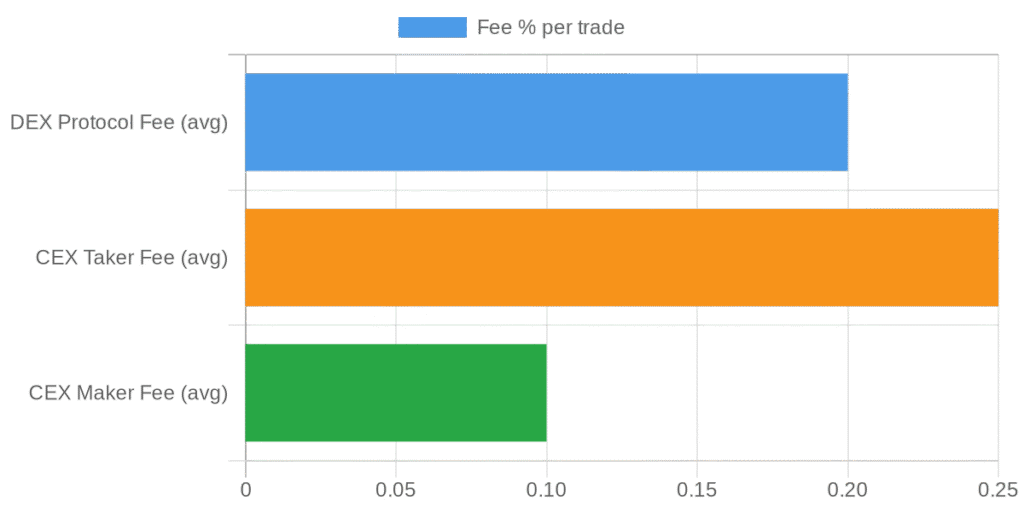
Fees vary significantly across platforms, but most exchanges use some version of a maker-taker model. Makers add liquidity to the order book (limit orders that don’t fill immediately). Takers remove liquidity (market orders, or limit orders that fill right away). Takers typically pay more.
Standard fees on major CEXs range from 0.1% to 0.5% per trade for retail users, with discounts for higher volume or holding the exchange’s native token. On DEXs, you pay protocol fees (usually 0.05%–0.3%) plus gas fees — transaction costs charged by the underlying blockchain, which can spike dramatically during high network congestion.
Beyond trading fees, watch for: withdrawal fees (charged per transaction when moving crypto off the platform), deposit fees (rare but exist on some fiat deposit methods), and spread-based fees on instant buy/sell features, which are often more expensive than using the order book directly.
Is a Crypto Exchange Safe to Use?
Safety is the right thing to obsess over here. The short answer: reputable exchanges with proper security infrastructure are reasonably safe. But the risk is never zero, and the history of crypto is littered with exchange failures, hacks, and rug pulls.
Centralized exchanges have lost billions in funds to hacks — Bybit’s $1.5 billion hack in February 2025 is the most recent major example. A well-run CEX mitigates this through cold storage (keeping the majority of funds in offline wallets), multi-signature withdrawal systems, and insurance funds. Look for platforms that hold 95%+ of user assets in cold storage and publish proof-of-reserves.
Regulatory oversight adds another layer. Exchanges operating under licenses from the FCA (UK), FinCEN (US), or MiCA-compliant jurisdictions face mandatory capital requirements and security audits. Unregulated exchanges offer none of those protections.
For most users, the practical security checklist is simple: enable 2FA on your account, use a hardware wallet for long-term holdings, and never leave more on an exchange than you’re actively trading. Those three habits eliminate the majority of personal risk.
Crypto Exchange vs. Crypto Wallet: What’s the Difference?
These two concepts confuse a lot of beginners. They’re different tools that serve different purposes.
A crypto exchange is where you trade. It’s a marketplace. When you buy BTC on Binance, the exchange holds it in a custodial wallet on your behalf — you see a balance, but the private keys belong to Binance.
A crypto wallet is where you store. It holds your private keys, giving you direct ownership and control of your assets. Wallets come in two forms: hot wallets (software, connected to the internet, like MetaMask) and cold wallets (hardware devices like Ledger or Trezor, stored offline).
You can use both together. Most people do: buy on an exchange, then withdraw to a personal wallet for anything you’re not actively trading. If you’re reviewing platforms and trying to decide what tools you need, the exchange review hub at Tradelize covers the top options with comparisons on custody, security, and supported assets.
How to Choose the Right Crypto Exchange
Start with regulatory status. Is the exchange licensed in your country? Does it have a verifiable compliance track record? No license is a yellow flag at minimum.
After that, these are the criteria that actually matter:
- Supported assets: Does it list the cryptocurrencies you want to trade? Some exchanges focus on major coins; others list hundreds of altcoins.
- Liquidity: Thin order books mean bad prices. Check 24-hour trading volume for the pairs you care about — deeper markets give you better execution.
- Fee structure: Compare maker-taker rates at your expected trading volume. The difference between 0.1% and 0.25% is significant over hundreds of trades.
- Fiat access: Can you deposit and withdraw in your local currency? What are the methods (bank transfer, card, PayPal)?
- Security history: Has the exchange ever been hacked? How did they respond? Do they publish proof-of-reserves?
- UX: This matters more than it should. A platform that’s confusing to navigate leads to costly mistakes.
For beginners, the priority is simplicity and fiat access. Coinbase and Kraken rank well on both. For active traders, fee structure and liquidity take over as the dominant criteria. For privacy-conscious users, a reputable DEX may be worth the learning curve.
The first time you wire money to an exchange, the verification process feels slow and invasive. ID scans, selfies, waiting periods. It took me three days to get fully verified on one platform before I could trade. But that friction is the exchange doing its job — proper KYC is what keeps exchanges operational and legally compliant. Once you’re through it, the process doesn’t repeat.
The Bottom Line on Crypto Exchanges
A crypto exchange is the entry point for anyone buying, selling, or trading digital assets. Centralized exchanges run the market — holding 87.4% of volume — because they offer the simplest onboarding, the deepest liquidity, and fiat access that DEXs can’t match (CoinLaw, 2025). DEXs are growing, now handling roughly one in five spot trades, and matter for users who prioritize custody and privacy.
The choice between CEX and DEX isn’t about which is “better” — it’s about what you need. Most traders use both. Pick a reputable CEX with strong security practices and regulatory oversight to start, then explore DEXs once you’re comfortable managing your own keys. For in-depth platform comparisons, the Tradelize exchange review hub is a useful starting point.
Frequently Asked Questions
What is the difference between a centralized and decentralized crypto exchange?
A centralized exchange (CEX) is run by a company that holds your funds and manages trading on your behalf — easier to use, with fiat support and customer service. A decentralized exchange (DEX) runs on smart contracts with no intermediary, giving you full custody of your assets but requiring more technical knowledge to navigate.
Do I need a crypto exchange to buy Bitcoin?
Yes, in most cases. Crypto exchanges are the primary way most people purchase Bitcoin with fiat currency. You create an account, complete identity verification, deposit funds via bank transfer or card, and buy BTC directly. P2P platforms and Bitcoin ATMs are alternatives, but exchanges offer the best prices and liquidity for most buyers.
Is a crypto exchange the same as a crypto wallet?
No. An exchange is where you trade crypto. A wallet is where you store it and control your private keys. Most exchanges provide a built-in custodial wallet, meaning they hold your keys for you — convenient, but not full ownership. For long-term storage, transferring assets to a personal hardware wallet gives you direct control.
What fees do crypto exchanges typically charge?
Most major centralized exchanges charge 0.1%–0.5% per trade using a maker-taker model, with lower rates for higher trading volumes or holding the platform’s native token. Withdrawal fees vary by asset. Decentralized exchanges charge protocol fees (typically 0.05%–0.3%) plus variable blockchain gas fees that can spike during network congestion.
Which crypto exchange is best for beginners?
Beginners typically do best on exchanges with clean interfaces, strong regulatory credentials, and easy fiat onboarding. Coinbase, Kraken, and Gemini are commonly recommended for US-based users; Bitstamp and Kraken have strong reputations in Europe. The most important criteria: regulatory compliance, proof-of-reserves transparency, and a fee structure that doesn’t punish small trade sizes.

Our Review Methodology
We evaluate each post based on thorough research, credibility of sources, accuracy of information, and relevance to our readers. Our editorial team follows strict guidelines to ensure all content meets high standards of quality.
Disclaimer
The content in this article is provided for informational purposes only and does not constitute financial, investment, or professional advice. Always do your own research before making any decisions.