Swing trading crypto means holding a position for days to weeks, aiming to capture one directional price move before it reverses. With Bitcoin's annualized volatility running around 54%, compared to 15.1% for gold and 10.5% for equities (iShares/BlackRock, 2025), the swings in crypto are bigger, faster, and more frequent than in any other asset class. That's what makes swing trading attractive here. It's also what makes it dangerous without a plan.
This isn't day trading's frantic pace, and it's not the passive patience of long-term holding. Swing trading sits in between. Active enough to capture meaningful moves, passive enough that you're not glued to charts all day. You analyze, enter, set your stops, and check in once or twice daily. For participants who want exposure to cryptocurrency markets without the exhaustion, that's the draw.
"The defining characteristic that separates the consistent winners from everyone else is this: the winners have attained a mind-set that allows them to remain disciplined, focused, and, above all, confident in spite of the adverse conditions," explains Mark Douglas, trading psychologist and author of Trading in the Zone.
Swing trading crypto involves holding positions for days to weeks to capture mid-term price moves. With Bitcoin's 54% annualized volatility (BlackRock, 2025), the strategy offers substantial profit potential, but requires disciplined risk management, technical analysis skills, and emotional control. Most traders target 10-30% gains per trade with strict stop-losses.
What Is Swing Trading in Crypto?
According to the CoinGecko 2025 Annual Report, crypto markets averaged $161.8 billion in daily trading volume at their 2025 peak. Swing traders look to profit from the multi-day price movements that this volume creates, holding positions anywhere from two days to several weeks.
The concept is straightforward. Markets don't move in straight lines. They trend upward, pull back, consolidate, then push again. A swing trader identifies the beginning of one of these moves, enters a position, rides the momentum, and exits before the reversal eats into profits.
What separates this approach from alternatives? Time horizon. A day trader opens and closes positions within hours, sometimes minutes. A position trader maintains holdings for months. A long-term holder (HODLer in crypto speak) purchases and forgets about it for years. Swing practitioners occupy the middle ground.
| Trading Style | Holding Period | Time Commitment | Primary Analysis |
|---|---|---|---|
| Day Trading | Minutes to hours | Very high (all day) | Technical, short timeframes |
| Swing Trading | Days to weeks | Moderate (1-2 checks/day) | Technical + some fundamental |
| Position Trading | Weeks to months | Low | Fundamental + macro |
| HODLing | Months to years | Very low | Fundamental conviction |
One thing makes crypto swing trading different from stock swing trading: crypto markets run 24/7/365. There's no closing bell, no weekend break. That constant operation means gaps are rare, but it also means a trade can move against you while you sleep. More on managing that risk later.
How Does Swing Trading Compare to Day Trading and HODLing?
The practical difference between these approaches boils down to how you allocate your hours and handle downside exposure. According to a study tracking over 450,000 traders on the Taiwan Stock Exchange, only 0.88% were consistently profitable. Day traders faced even worse odds due to the frequency of their trades and compounding fees.
Intraday speculation sounds exciting. You're in and out, locking in quick profits. Here's what people don't mention: the screen time is brutal. Professional scalpers and day-frequency operators sit in front of charts for 6-10 hours. They're reacting to every candle, every volume spike. Commission and exchange fees accumulate rapidly when you're executing dozens of orders daily. And the psychological burden of rapid gains and losses erodes focus over time.
Swing trading flips that dynamic. You perform your research when activity is quiet, configure your entries and stops, then walk away. Maybe you review the position morning and evening. That's it. The per-trade profit potential is actually higher because you're capturing larger moves — typically targeting 10-30% rather than the 1-3% a day trader pursues.
HODLing is the opposite extreme. You buy Bitcoin or Ethereum, put it in cold storage, and come back in a few years. Sounds easy, but consider this: Bitcoin fell from its all-time high near $126,000 in October 2025 to below $60,000 by February 2026, a 50% decline in four months (CoinGecko, 2025). A HODLer rides that entire drawdown. A swing trader would've been out near the top with defined exit rules.
Neither approach is inherently better. Day trading demands your full attention. HODLing demands your patience during brutal drawdowns. Swing trading demands discipline and technical skill, but lets you keep a life outside of trading.
What Are the Best Swing Trading Strategies for Crypto?
Four strategies account for most successful crypto swing trades. Each works in different market conditions, so the real skill is knowing which one to deploy and when. No single approach works in every market.
Trend Following
This is the simplest strategy and the one beginners should learn first. You identify the direction of the prevailing trend on daily or weekly charts, then enter positions that follow it.
The mechanics: use a moving average crossover (the 50-day crossing above the 200-day is a classic bullish signal) or trendline breaks to confirm direction. Enter on pullbacks to support within the trend. Set your stop-loss below the most recent swing low.
During strong trends, this approach catches the bulk of the move. It struggles in choppy, range-bound markets. That's when you stop trading it, not force it.
Support and Resistance Trading
Every asset bounces between price levels where buyers step in (support) and sellers take profits (resistance). In crypto, these levels tend to form around psychologically significant round numbers like $50,000, $60,000, and $100,000 for Bitcoin.
The play: buy near support with a stop just below it, and sell near resistance. If support breaks, you're out with a small loss. If the trade works, your risk/reward ratio is clearly defined before you enter.
Where this falls apart: during strong breakouts. If Bitcoin smashes through a resistance level with high volume, this strategy has you selling right when the biggest move begins. That's why you need more than one strategy.
Breakout Trading
When price consolidates in a narrow range and then breaks out with volume, that's a breakout trade. The compressed price action builds energy like a spring — when it releases, the move can be explosive.
Watch for chart patterns like triangles, flags, and rectangles. The breakout needs volume confirmation. A price break on low volume is usually a fake-out. Enter on the breakout candle close, set your stop below the consolidation range, and target a move equal to the height of the pattern.
For more on this strategy, see our guide on breakout trading in crypto.
Fibonacci Retracement
After a strong move, prices tend to pull back to specific levels before continuing. Fibonacci retracement plots these levels (23.6%, 38.2%, 50%, and 61.8%) based on the prior move.
The 38.2% and 61.8% levels see the most action in crypto. If Bitcoin rallies from $60,000 to $80,000, the 38.2% retracement sits at roughly $72,360. If price pulls back to that level and finds buyers, that's your entry for the next leg up.
Fibonacci works best when combined with other confluence — a Fibonacci level that also sits on horizontal support, a moving average, or a high-volume node carries more weight than a Fibonacci level alone.
Which Indicators Work Best for Crypto Swing Trading?
No single indicator tells you everything. The traders who blow up their accounts are usually the ones who follow one indicator blindly. Use two or three in combination, and let them confirm each other.
Relative Strength Index (RSI) measures momentum on a 0-100 scale. Readings above 70 suggest overbought conditions (price might pull back), below 30 suggests oversold (price might bounce). In crypto, these levels hit more often than in traditional markets because of the higher volatility. Some traders adjust to 80/20 for crypto.
Moving Averages, specifically the 50-day and 200-day, show the overall trend direction. Price above both? Bullish. Below both? Bearish. The crossover between them generates signals: a "golden cross" (50 above 200) is bullish, a "death cross" (50 below 200) is bearish. Simple, but it's kept traders on the right side of major moves for decades.
MACD (Moving Average Convergence Divergence) tracks the relationship between two moving averages. When the MACD line crosses above the signal line, it's a buy signal. Histogram bars growing taller confirm strengthening momentum. Divergence between MACD and price, where price makes new highs while MACD doesn't, is a powerful reversal warning.
Bollinger Bands wrap two standard deviations around a 20-period moving average. When bands squeeze tight, a big move is coming (though not which direction). Price touching the upper band in an uptrend is normal — it means momentum is strong. A touch of the lower band can signal a buying opportunity if the overall trend is up.
Apply these indicators on the 4-hour, daily, or weekly charts. The shorter timeframes generate too much noise for swing trading.
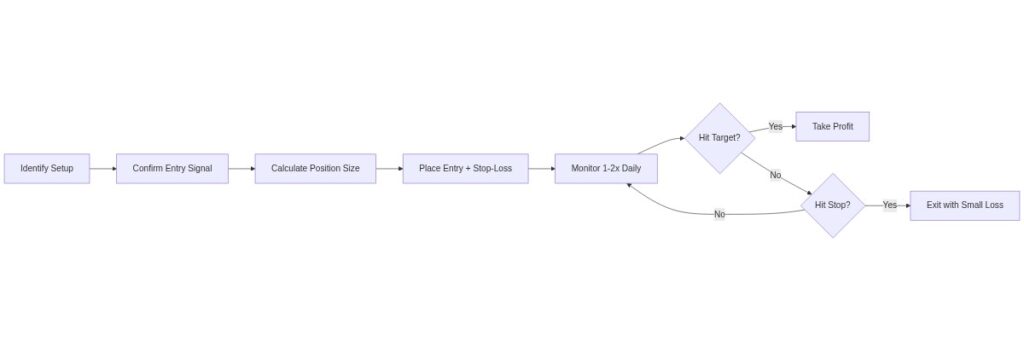
How Do You Set Up a Crypto Swing Trade Step by Step?
Setting up a swing trade follows a repeatable process. According to a Brazilian study of futures traders, 97% lost money. Most of those losses came from skipping the planning steps below or ignoring risk limits. Skip any step and you're gambling, not trading.
Step 1: Pick your market. Start with high-liquidity coins — Bitcoin and Ethereum offer the tightest spreads and most reliable chart structures. Low-cap altcoins might deliver bigger percentage moves, but they also have wider spreads and thinner order books that can trigger your stop-loss on random wicks.
Step 2: Identify the trend. Open the daily chart. Is price making higher highs and higher lows (uptrend)? Lower highs and lower lows (downtrend)? Or chopping sideways? Swing trading with the trend gives you better odds than fighting it.
Step 3: Find your entry. Look for a pullback within the trend, a support level test, or a breakout setup. Wait for confirmation — don't jump in on the first sign of a bounce. A confirmation candle (a bullish engulfing pattern, a close above resistance) reduces false entries.
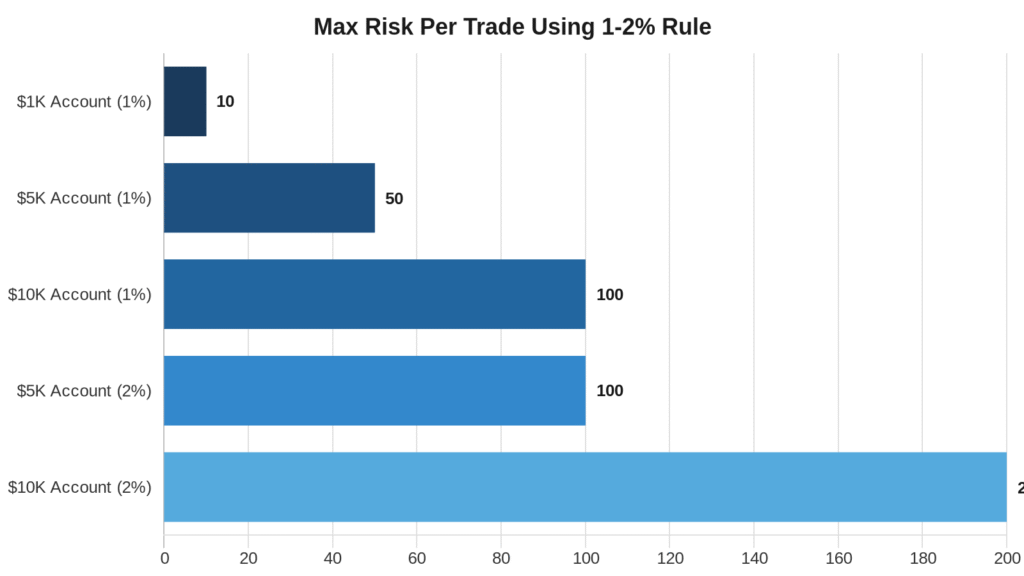
Step 4: Calculate position size. This is where most beginners get it wrong. Risk no more than 1-2% of your total account on any single trade. If you have $5,000 and you're risking 2%, that's $100 of risk. If your stop-loss is 5% below your entry, your position size is $2,000.
Step 5: Place the trade. Set your entry order, your stop-loss, and your take-profit target simultaneously. Target a 2:1 reward-to-risk ratio minimum. If you're risking $100, your target should be at least $200 in profit.
Step 6: Manage and exit. Check the trade once or twice daily. If price moves in your favor, consider trailing your stop-loss to lock in profits. Don't move your stop-loss further away to "give the trade room." That's how small losses become catastrophic ones.
New to trading? Start with a paper trading account to practice this process without risking real money.
What Are the Risks of Swing Trading Crypto?
The total crypto market capitalization dropped 23.7% in Q4 2025 alone, marking a -10.4% year-on-year decline, crypto's first annual downturn since 2022 (CoinGecko 2025 Annual Report). Swing traders were on both sides of that move: the ones with risk management survived. The ones without it didn't.
Overnight and weekend gaps. Because crypto trades 24/7, your position doesn't pause when you go to sleep. A regulatory announcement, exchange hack, or whale dump at 3 AM can move prices 10-20% before you wake up. Stop-losses help, but in extreme moves they can slip past your set price.
Emotional trading. Your trade is down 8% on day two. Do you hold because your thesis is intact? Or do you panic sell because the loss is bigger than you expected? Mark Douglas put it well: "The best traders aren't focused on being right; they're focused on executing their edge consistently." The answer should come from your plan, not your feelings.
I learned this the hard way on an ETH swing trade in late 2025. Entered at $2,800 after a clean pullback to the 50-day moving average, targeting $3,200. The setup was textbook. Then overnight news about potential stablecoin regulation hit, and ETH gapped down to $2,550. My stop was at $2,680, so I took the loss. About 1.5% of my account. Annoying, but manageable. The traders who didn't have stops watched it drop another 15% over the next week.
Overtrading. Not every chart pattern is a trade. The best swing traders take four to eight trades per month, not four per day. Forcing trades in choppy markets is the fastest way to drain an account through fees and small losses that compound.
Liquidity risk. That micro-cap altcoin with the "perfect setup" might not have enough buyers on the other side when you want to exit. Stick to coins with consistent daily volume above $100 million for reliable execution.
Regulatory risk. The SEC and CFTC issued a joint statement in September 2025 aimed at harmonizing crypto regulation (Kroll, 2025). While the direction is toward clearer rules, sudden policy shifts still move markets. The passage of the GENIUS Act stablecoin framework in July 2025 is a step toward stability, but regulatory surprises remain a real risk.
Trading involves risk. Past performance does not guarantee future results. Never risk money you can't afford to lose.
Which Cryptocurrencies Are Best for Swing Trading?
The best swing trading candidates share three characteristics: high liquidity, clear chart patterns, and enough volatility to generate meaningful moves. Not every coin qualifies.
Bitcoin (BTC) is the default choice. It has the deepest liquidity, the tightest spreads, and the most institutional participation. Its chart patterns are the most reliable because more traders watch the same levels. The downside? Percentage moves are smaller than altcoins. A 10% Bitcoin swing might take weeks, while an altcoin can do that in hours.
Ethereum (ETH) offers slightly higher volatility than Bitcoin with nearly as much liquidity. Its price action often leads altcoin rallies, making it a useful indicator for the broader market direction.
Large-cap altcoins like Solana (SOL), Cardano (ADA), and Avalanche (AVAX) provide bigger percentage swings but thinner order books. They tend to amplify Bitcoin's moves: when BTC drops 5%, these might drop 10-15%. That works both ways.
What to avoid: memecoins, tokens with less than $50 million daily volume, and newly listed coins without enough price history to analyze. The crypto market ended 2025 with memecoins losing $40 billion in market cap (CoinGecko, 2025). That's not swing trading territory. That's gambling.
When selecting coins, check the liquidity on your specific exchange. A coin might have $200 million in global volume but only $5 million on the exchange you use — that thin local order book will create slippage on your entries and exits.
To understand what drives these price moves, read our guide on what causes crypto to go up and down.
Who Should Consider Swing Trading Crypto?
Swing trading works best for traders who have some technical analysis foundation but can't or don't want to trade full time. The moderate time commitment (30-60 minutes per day for analysis and trade management) makes it practical for people with day jobs.
Good fit if you:
- Understand basic chart patterns, support/resistance, and at least two technical indicators
- Can commit to checking trades once or twice daily without obsessing
- Have capital you can afford to lose (swing trading is still speculative)
- Handle drawdowns without panic-selling
Poor fit if you:
- Need immediate gratification from every trade
- Can't stick to a stop-loss when a trade goes against you
- Want to trade with money earmarked for rent or bills
- Don't want to learn technical analysis
Beginners can absolutely start here — it's more forgiving than day trading since you have time to think through decisions. But "more forgiving" doesn't mean risk-free. Start with crypto trading basics if concepts like support, resistance, and risk management are new to you.
If you want to practice without risking real money, a paper trading account lets you test strategies in live market conditions. Most crypto brokers and exchanges offer demo accounts.
The Bottom Line on Swing Trading Crypto
Swing trading crypto captures medium-term price moves, typically targeting 10-30% gains over days to weeks, without requiring the constant screen time of day trading. With Bitcoin's annualized volatility at 54% (BlackRock, 2025), the opportunities are real, but so is the risk of significant loss without disciplined position sizing and stop-loss management.
The traders who survive long-term aren't the ones who find the perfect strategy. They're the ones who manage risk on every single trade, stick to their rules when emotions push back, and accept small losses as part of the process. That's the whole game.
Ready to build your skills? Start with paper trading crypto to test strategies risk-free, then apply what you've learned with small positions on a trusted crypto broker.
Frequently Asked Questions
Is swing trading crypto profitable?
Swing trading crypto can be profitable, but most traders lose money — a study of 450,000 traders found only 0.88% were consistently profitable. The difference is risk management: successful swing traders risk 1-2% per trade, maintain 2:1 reward-to-risk ratios, and accept that 40-50% of trades will lose. Profit comes from winning trades being larger than losing ones, not from winning every trade.
How long do swing trades typically last in crypto?
Most crypto swing trades last between two days and four weeks. The exact duration depends on the setup — a breakout trade might play out in three to five days, while a trend-following trade in a strong uptrend could run for two to three weeks. Let the chart and your target dictate when to exit, not an arbitrary time limit.
Can you start swing trading crypto with $100?
Technically yes, but it's difficult. With $100 and a 1% risk rule, you're risking $1 per trade — which barely covers trading fees on most exchanges. A more practical starting amount is $500-$1,000, which allows meaningful position sizes while keeping risk per trade manageable. Start with a paper trading account first regardless of your capital.
What is the best timeframe for swing trading crypto?
The daily chart is the primary timeframe for most crypto swing traders. It filters out intraday noise while revealing multi-day trends. Use the 4-hour chart for timing entries within setups identified on the daily. The weekly chart provides overall trend context. Avoid anything below 1-hour for swing trading; that's day trading territory.
Is swing trading better than day trading crypto?
Neither is objectively better. They suit different lifestyles. Swing trading requires 30-60 minutes daily and works for people with other commitments. Day trading demands full-time attention. Swing trading has lower transaction costs (fewer trades) and allows more thoughtful analysis. Day trading offers faster feedback and doesn't carry overnight risk. Choose based on your available time, not projected returns.

Our Review Methodology
We evaluate each post based on thorough research, credibility of sources, accuracy of information, and relevance to our readers. Our editorial team follows strict guidelines to ensure all content meets high standards of quality.
Disclaimer
The content in this article is provided for informational purposes only and does not constitute financial, investment, or professional advice. Always do your own research before making any decisions.