There’s a scene that plays out in crypto communities constantly. Someone watches Bitcoin climb for months, hesitates, watches it run higher, finally buys near the peak — then watches it drop 40%. The flip side is just as common: someone waits for a “better entry,” the price keeps running, and they never buy at all.
Dollar-cost averaging crypto exists precisely because of this. It doesn’t promise perfect entries. It doesn’t guarantee the best possible return, either — we’ll get to that. What it does is get you into the market consistently, strip out most of the timing pressure, and historically deliver solid long-term results for investors who stick with it.
Not everyone does stick with it, though. People DCA into tokens with no fundamentals. They over-diversify into 20 altcoins with $50 per week. They keep buying the wrong assets and stop during the bear markets where discipline matters most. This guide covers the whole picture, including the parts most DCA explainers quietly skip over.
Dollar-cost averaging crypto strategy (DCA) means investing a fixed amount in crypto at regular intervals, regardless of price. It doesn’t always beat lump-sum investing, but for most people managing volatility and building long-term positions, it’s the most practical approach available.
How Does Dollar-Cost Averaging Work in Crypto?
In a 2024 survey of active crypto investors, Kraken found that 59.13% identified DCA as their primary investment strategy, with reduced volatility exposure cited as the leading reason (Kraken, 2024). That figure matters because it represents deliberate choice, not passive default.
The mechanics are straightforward. Say you plan to invest $1,200 in Bitcoin over a year. Instead of buying $1,200 worth at once, you buy $100 each month. Some months you’ll buy at $90,000 per BTC. Other months at $60,000. Your average cost ends up somewhere in between: lower than the peak, higher than the trough, but almost always more favorable than if you’d mistimed a single entry.
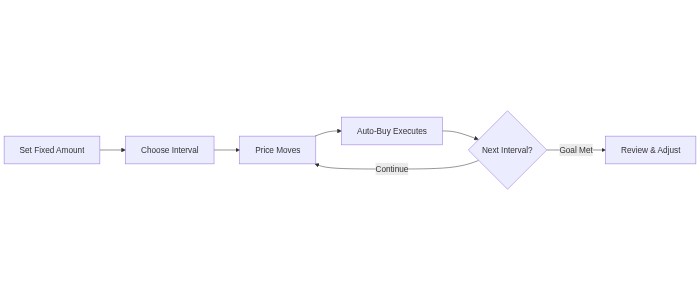
What makes this work in crypto specifically is the extreme price variation. When prices drop (and in crypto, they drop hard) your fixed dollar amount buys more coins. When prices spike, you buy fewer. Over enough cycles, this averaging effect cushions the worst timing mistakes.
DCA doesn’t require any knowledge of chart patterns or market cycles. Set it, let it run, and reassess periodically. At least, that is what I do. That simplicity is part of the appeal, and it’s why DCA attracts both total newcomers and seasoned traders who want to accumulate holdings without watching screens all day. The automation question matters more than most guides acknowledge: investors who set up recurring auto-buys tend to maintain DCA discipline better than those executing manually, because there’s no weekly decision point where emotion can intervene. I hope this answers the most asked question- What is dollar cost averaging in crypto?
Why Crypto’s Volatility Makes DCA More Effective Than in Traditional Markets
Bitcoin’s annualized volatility regularly runs between 50% and 100%, compared to the S&P 500’s historical average of around 15–20% (CoinGecko, 2024). That’s not a marginal difference. It means a poorly-timed entry in crypto can look dramatically worse than the same mistake in equities, and it takes far longer to recover from.
That volatility is exactly why DCA transfers well from stocks to crypto. In traditional equities, the technique helps but the stakes of a bad entry are comparably limited. In crypto, timing mistakes are magnified. A single lump-sum purchase at December 2017 prices took years to recover, and most investors who experienced that didn’t stick around to find out it eventually would.
The Behavioural Dimension of DCA
The behavioral dimension matters here too. Crypto’s volatility doesn’t just affect returns mathematically; it affects investor behavior. The 2022 bear market (Bitcoin fell roughly 77% peak-to-trough) flushed out enormous amounts of capital, largely from investors who bought near the top with lump sums and couldn’t absorb the psychological damage of watching their portfolio halve, then halve again. DCA holders who kept their schedule through that drawdown largely came out ahead. Not because they were smarter, but because their strategy didn’t require them to make a decision every time the market moved.
We ran a scenario on dcaBTC.com: $100 invested weekly in Bitcoin starting January 2022 — about three months after Bitcoin’s November 2021 all-time high, nearly the worst possible entry point you could have picked. By end of 2024, that $15,600 in total contributions had grown to approximately $41,200.
Not the biggest win you’ll see quoted in a DCA headline, but worth considering given the starting conditions.
A lump-sum purchase of the same $15,600 at January 2022 prices (~$46,500/BTC) would have grown to roughly $32,000 by end of 2024, a solid return but notably lower than the DCA outcome, and one that required holding through an 80% drawdown most investors don’t actually sustain.
DCA vs. Lump Sum: Which Crypto Investing Strategy Actually Wins?
Lump-sum investing outperforms DCA roughly two-thirds of the time in rising markets. That’s a well-documented finding from Vanguard’s long-running investment analysis. The logic is simple: if an asset trends upward over time, getting all your money in earlier captures more of that uptrend.
That statistic, though, assumes a few things that often don’t hold in practice. It assumes you have a lump sum ready to deploy. It assumes you invest it immediately rather than waiting for a “better entry.” And it assumes you don’t panic sell during the 40%–80% drawdowns that happen regularly in crypto. All three assumptions break down more often than most guides admit.
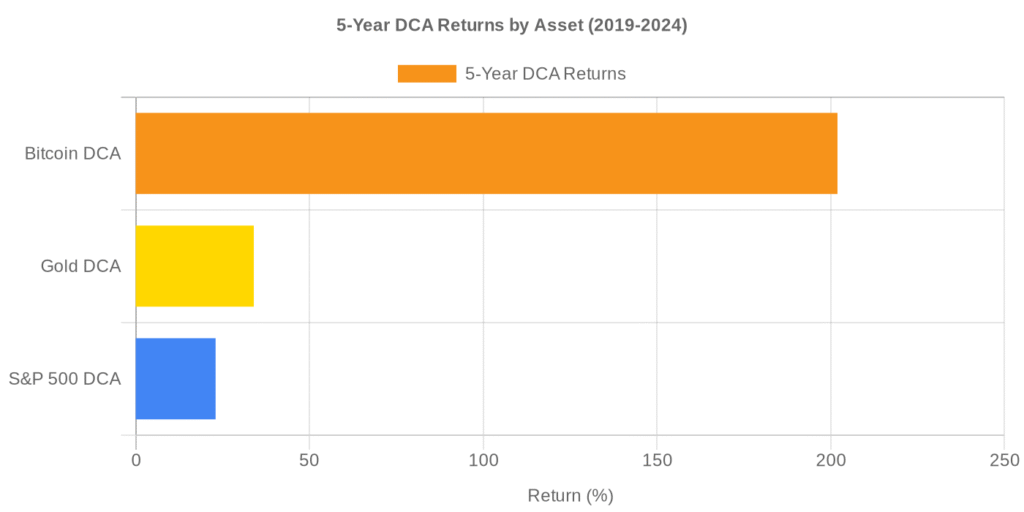
Backtesting data from dcaBTC.com shows that $10 invested weekly in Bitcoin from January 2019 through January 2024 turned $2,620 into approximately $7,913 — a 202% return (dcaBTC.com backtest, 2024). Over the same five-year period, equivalent weekly DCA into gold returned roughly 34% and into the Dow Jones approximately 23%. The volatility gap works in Bitcoin’s favor over that window, though results vary considerably depending on entry period.
The honest answer on DCA vs. lump sum: lump sum wins more often in uptrending markets, and DCA wins more often in volatile, uncertain ones. Crypto, with its regular 50%+ drawdowns and multi-year recovery cycles, DCA matches the risk profile of most retail investors better. It’s not the mathematically optimal strategy in every scenario. It’s the one most people can actually execute without blowing up their investment psychology.
How to Set Up a DCA Strategy for Bitcoin (Step by Step)
Setting up automated Bitcoin DCA takes under 15 minutes on most exchanges, and the setup process is similar across platforms. Automating this matters: investors who set auto-buys maintain their schedule during bear markets at higher rates than those executing manually, because there’s no weekly decision point where doubt can take over.
Step 1: Choose your exchange. Not all exchanges support recurring purchases natively. Kraken, Coinbase, and Strike are frequently cited for reliable auto-buy features with reasonable fee structures.
Step 2: Decide on your amount. The amount matters less than the consistency. Starting with $25–$50 per week is sufficient to build a solid position over time. A reasonable guideline: allocate only capital you won’t need for the next 3–5 years minimum.
Step 3: Set your interval. Weekly tends to produce slightly better average entry prices than monthly because higher purchase frequency captures more price variation. Daily DCA adds further smoothing but increases transaction fee costs on most platforms. Often not worth it unless your exchange offers zero-fee recurring orders.
Step 4: Enable recurring orders. Most exchanges allow you to schedule automatic purchases tied to a bank account or card. Set it, confirm the first purchase has executed, and leave it alone.
Step 5: Review quarterly. The point of DCA is to remove the compulsion to watch prices daily. Set a quarterly calendar reminder to check your accumulated position, adjust amounts if your income changes, and reconfirm your investment thesis.
One thing worth doing before all of this, according to me is to check the fee structure carefully. Some platforms charge 1.5–3% per transaction on auto-buys. At those rates, fees become a real drag on returns over years. Fee-free or low-fee recurring options exist; it’s worth 10 minutes of comparison to find them. It’s not glamorous advice, but over five years of weekly purchases, fee optimization often matters more than entry timing.
“Cryptocurrencies are the best-performing asset class in history. Don’t miss long-term opportunities because of short-term market movements.” Raoul Pal
Raoul Pal, Founder, Real Vision — public remarks on X
How Often Should You DCA Into Crypto?
Higher purchase frequency reduces average cost in volatile markets. That’s the mathematical case for weekly over monthly DCA. A weekly schedule captures more price variation throughout the month, which smooths the average entry price more effectively than a single monthly purchase (dcaBTC.com analysis, 2024). The difference is measurable but not dramatic; both outperform sporadic one-time purchases during uncertain market conditions.
Daily DCA produces the lowest average cost mathematically, but practical impact diminishes once you factor in transaction fees on most exchanges. If your platform charges per transaction, daily buying with small amounts means you’re paying fees far more frequently, which directly eats into the cost-averaging benefit you’re trying to capture.
For most investors: weekly works well, monthly is acceptable, daily is usually overkill unless your exchange is fee-free.
Breaking-down Frequency
The frequency question also connects to psychological sustainability. If $200/week creates budget anxiety, that’s a signal to reduce the amount or frequency. Not to push through and abandon the strategy at exactly the wrong moment.
DCA only delivers its full benefit when maintained consistently through drawdowns. The investor who DCA’s $20/week for 5 years outperforms the one who starts $200/week and stops after 8 months, without exception.
One nuance that experienced DCA practitioners apply: slight frequency or amount increases during sharp selloffs. If Bitcoin drops 25% in a week and you have spare capital, doubling your DCA contribution for that period amplifies the cost-averaging effect at advantageous prices. This isn’t market timing in the traditional sense: you’re not predicting when the decline ends, just taking advantage of prices that are demonstrably lower than recent history.
What Crypto Should You DCA Into?
Bitcoin accounts for roughly half of total crypto market capitalisation, with Ethereum adding another 15–20%, putting the two leading assets at around 65–70% of the total market (CoinGecko, Q1 2026). They’re the most obvious DCA targets, with the deepest liquidity, longest price histories, and most developed fundamental cases for long-term value.
The case for DCA-ing Bitcoin specifically is straightforward: longest track record, highest institutional adoption, clearest narrative as digital store of value, and backtesting data going back to 2010. Ethereum’s case is similar with added complexity: the post-Merge supply model, smart contract ecosystem, and ongoing protocol development create a different but credible investment thesis. For DCA purposes, either works. Both have.
Know More about Altcoins in DCA
Altcoins are a different matter. DCA works best on assets you’re genuinely confident will exist and retain value in 5+ years. Applying it to projects with uncertain fundamentals, small market caps, or heavy team-token vesting schedules extends the strategy beyond what it’s designed for. It’s not categorically wrong, but DCA doesn’t reduce the fundamental risk that a project goes to zero. It just smooths the entry price on the way down.
“If you like spending six to eight hours per week working on investments, do it. If you don’t, then dollar-cost average into index funds.” Warren Buffett
A reasonable portfolio split for most DCA investors: 60–70% BTC, 20–30% ETH, and no more than 10–15% in any single altcoin position. That’s not a universal rule. Your conviction and time horizon matter, but it reflects a structure where DCA’s volatility-smoothing effect has room to work properly. For comparing which exchanges support automated multi-asset DCA, our crypto broker reviews on Tradelize break this down by platform.
DCA Mistakes That Cost Crypto Investors Money
- Stopping during bear markets: The biggest one, by far. DCA delivers its most favourable average cost during extended price drops. Those are the months when your fixed dollar amount buys the most coins. Stopping when the market is down is functionally identical to buying high and selling low: you exit cheap and miss the eventual recovery. The investors who maintained DCA through 2018’s -83% drawdown and 2022’s -77% drop were the ones who came out materially ahead.
- Over-diversifying into too many assets: There’s a version of DCA that feels productive, with weekly purchases spread across 20 tokens, but achieves something closer to building a poorly managed index of speculative assets. Concentrate your DCA budget on assets you’ve actually researched and have conviction in.
- Ignoring fees: On exchanges charging 2%+ per transaction, a $100 weekly DCA costs roughly $8/month in fees, which adds up to nearly $500 over five years. That’s capital that could compound in the investment itself. Fee structures matter more in DCA than in one-time purchases because they recur with every execution.
- Treating DCA as a substitute for research: DCA doesn’t do your fundamental analysis for you. If you’re consistently buying into a project that loses its utility or team, you’re accumulating more of something that may become worthless. Review your DCA targets once or twice a year.
- Setting amounts you can’t sustain: Consistency beats size. The investor who DCA’s $20/week for 5 years outperforms the one who starts at $200/week and stops after 8 months.
There’s also a specific error we see in copy trading contexts: investors following DCA-oriented traders on platforms like Tradelize but then manually overriding the strategy during drawdowns. If you’re exploring copy trading guides and following a systematic DCA trader, the strategy only works if you let it run. Intervening on individual positions during red weeks defeats the systematic structure that makes DCA effective in the first place.
I personally started using DCA during a tumultuous phase in the crypto market where prices were swinging hard week to week. The largest difference wasn’t just the average entry price – it was psychological. Once I automated recurring purchase, I stopped worrying about if a given day was the “right” moment to enter. Some buys were at local highs, some in steep declines but consistency over time mattered more than any particular entry point. That change from emotional reaction to following a set framework made it a lot simpler to stay in the game during times when most of the folks around me were panic selling or waiting forever for the perfect downturn.
The Bottom Line on Dollar-Cost Averaging Crypto
Dollar-cost averaging crypto is the most practical long-term strategy for most retail investors navigating Bitcoin and Ethereum’s volatility. It doesn’t guarantee the highest possible returns — lump-sum investing outperforms roughly two-thirds of the time in rising markets — but it consistently delivers strong risk-adjusted results while keeping investor behaviour aligned with long-term goals. For anyone building a crypto position from regular income, without a lump sum, or without high confidence about where we are in the market cycle, DCA is the most sensible structure available. Start by comparing exchanges that support automated recurring purchases via our crypto broker reviews to find the right platform for your DCA setup.
This article is for informational purposes only and does not constitute personal financial advice. Cryptocurrency investments carry substantial risk. Past performance is not indicative of future results.
Frequently Asked Questions
1. What is the ideal amount to DCA into crypto?
There’s no universal right amount. The more useful question is: what can you sustain weekly or monthly for at least 2–3 years? Most DCA practitioners suggest 5–10% of disposable income as a starting point. Consistency matters more than size. A smaller fixed amount maintained through bear markets outperforms a larger amount abandoned halfway.
2. Is DCA better than lump-sum investing in crypto?
Many traders assume DCA always wins, but the data says otherwise. Lump-sum investing outperforms DCA roughly two-thirds of the time in rising markets, because it deploys capital earlier in an uptrend. DCA’s advantage is in volatile or declining markets, and behaviorally it removes the pressure of timing a single entry. Most retail investors are better served by DCA, but it depends on capital availability and risk tolerance.
3. How long should I keep DCA-ing into Bitcoin?
If you’re using DCA for long-term wealth building, a minimum 3–5 year horizon is realistic. Bitcoin’s historical cycles run roughly 4 years (loosely aligned with halving events), meaning holding through at least one full cycle gives the strategy time to work as intended. Short-horizon DCA (under 12 months) still smooths entry prices but eliminates the long-term compounding advantage.
4. Can I DCA across multiple cryptocurrencies at once?
Yes, and many investors do. DCA-ing BTC and ETH simultaneously is straightforward and supported on most major exchanges. Spreading your DCA budget across 10+ altcoins increases complexity, fee exposure, and the risk that one or more assets loses value permanently. If you’re using DCA for long-term accumulation, concentrate on assets you’re genuinely confident in over a 5+ year timeframe.
5. Does DCA work during a crypto bull market?
If you’re asking me to be straight about it — DCA underperforms a lump-sum purchase in sustained bull markets. If Bitcoin doubles over 6 months, your average buy price will be higher than if you’d invested everything at the start. That said, reliably identifying bull markets in real time is harder than it looks in hindsight. Most investors don’t realise they’re in one until it’s well underway, and the cost of waiting for certainty is often higher than the cost of averaging in systematically.

Our Review Methodology
We evaluate each post based on thorough research, credibility of sources, accuracy of information, and relevance to our readers. Our editorial team follows strict guidelines to ensure all content meets high standards of quality.
Disclaimer
The content in this article is provided for informational purposes only and does not constitute financial, investment, or professional advice. Always do your own research before making any decisions.