Quick Verdict
Robinhood is a US broker with a simple app, $0 commissions on stocks, ETFs and equity options, and more than 90 crypto assets. It now offers 24/7 chat and phone support, retirement accounts and an advanced desktop platform called Legend. The trade-offs are: crypto trades now carry fees or spreads, crypto is not insured, and it has a long regulatory record. It suits US beginners and active app users who keep their crypto exposure modest.
Key Takeaways
- Stocks and cash are well protected at Robinhood, while crypto relies on the company’s own safeguards.
- Stock, ETF and equity options trades cost nothing, but crypto now carries fees or spreads.
- Robinhood Gold is the main upgrade, adding cheaper margin, a higher cash rate and an IRA match.
- Customer support has improved, with 24/7 chat and phone, though complaints about restrictions remain.
- The regulatory record is the biggest caution, with repeated fines from the SEC, FINRA and New York.
- Stocks and cash are well protected at Robinhood, while crypto relies on the company’s own safeguards.
- Stock, ETF and equity options trades cost nothing, but crypto now carries fees or spreads.
- Robinhood Gold is the main upgrade, adding cheaper margin, a higher cash rate and an IRA match.
- Customer support has improved, with 24/7 chat and phone, though complaints about restrictions remain.
- The regulatory record is the biggest caution, with repeated fines from the SEC, FINRA and New York.
Pros
- Low trading costs: Stocks, ETFs and equity options trade with $0 commission.
- Wide crypto choice for a broker: More than 90 crypto assets in the US, tradable 24/7.
- Strong protection for securities: SIPC cover up to $500,000, including $250,000 in cash.
- Simple app: The mobile app is easy for beginners, and Legend suits active traders.
- 24/7 support: In-app chat and phone support are open around the clock.
- Useful Gold perks: For $5 a month, members get a 3.6% rate on cash and a 3% IRA match.
Cons
- Crypto is uninsured: Crypto holdings are not covered by SIPC or the FDIC.
- Crypto costs have risen: Exchange-routed orders pay up to 0.95% for small traders.
- Long list of fines: Penalties include FINRA’s record $70 million action in 2021.
- Payment for order flow: Robinhood earns from routing orders, which can affect execution prices.
- US-focused product range: No mutual funds, bonds or forex.
- Mixed reviews: About 38% of Trustpilot reviews are 1-star.
Robinhood Overview
| Parameter | Details |
|---|---|
| Broker Name | Robinhood |
| Year Established | 2013 |
| Headquarters Location | Menlo Park, California, USA |
| Regulatory Compliance | SEC, FINRA and SIPC (securities); NFA (futures); NYDFS licence and FinCEN registration (crypto) |
| Trading Instruments | Stocks, ETFs, options, index options, futures, event contracts, more than 90 crypto assets |
| Available Cryptocurrencies | Bitcoin, Ethereum, XRP, Solana, Dogecoin and more (Availability varies by state) |
| Account Types | Individual, joint, custodial, traditional, Roth and rollover IRAs, Robinhood Strategies |
| Minimum Deposit | $0 |
| Base Currencies Supported | USD |
| Leverage | Up to 2:1 on margin, more on futures |
| Average Spreads | NA |
| Commission | Stocks, ETFs and their options are commission-free. Futures carry a per-contract fee. |
| Deposit Methods | Bank transfer (ACH), instant bank transfer, debit card, and incoming domestic wire. |
| Withdrawal Methods | Bank transfer (ACH), instant bank transfer, external debit card, outgoing domestic wire, and ACATS transfer-out to another broker. |
| Deposit/Withdrawal Fees | Deposits: none from Robinhood. Standard ACH withdrawals: free. Instant withdrawals to a debit card or bank can incur 1.75% (minimum $1, maximum $150 per transaction). An outgoing wire costs $25. ACATS out costs $100, for both partial and full transfers. |
| Trading Platforms | Robinhood mobile app, Robinhood website, Robinhood Legend, Robinhood Wallet, Robinhood Cortex |
| Mobile App Availability | Yes |
| Order Types | Market, limit, stop, stop limit, and trailing stop |
| Execution Model | Orders routed to market makers (agency model, payment for order flow) |
| Fund Segregation | Yes, customer funds are segregated; SIPC covers up to $500,000 ($250,000 cash) |
| Demo Account | No |
| Support Channels | Live chat, phone callback, Help Center |
| Support Availability | Chat 24/7; phone 7 AM–9 PM ET (Mon–Fri) |
Introduction
This Robinhood review answers the question most readers ask first: yes, Robinhood is a safe, regulated broker for stocks and cash, but crypto carries less protection. Its US broker-dealers are registered with the SEC and are members of FINRA and SIPC. Robinhood Crypto holds a New York virtual currency licence. However, crypto is not covered by SIPC, and the company has paid several large regulatory fines.
Is Robinhood Safe?
Yes, Robinhood is safe for stocks and cash, and reasonably safe for crypto, but with weaker protection. Here is how each part of your account is protected.
Regulation by Entity
| Entity | What it does | Regulator |
|---|---|---|
| Robinhood Financial LLC | Brokerage accounts | SEC, FINRA, SIPC member |
| Robinhood Securities LLC | Clearing and custody | SEC, FINRA, SIPC member |
| Robinhood Derivatives LLC | Futures and event contracts | CFTC, NFA member |
| Robinhood Crypto LLC | US crypto trading | NYDFS virtual currency licence, FinCEN money services business |
Outside the US, Robinhood runs separate companies under UK and EU rules. In the EU it operates under MiCA, the EU’s crypto rules, and offers more than 65 digital assets.
Investor Protection
- Securities: SIPC covers up to $500,000 per customer, including $250,000 in cash, if the broker fails. It does not cover market losses.
- Uninvested cash: Cash in the sweep program is moved to partner banks, where it can qualify for FDIC insurance above the usual $250,000 limit.
- Crypto: Not covered by SIPC or the FDIC. Robinhood says it keeps most customer crypto in cold storage, offline and away from hackers.
Account Security
Robinhood offers two-factor authentication, biometric login, security keys and alerts for new devices. Turn these on as soon as you open an account. The company has had security failures. In November 2021, an attacker obtained the names or email addresses of about 7 million customers. The SEC later cited that incident in its 2025 settlement.
Reputation and User Feedback
Fines and Regulatory History
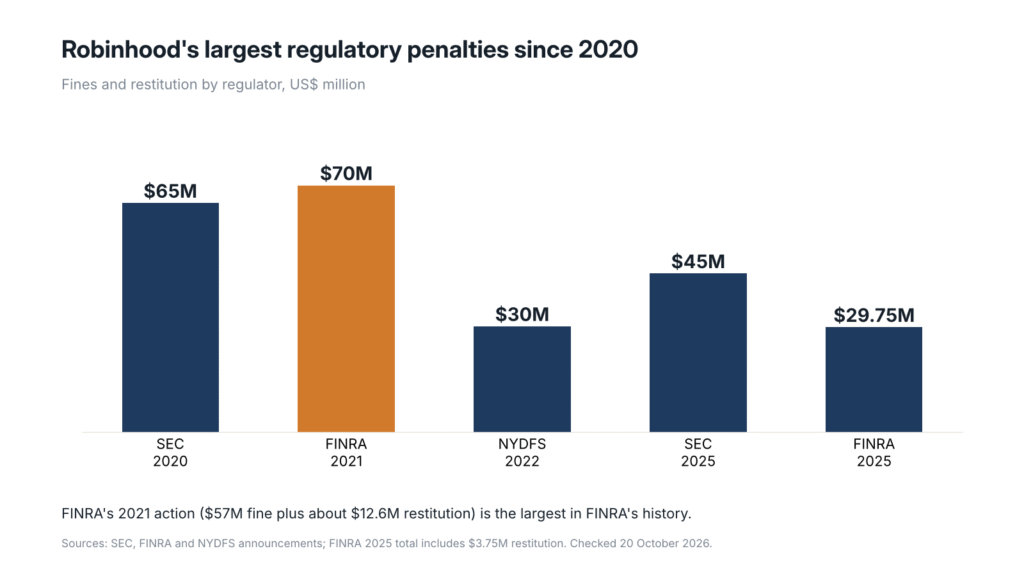
Robinhood has a long record of regulatory penalties. These are the largest:
| Year | Regulator | Amount | Reason |
|---|---|---|---|
| 2020 | SEC | $65 million | Misleading customers about payment for order flow and execution quality |
| 2021 | FINRA | $70 million | Misleading information, March 2020 outages and options approvals |
| 2022 | NYDFS | $30 million | Crypto anti-money-laundering and cybersecurity failures |
| 2025 | SEC | $45 million | More than ten violations, including late suspicious activity reports and cybersecurity gaps |
| 2025 | FINRA | $29.75 million | Undisclosed “collaring” of market orders, AML gaps and supervision failures |
The 2021 FINRA case remains the largest in FINRA’s history. Jessica Hopper, head of FINRA’s enforcement department, said the penalty “reflects the scope and seriousness of Robinhood’s violations.” She added that compliance “cannot be sacrificed for the sake of innovation” (FINRA). The SEC’s January 2025 order split its $45 million penalty between Robinhood Securities ($33.5 million) and Robinhood Financial ($11.5 million).
User Feedback
Robinhood’s reviews are polarised: many users are very happy and a large group are not. For this Robinhood review, we checked Trustpilot, the app stores and Robinhood’s own fee and support pages on 20 October 2026.
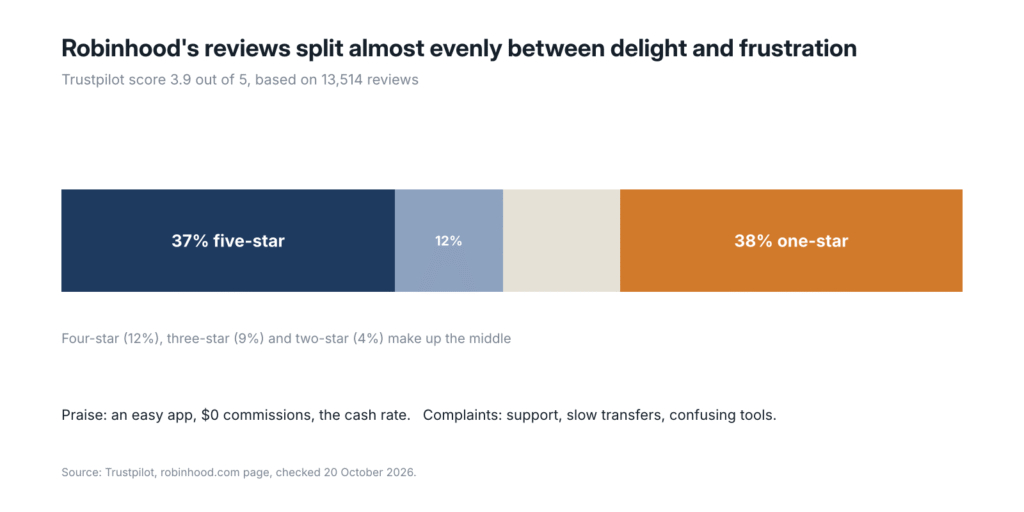
On Trustpilot, Robinhood scores 3.9 out of 5 from 13,514 reviews. Of those, 37% are 5-star and 38% are 1-star. Praise centres on the easy app, $0 commissions, the cash rate and card rewards. Complaints centre on support, slow transfers and a confusing interface for some tools. App store ratings are higher, at about 4.3 on Apple’s App Store and 4.4 on Google Play.
Trading Instruments
Robinhood covers the main US asset classes, with a few clear gaps:
- Stocks and ETFs: Thousands of US-listed stocks and ETFs, with fractional shares from $1.
- Options: Equity options at $0 commission, plus index options for a per-contract fee.
- Futures: Index, commodity and crypto futures through Robinhood Derivatives.
- Event contracts: Prediction-market contracts on economic, political and sports outcomes, offered through a CFTC-regulated exchange.
- Crypto: More than 90 crypto assets, covered in the section above.
Robinhood does not offer mutual funds, bonds or forex. Investors who want those, or non-US shares, will need a second broker.
Account Types & Trading Conditions
Robinhood offers more account types than its early reputation suggests:
| Account | Who it’s for | Key features |
|---|---|---|
| Individual and joint | Most investors | $0 minimum, full product range |
| Custodial | Parents investing for a child | Account held for a minor until adulthood |
| Traditional, Roth and rollover IRA | Retirement savers | 1% match on contributions, or 3% with Gold |
| Robinhood Strategies | Hands-off investors | Managed portfolios for 0.25% a year, capped at $250 for Gold members |
Robinhood Gold ($5 a month) is a membership you add to any of these accounts, not a separate account. It pays 3.6% on uninvested cash and brings cheaper margin and bigger instant deposits. The 3% IRA match is worth up to $225 a year at the 2026 contribution limit. You keep the full match only if you stay subscribed for a year and leave the money in the IRA for five years.
Trading Platforms and Tools
Robinhood offers three ways to trade, plus a separate crypto wallet:
| Feature | Robinhood app | Web | Robinhood Legend |
|---|---|---|---|
| Best for | Beginners | Casual investors | Active traders |
| Charting | Basic | Basic | Multi-chart layouts, many indicators |
| Order types | Market, limit, stop, stop-limit, trailing stop | Same as app | Advanced order entry |
- Robinhood app: The core experience on iOS and Android, built for quick trades and watchlists.
- Robinhood Legend: A desktop platform launched in October 2024 with customisable layouts and technical indicators.
- Robinhood Wallet: A separate self-custody app for holding crypto outside your brokerage account.
- Robinhood Cortex: An AI research tool for Gold members that turns market data into insights.
Robinhood doesn’t offer a demo account, so new users practise with small fractional trades instead.
Robinhood Fees
Robinhood’s everyday trading is cheap, and most costs only apply to extra services:
| Fee | Amount |
|---|---|
| Stocks, ETFs, equity options | $0 commission |
| Index options | Per-contract fee, from $0.35 for Gold members |
| Futures | $0.75 per contract, or $0.50 for Gold members |
| Crypto | Spread or maker/taker fee (see the crypto section) |
| Robinhood Gold | $5 a month or $50 a year |
| Margin interest | From 5% for Gold members; first $1,000 interest-free |
| Standard ACH deposit or withdrawal | Free |
| Instant withdrawal | 1.75%, minimum $1, maximum $150 |
| Full account transfer out (ACATS) | $100 |
| Inactivity or account fee | None |
Robinhood also earns payment for order flow (PFOF) from the market makers that fill your stock and options orders. It is not a fee you see, but it can affect the price you get on each trade.
Deposits and Withdrawals
Moving money into and out of Robinhood is free by standard bank transfer (ACH). Instant withdrawals to a debit card or bank account cost 1.75% per transfer, with a $1 minimum and a $150 cap. Stock and options sale proceeds settle on the next trading day (T+1). Crypto withdrawals to an external wallet carry only the blockchain network fee.
Some users report withdrawals held for days while Robinhood reviews an account or a deposit. Keep your profile details up to date, and expect checks after large deposits.
Customer Support
Robinhood offers 24/7 support through in-app chat and phone, which it rolled out in 2021 and 2022 after years of criticism. You request a call from inside the app rather than dialling a public number. Robinhood says support “can be reduced or unavailable” during periods of very high demand or market volatility.
Support quality is still the most common complaint in reviews, mainly around account restrictions and unresolved cases. For urgent security issues, such as a suspected account takeover, contact support from the app and change your email password straight away.
How to Use Robinhood: Step-by-Step Guide
- Download the app: Get Robinhood from the App Store or Google Play, or sign up at robinhood.com.
- Enter your details: Add your name, address, date of birth and Social Security number, as US rules require.
- Verify your identity: Upload a photo ID if asked. Many accounts are approved within minutes.
- Turn on security: Set up two-factor authentication or a security key before you deposit.
- Link your bank and deposit: Connect a bank account and fund by ACH. There is no minimum.
- Start trading: Search for a stock, ETF, option or coin, and place your first order.
Who Is Robinhood Best For?
Robinhood is best for US investors who want a simple, low-cost app for stocks, ETFs and small crypto positions.
- Good fit: Beginners buying their first shares, including fractional shares from $1.
- Good fit: Active traders who want Legend, futures and cheap equity options.
- Good fit: Savers who will use Gold’s cash rate and IRA match.
- Poor fit: Frequent crypto traders, who will find lower fees on many exchanges.
- Poor fit: Investors who need mutual funds, bonds, forex or non-US shares.
If you want to compare other platforms, our crypto broker reviews and our Revolut review are good next reads.
Final Verdict
This Robinhood review finds a broker that is safe for stocks and cash, easy to use and cheap for everyday trading. It has also grown up, with 24/7 support, retirement accounts, Legend and a broader crypto line-up. The cautions are equally clear: crypto is uninsured and no longer free to trade, and the company’s regulatory record is long.
For a US investor who mainly buys stocks and ETFs, and holds a modest amount of crypto, Robinhood is a sound choice. Heavy crypto traders and investors who want the widest product range should look elsewhere. Our Trust Score methodology explains how we rate brokers.
Frequently Asked Questions
Is Robinhood safe to use?
Yes. Robinhood’s US broker-dealers are registered with the SEC and are members of FINRA and SIPC, so securities are covered up to $500,000, including $250,000 in cash. Robinhood Crypto is licensed in New York. However, crypto is not covered by SIPC or the FDIC, and Robinhood has paid several large regulatory fines, including FINRA’s record $70 million penalty in 2021.
Is crypto on Robinhood insured?
No. Crypto held at Robinhood is not protected by SIPC or the FDIC. Robinhood says it keeps most customer crypto in cold storage and uses its own security measures. If you want full control of your coins, you can move many of them to an external wallet, including the separate Robinhood Wallet app, paying only the network fee.
What are Robinhood’s crypto fees?
It depends on how your order is routed. With default market maker routing, the cost is built into the spread. With exchange routing, Robinhood charges maker and taker fees based on your 30-day volume. Taker fees start at 0.95% for volumes up to $10,000 and fall to 0.03% for the largest traders. Robinhood says these fees are still rolling out to customers.
Does Robinhood have customer service by phone?
Yes. Robinhood offers 24/7 support through in-app chat and phone, rolled out in 2021 and 2022. You request a call from inside the app rather than calling a public number. Robinhood notes that support can be reduced during periods of very high demand or market volatility, so response times can vary.
Is Robinhood Gold worth it?
Robinhood Gold costs $5 a month or $50 a year. It is worth it if you keep cash in your account, contribute to a Robinhood IRA or use margin. Gold pays 3.6% on uninvested cash, a 3% IRA match worth up to $225 a year, and cheaper margin from 5%. Casual investors with small balances may not earn back the fee.

Our Review Methodology
At Tradelize, we follow strict editorial standards to ensure all content is accurate, unbiased, and thoroughly researched. Our reviews, guides, and articles are fact-checked by a team of experienced cryptocurrency and finance professionals, and are not influenced by advertisers or affiliate relationships. Our Trust Score methodology combines direct data scraping from official broker, exchange, and wallet websites with sentiment analysis of up to 1000 verified user reviews. This dual-source approach enables us to objectively evaluate platform features, fees, regulations, security, and customer satisfaction. We then compile comprehensive, specification-based reviews that reflect both technical details and real user experience.
Disclaimer
Trading cryptocurrencies, forex, CFDs, and other derivatives involves significant risk and may not be suitable for all investors. Leverage can amplify both gains and losses. Past performance is not indicative of future results. The content on Tradelize is for informational purposes only and does not constitute financial or investment advice. Always seek professional guidance before making financial decisions. For full risk disclosures, click here.