Quick Verdict
Revolut became a fully licensed UK bank in March 2026.
Deposits now carry FSCS protection up to £120,000 once an account moves to the bank, and the app puts banking, stocks, commodities, and 200+ cryptocurrencies in one place. For crypto buyers, the catch is price: 1.49% per trade on Standard and Plus plans is high next to a dedicated exchange. Revolut’s own answer is Revolut X, where taker fees drop to 0.09%. Crypto sits outside every compensation scheme, and support remains the most common complaint.
Key Takeaways
- Banking: Revolut Bank UK Ltd launched in March 2026, and eligible UK deposits carry FSCS cover up to £120,000 once migrated.
- Crypto fees: 1.49% in-app for Standard and Plus, 0.99% for Premium and Metal, and from 0.49% for Ultra.
- Revolut X: a separate exchange with 0% maker and 0.09% taker fees on 300+ tokens, for UK and EEA users only.
- Protection gap: crypto is held by Revolut Ltd, not the bank, and is not covered by the FSCS.
- Not available: US customers have had no Revolut crypto service since October 2023.
Pros
- A full UK banking licence, with FSCS cover up to £120,000 on migrated deposits
- Revolut X offers 0.09% taker fees, competitive with dedicated crypto exchanges
- 200+ coins in the app, 300+ on Revolut X, plus staking on 16 tokens
- One app for up to 36 currencies, stocks, ETFs, and commodities
- No custody, inactivity, or account closure fees on any plan
- Support available 24/7 in 100+ languages, though complex cases draw complaints
Cons
- In-app crypto fees of 1.49% are well above exchange rates for small buys
- Minimum fees make tiny crypto orders expensive, from £0.99 per trade
- Crypto carries no FSCS protection, and assets are pooled across customers
- No crypto for US customers, and Revolut X is limited to the UK and EEA
- Frequent complaints about frozen accounts and slow support on complex cases
- A €3.5 million fine from the Bank of Lithuania in April 2025 over anti-money-laundering controls
Revolut Overview
| Parameter | Details |
|---|---|
| Broker Name | Revolut |
| Year Established | 2015 |
| Headquarters Location | 30 South Colonnade, London E14 5HX, United Kingdom |
| Regulatory Compliance | Revolut Bank UK Ltd (PRA-authorised, FCA-regulated, FRN 981170), Revolut Ltd (FCA e-money and cryptoasset registration, FRN 900562), Revolut Trading Ltd (FCA, FRN 933846), Revolut Bank UAB (Bank of Lithuania and ECB), and Revolut Digital Assets Europe Ltd (CySEC, under MiCA) |
| Trading Instruments | Cryptocurrencies, stocks and ETFs, commodities, and currency exchange |
| Available Cryptocurrencies | 200+ in the app, including Bitcoin, Ethereum, Solana, Cardano, XRP, Dogecoin, Polkadot, Chainlink, and Uniswap; 300+ tokens on Revolut X |
| Account Types | Standard, Plus, Premium, Metal, and Ultra |
| Minimum Deposit | $0 |
| Base Currencies Supported | Up to 36 currencies held and exchanged in-app |
| Leverage | None in the main app or on Revolut X, which are spot-only. In some EEA countries, the separate Revolut Invest app offers CFDs at up to 1:5 on stocks, 1:10 on commodities, and 1:20 on gold and indices |
| Average Spreads | No published spread on crypto or stocks, where Revolut charges a stated commission. Commodities are priced on the buy and sell spread instead |
| Commission | Crypto: 1.49% (Standard and Plus), 0.99% (Premium and Metal), from 0.49% (Ultra), each with a minimum fee. Revolut X: 0% maker, 0.09% taker. Stocks: 0.25% of the order (0.12% Ultra), minimum £1, after the monthly free allowance |
| Deposit Methods | Bank transfer, linked account, debit or credit card, Apple Pay, Google Pay, transfer from another Revolut user, and cash deposit at authorised retailers |
| Withdrawal Methods | Bank transfer, card withdrawal, and crypto withdrawal to external wallets on supported coins and networks |
| Deposit/Withdrawal Fees | Deposits are generally free, though some card types carry a fee. Crypto withdrawals carry network and platform fees shown in the app |
| Trading Platforms | Revolut mobile app (iOS and Android), and Revolut X as a mobile app or at exchange.revolut.com |
| Mobile App Availability | Yes, on iOS and Android |
| Order Types | Stocks: market, market-on-open, limit, stop, and recurring buy. Revolut X: market, limit, take-profit/stop-loss, conditional, and TWAP |
| Execution Model | Spot execution through Revolut's own order book on Revolut X, and quoted pricing in the main app |
| Fund Segregation | Yes. Fiat is safeguarded or held as bank deposits, and crypto is held separately in pooled custody accounts |
| Demo Account | None. Revolut does not offer a demo or practice profile |
| Support Channels | In-app chat, in-app calls, the Help Centre, and [email protected] for locked-out users |
| Support Availability | 24/7, 365 days a year, in 100+ languages |
Introduction
Revolut launched in 2015 as a cheap way to spend abroad and now reports more than 75 million personal customers across 40 markets. Its 2025 results, published in March 2026, showed revenue up 46% to $6.0 billion and pre-tax profit up 57% to $2.3 billion. The same month brought the change that matters most to this Revolut review: the Prudential Regulation Authority lifted the restrictions on its banking licence, and Revolut began trading as a full UK bank.
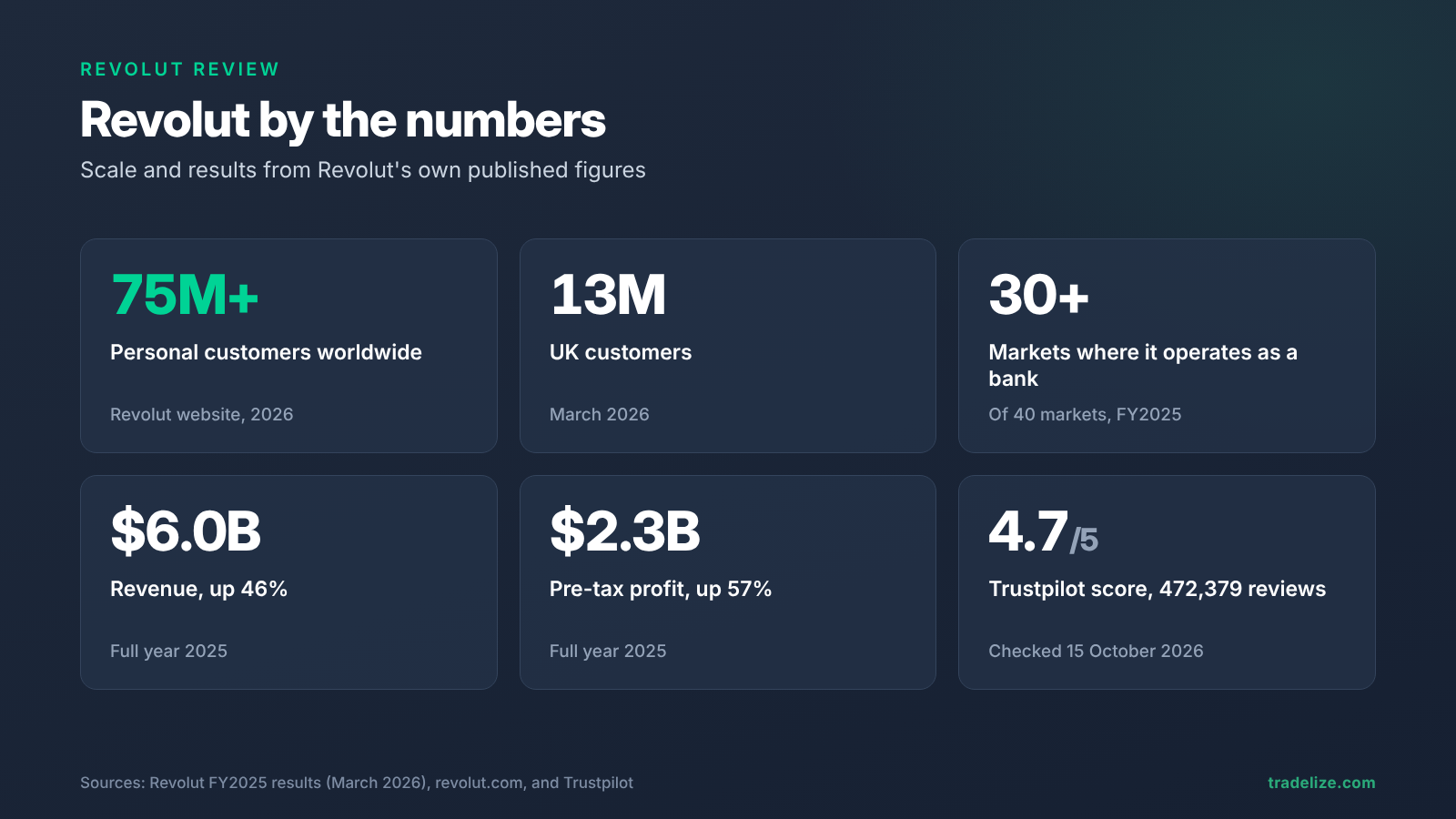
For a crypto trader, Revolut is really two products. The main app is built for convenience, with one-tap buys sitting next to your current account. Revolut X is a separate exchange aimed at active traders, priced accordingly. The gap between the two is wide enough that picking the wrong one can cost you more than fifteen times as much per trade.
Is Revolut Safe?
Yes, Revolut is safe for everyday banking, and its position improved in 2026. It holds a full UK banking licence, is regulated as a bank in over 30 of its 40 markets, and keeps client crypto 1:1 without lending it out. Two things deserve attention before you commit: crypto sits outside the compensation schemes that protect your cash, and Revolut has drawn regulatory and consumer-group criticism over financial crime controls.
Regulatory Compliance
Different parts of Revolut sit under different licences, which decide what protects your money.
- Revolut Bank UK Ltd is authorised by the Prudential Regulation Authority and regulated by the FCA (FRN 981170). It launched in March 2026 after the PRA lifted its mobilisation restrictions.
- Revolut Ltd holds FCA e-money authorisation and is registered with the FCA to offer cryptoasset services (FRN 900562). That registration covers anti-money-laundering supervision only.
- Revolut Trading Ltd (FRN 933846) is FCA-authorised for investment services.
- Revolut Bank UAB holds a credit institution licence from the Bank of Lithuania and the European Central Bank, and serves EEA customers.
- Revolut Digital Assets Europe Ltd holds a MiCA licence from the Cyprus Securities and Exchange Commission, granted in October 2025, covering 30 EEA countries.
What Protects Your Money
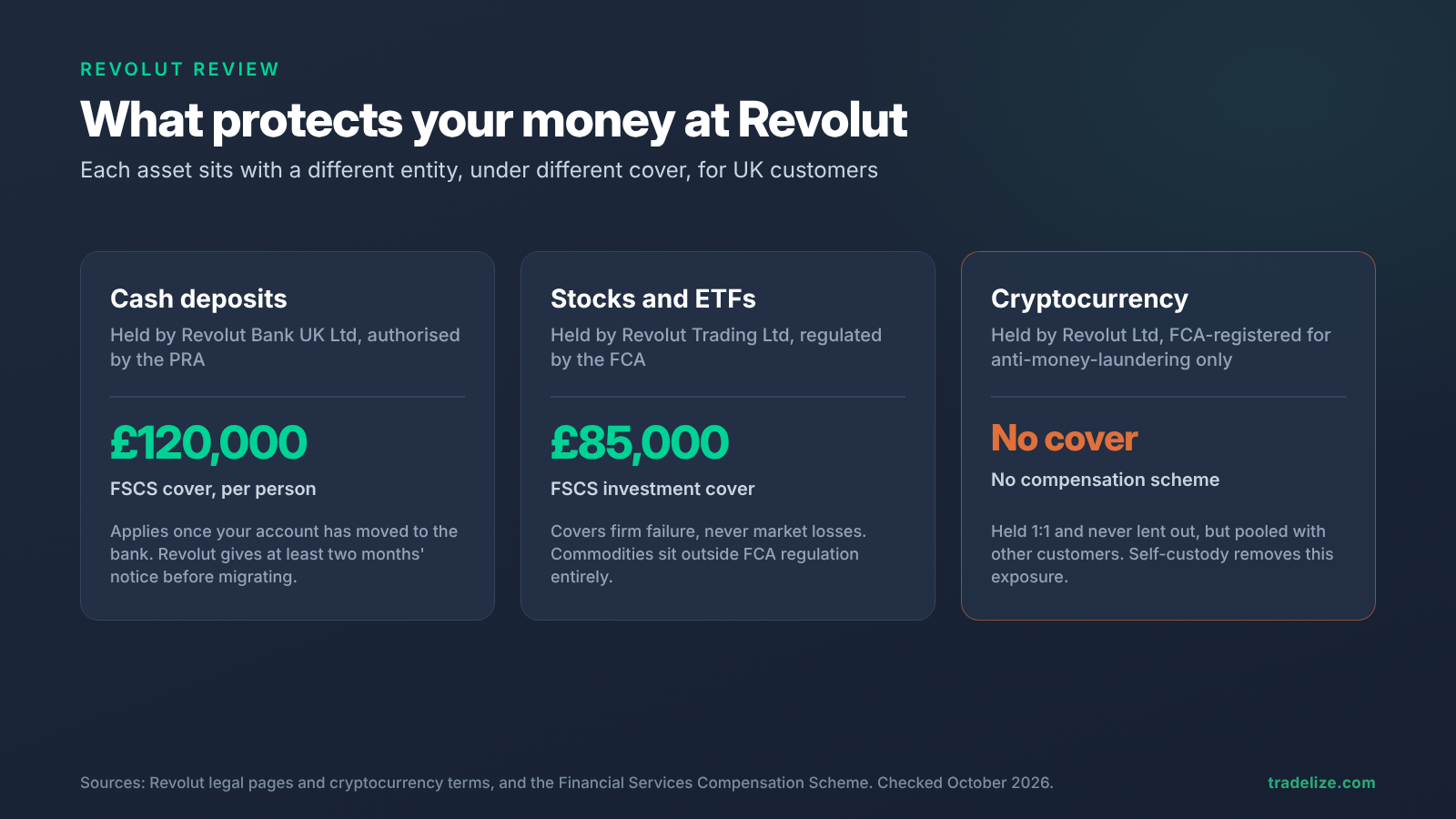
UK deposits held with Revolut Bank UK Ltd are covered by the Financial Services Compensation Scheme up to £120,000 per person, a limit that rose from £85,000 on 1 December 2025. The migration is staged, not instant. Revolut gives at least two months’ notice before moving an account to the bank, and customers who joined from March 2026 may still start on an e-money account, so check which entity holds your account in the app before relying on the cover. EEA customers bank with Revolut Bank UAB, where the Lithuanian deposit scheme covers €100,000.
Crypto is the exception. Revolut’s cryptocurrency terms state that you “will not be protected by the Financial Services Compensation Scheme.” Revolut says it holds coins 1:1 and does not lend them out, but they sit in pooled accounts shared with other customers. For a large position, a self-custody wallet removes that exposure.
Security Features
| FEATURE | DETAILS |
|---|---|
| Two-factor authentication | Biometric or PIN approval on login and key actions, tied to your device |
| Crypto custody | Held 1:1 with licensed custodians, using multi-signature wallets and cold storage, and never lent out |
| Card controls | Freeze and unfreeze, disposable virtual cards, and per-category spending limits |
| Fraud monitoring | A 24/7 team using machine learning to flag suspicious transactions |
Privacy Practices
Revolut runs Know Your Customer checks at sign-up using an ID document and a selfie, and may ask for more if your activity triggers its risk filters. Data is stored under GDPR and FCA rules and is not sold to third parties, and you can adjust marketing and analytics settings in the app.
Reputation and User Feedback
Trustpilot and Community Reviews
When we checked Trustpilot on 15 October 2026, Revolut held a TrustScore of 4.7 out of 5 from 472,379 reviews, with 80% of reviewers giving five stars and 7% giving one. That is a strong score for a bank of its size, and the reviews behind it point to the app, the exchange rates, and the speed of transfers.
The picture is less flattering elsewhere. In October 2025, Which? reported Financial Ombudsman Service data showing 3,242 authorised push payment fraud complaints against Revolut in 2024, more than any other major UK firm. In April 2025, the Bank of Lithuania fined Revolut Bank UAB €3.5 million over failures in monitoring business relationships and spotting suspicious transactions.
Common Complaints and Praise
Recurring Praise:
- A fast, well-designed mobile app
- Interbank exchange rates and multi-currency accounts
- Instant transfers and real-time notifications
- Budgeting tools, Pockets, and savings features
Recurring Complaints:
- Accounts frozen or restricted during compliance reviews
- Slow resolution on complex support cases
- Lengthy verification for some customers
- Features that vary by country
Trading Instruments
The main Revolut app and Revolut X are spot-only, so you cannot lose more than you put in. Leverage sits in a separate product: Revolut Invest, launched in 2024 through Revolut Securities Europe UAB, offers CFDs in some EEA countries at up to 1:5 on stocks, 1:10 on commodities, and 1:20 on gold and major indices. It is not available in the UK, and the crypto covered in this review carries no leverage on either platform. Read our guide to margin trading before using a leveraged account.
Available Cryptocurrencies
The main app supports 200+ cryptocurrencies, including Bitcoin, Ethereum, Solana, Cardano, XRP, Dogecoin, Polkadot, Chainlink, and Uniswap, and Revolut X carries 300+ tokens. You can set up recurring buys, use spare-change round-ups, and buy themed collections in a tap.
Staking is available on 16 tokens, including Ethereum, Solana, Cardano, Polkadot, Tezos, and Tron. Revolut takes a commission on rewards and shows the rate net of that fee, though it publishes neither figure. The projected rate comes from past rewards and is not guaranteed. Our guide to crypto staking covers the lock-up risks.
You can move coins both ways. Revolut supports deposits from external wallets on 30+ cryptocurrencies, and withdrawals to external wallets on 30+ coins, each on selected blockchain networks. It publishes the headline count but not the full list or the fees, so check Crypto, then More, then Limits and fees in the app before planning a transfer.
Two restrictions matter: US customers have had no Revolut crypto service since 3 October 2023, and Revolut X is limited to the UK and the 30 EEA countries. Revolut also dropped Tether’s USDT for customers in the EEA and Switzerland by 31 August 2026 under MiCA rules, and launched a euro stablecoin, EURR, the same month. UK customers keep USDT.
Other Trading Instruments
- Stocks and ETFs: 4,000+ UK, US, and EEA listings, with fractional shares and a UK Stocks and Shares ISA
- Commodities: gold, silver, platinum, and palladium, none of which the FCA regulates
- Currency exchange: up to 36 currencies at interbank rates within plan limits
Account Types & Trading Conditions
Types of Accounts
| PLAN | UK PRICE | BEST FOR |
|---|---|---|
| Standard | Free | Occasional spending and small crypto buys |
| Plus | £3.99/month | Higher exchange limits and purchase protection |
| Premium | £8.99/month | Unlimited currency exchange and 0.99% crypto fees |
| Metal | £16.99/month | Cashback, higher ATM limits, and travel perks |
| Ultra | £60/month | Active traders wanting crypto fees from 0.49% |
Trading Costs by Plan
Crypto in the main app is priced on a sliding scale by plan, and you always pay whichever is greater: the percentage or the minimum fee.
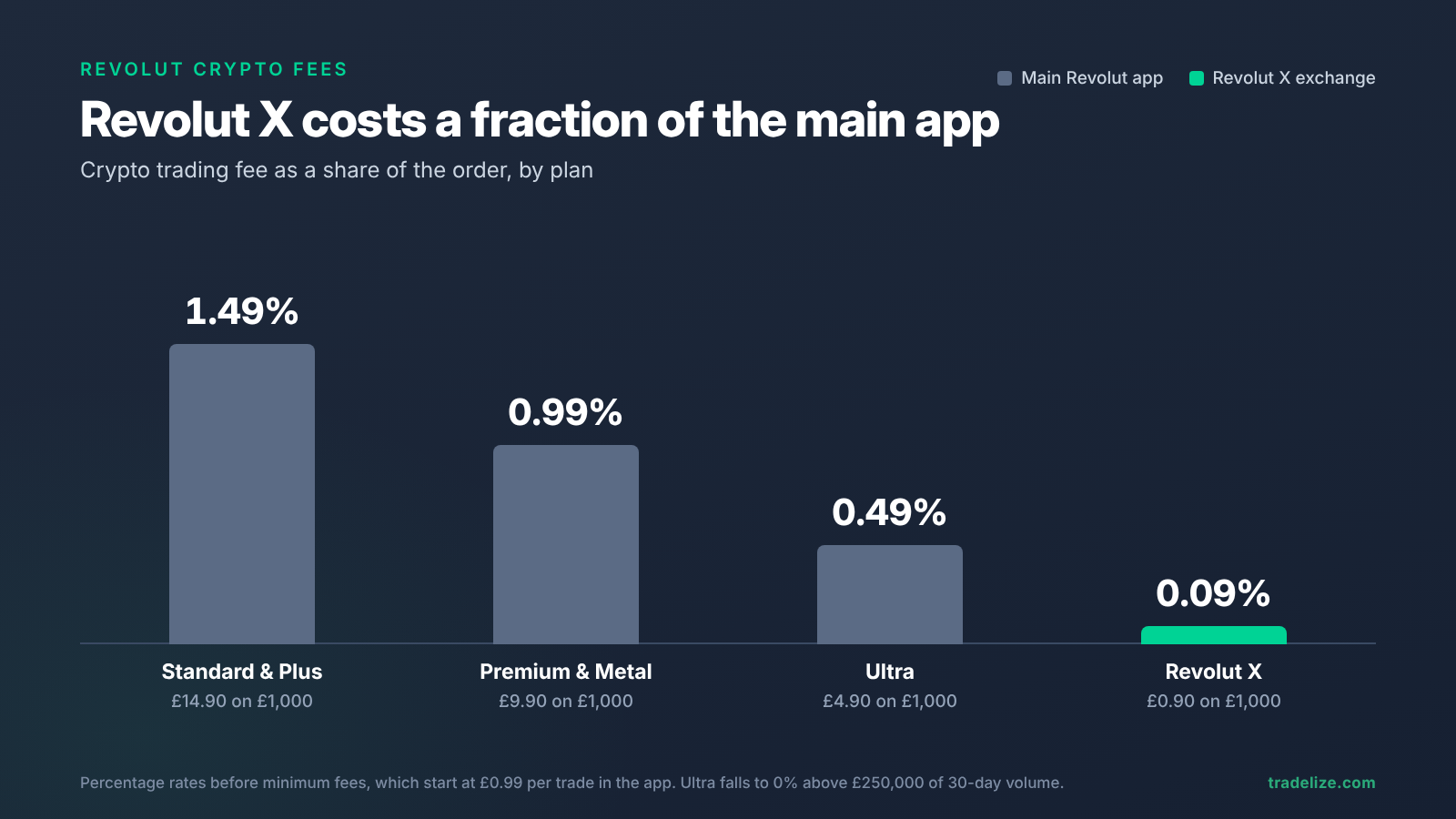
Standard and Plus pay 1.49%. Premium and Metal pay 0.99%. Ultra starts at 0.49% and falls through volume tiers to 0% once 30-day volume reaches £250,000.
The minimum fee is what catches small buyers. Orders under £2 are charged 50% of the trade, and above that the minimum rises in bands: £0.99, £1.49, £1.99, £2.49, and £2.99 up to £200, after which the percentage always wins. A £20 buy on a Standard plan therefore costs £1.49, or 7.5% of the order.
Revolut X changes the maths entirely, at 0% maker and 0.09% taker fees with no volume tiers. On a £1,000 trade, that is £0.90, against £14.90 in the main app on a Standard plan. If you trade crypto more than occasionally and live in the UK or EEA, use Revolut X.
Stocks cost 0.25% of the order, or 0.12% on Ultra, with a £1 minimum, after a monthly allowance of one free trade on Standard rising to ten on Metal and Ultra. There are no custody fees.
Trading Platforms and Tools
Revolut runs two platforms. The main app, on iOS and Android, carries everything: crypto, stocks, commodities, spending, and budgeting, and the web interface handles account management, not trading. Revolut X works as its own app or in a browser at exchange.revolut.com, with an order book, charts, and maker and taker pricing. It carries the order types active traders expect, including take-profit and stop-loss, conditional orders, and TWAP orders that split a large trade over a set period. There is no MetaTrader or TradingView integration.
The tools suit everyday investors, not chartists: recurring buys on crypto and stocks, auto-exchange that converts currency at a target rate, Pockets for budgeting, Savings for interest, disposable virtual cards, and spending analytics. What you will not find is an economic calendar, advanced technical analysis, or an API.
Revolut Fees
Trading costs are covered above, and Revolut’s published fee schedule sets out every band.
Deposit and Withdrawal Fees
Deposits by bank transfer, linked account, Apple Pay, or Google Pay are free, though some card types carry a fee. Fiat withdrawals to a UK bank account are free. SWIFT transfers may carry third-party charges. Crypto withdrawals carry network and platform fees, shown in the app before you confirm.
Other Fees
| FEE | STANDARD | PLUS | PREMIUM AND ABOVE |
|---|---|---|---|
| Monthly currency exchange limit | £1,000 | £3,000 | Unlimited |
| Fee above the limit | 1% | 0.5% | None |
| Free ATM withdrawals | £200 or 5 withdrawals | £200 | £400 to £2,000 |
| Fee above the ATM limit | 2%, minimum £1 | 2%, minimum £1 | 2%, minimum £1 |
The exchange limit is shared across currencies, crypto, and commodities, so crypto buys eat into the same allowance as a holiday spend. A weekend surcharge applies from 17:00 Friday to 18:00 Sunday Eastern Time on Standard and Plus. There are no inactivity, closure, or custody fees on any plan.
Customer Support
Support Channels
Support runs 24/7, 365 days a year, through in-app chat in more than 100 languages. You can also call through the app, as there is no public phone number, and Ultra customers get a dedicated call button. Locked-out users can email [email protected]. Despite the round-the-clock cover, slow resolution on complex cases remains the most common complaint in user reviews.
Educational Resources
Crypto Learn offers short in-app courses on crypto and blockchain for all levels, with small crypto rewards on completion. There is no trading academy or webinar programme.
How to Use Revolut: Step-by-Step Guide
- Download the Revolut app from the App Store or Google Play.
- Register with your mobile number and verify it by SMS.
- Enter your name, address, and email, then complete identity verification with an ID document and a selfie, which also sets up your Revolut login.
- Add money by bank transfer, card, Apple Pay, or Google Pay.
- Choose a plan. Compare the monthly cost against the crypto fee you will pay at your trading volume.
- Open the Crypto section and accept the risk disclosures.
- Buy your first coin, or switch to Revolut X if you are in the UK or EEA and want 0.09% fees.
- Set up recurring buys or price notifications if you plan to invest steadily.
- Check withdrawal limits and fees under Crypto, then More, before moving coins to an external wallet.
- Turn on biometric login and card controls in your security settings.
Who Is Revolut Best For?
- Everyday users who want banking, spending, and casual crypto buying in one app
- Travellers and multi-currency earners who need up to 36 currencies at interbank rates
- Active crypto traders in the UK or EEA who use Revolut X for its 0.09% taker fees
- Beginners who want a regulated entry point, since crypto on Revolut carries no leverage.
It suits you less well if you buy small amounts on a Standard plan, where minimum fees could be a deterrent; if you want hundreds of altcoins or DeFi access, or if you are in the US. Our list of the best crypto brokers covers the alternatives.
Final Verdict
Revolut is a stronger proposition in 2026 than it was a year ago. A full UK banking licence, FSCS cover up to £120,000 on migrated deposits, and $2.3 billion in pre-tax profit all point to a business with staying power, and the app remains among the best in consumer finance.
For crypto specifically, the verdict splits by how you use it. The main app charges 1.49% on Standard and Plus, which is expensive for regular buying, and minimum fees make small orders worse. Revolut X solves that at 0.09%, but only if you live in the UK or EEA. Whichever you use, your coins carry no FSCS protection and sit in pooled custody, so a self-custody wallet is worth considering for anything substantial. Set against the fraud complaint record and the 2025 Lithuanian fine, Revolut earns its place as a convenient, well-regulated entry point into crypto, not as a specialist home for it.
Frequently Asked Questions
- Is Revolut safe to use?
Yes, Revolut is safe for everyday banking. Revolut Bank UK Ltd is authorised by the PRA and regulated by the FCA, and migrated UK deposits carry FSCS cover up to £120,000. Crypto is held separately by Revolut Ltd and is not covered by the FSCS.
- How much does Revolut charge for crypto?
Revolut charges 1.49% on Standard and Plus plans, 0.99% on Premium and Metal, and from 0.49% on Ultra, with a minimum fee from £0.99 per trade. Revolut X charges 0% maker and 0.09% taker fees.
- What cryptocurrencies can I trade on Revolut?
Revolut supports 200+ cryptocurrencies in the app, including Bitcoin, Ethereum, Solana, Cardano, and XRP, and 300+ tokens on Revolut X. Staking is available on 16 tokens.
- Can I move crypto in and out of Revolut?
Yes, on 30+ cryptocurrencies in each direction, on selected blockchain networks. Revolut does not publish the full list or the fees, so check Crypto, then More, then Limits and fees in the app before you transfer.
- Does Revolut offer crypto in the US?
No. Revolut Technologies Inc. stopped offering cryptocurrency services on 3 October 2023, and has not restored them. US customers can still use stocks, savings, and card products.
- Does Revolut offer leverage or forex trading?
Not on crypto. The main app and Revolut X are spot-only, so you trade with deposited money. Revolut Invest, a separate app available in some EEA countries, offers CFDs at up to 1:5 on stocks, 1:10 on commodities, and 1:20 on gold and indices. There is no demo account on either.

Our Review Methodology
At Tradelize, we follow strict editorial standards to ensure all content is accurate, unbiased, and thoroughly researched. Our reviews, guides, and articles are fact-checked by a team of experienced cryptocurrency and finance professionals, and are not influenced by advertisers or affiliate relationships. Our Trust Score methodology combines direct data scraping from official broker, exchange, and wallet websites with sentiment analysis of up to 1000 verified user reviews. This dual-source approach enables us to objectively evaluate platform features, fees, regulations, security, and customer satisfaction. We then compile comprehensive, specification-based reviews that reflect both technical details and real user experience.
Disclaimer
Trading cryptocurrencies, forex, CFDs, and other derivatives involves significant risk and may not be suitable for all investors. Leverage can amplify both gains and losses. Past performance is not indicative of future results. The content on Tradelize is for informational purposes only and does not constitute financial or investment advice. Always seek professional guidance before making financial decisions. For full risk disclosures, click here.