You can buy crypto with a credit card when two things line up: your card issuer allows it, and the exchange accepts it. A debit card and a bank transfer are the other two ways to pay, and both cost less, because a credit card is the only one that borrows the money. Most issuers bill a crypto purchase as a cash advance rather than an ordinary purchase, which adds a fee and starts the interest on day one.
This guide covers all three ways to buy crypto. Five steps take you from checking what you are allowed to use to fixing a failed payment, with the three routes compared side by side.
| Key takeaways 1. A credit card buy needs a yes from both your card issuer and the exchange. 2. Most issuers bill a crypto purchase as a cash advance, which adds a fee and starts interest at once. 3. A debit card runs through the same checkout and spends money you already have. 4. A bank transfer skips the card fee the other two pay, and takes the longest. 5. Read the fee line on the confirmation screen before you approve any order. |
1. Check what your bank, card issuer, and exchange allow
Three things decide whether your payment goes through: your card issuer, the exchange, and the rules where you live.
A cash advance is a card charge billed like a cash withdrawal, with its own fee and its own interest. Experian, a US credit bureau, says “Most major card issuers treat cryptocurrency purchases as cash advances”. Binance makes the same point from the exchange side: “Some banks may classify crypto transactions as quasi-cash payments, resulting in additional fees”.
Exchanges differ more than most buyers expect. Coinbase states plainly that credit cards cannot be used to purchase crypto assets at this time, and offers bank accounts and debit cards instead. Binance says it supports Visa and Mastercard credit and debit cards from over 220 countries.
A bank transfer skips the issuer question entirely. What matters there is whether the exchange accepts transfers in your country, and whether your own bank will send money to a crypto platform at all, since some will not.
So shortlist two exchanges that serve your country, then read each payment page alongside your card issuer’s terms. Checking this beforehand saves your time, because an exchange that cannot take your card rarely says so until you reach the payment screen. Our guide to choosing a crypto exchange covers what else to weigh.
2. Compare the three ways to pay
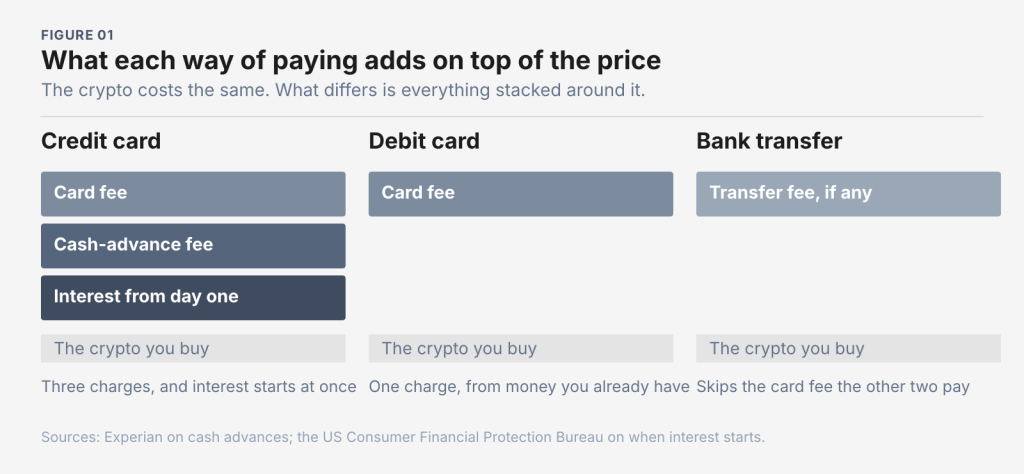
A credit card borrows the money. A debit card and a bank transfer use money you already have. This one difference drives most of the cost.
| Route | Typical speed | What to watch |
| Credit card | Minutes to a few hours | A cash-advance fee, and interest from the day you buy |
| Debit card | Minutes to a few hours | The card fee, the same one a credit card pays |
| Bank transfer | Minutes to a few days | You wait for the money to land before you can buy |
Crypto.com charges 3.99% plus a network fee on card purchases through its Pay on-ramp (May 2026), and that is before your issuer adds anything of its own.
What the issuer adds is the part people usually miss. Experian puts a cash-advance fee at “3% to 5% of the amount, or a flat minimum, whichever is greater”.
The interest does not wait either. The US Consumer Financial Protection Bureau says “interest on a cash advance starts as soon as you withdraw your money”, unlike other purchases “that have a grace period before they start to accrue interest”.
Put together, on a $500 credit card buy that is roughly $20 to the platform and another $15 to $25 to your issuer, so about $45 gone before a single day of interest. The same $500 on a debit card costs you the $20 and nothing else.
This matters most when the price falls. Experian warns you could be left “paying high interest on a balance that’s now worth less than what you charged”. Neither of the other two routes (debit card, bank transfer) carries that risk, because neither one lends you anything.
3. Open an account and pass the ID check
Once you have picked an exchange, create the account and clear its identity check before your first purchase. Identity verification, or KYC, is the ID check a platform runs before it lets you buy.
Have three things ready:
- A government photo ID.
- A recent proof of address, usually dated within the last three months.
- National ID or tax number your country requires.
Many checks clear in minutes, though some go to manual review and take longer. Some exchanges also hold card payments back until an account reaches a higher verification tier. Either way, start this before the day you plan to buy.
4. Add your payment method and buy
With the account verified, a card buy is four moves on the buy screen.
- Open the buy screen and choose your amount.
- Add the card in your own name. Many exchanges refuse prepaid, virtual, and business cards.
- Read the fee line before you confirm. It shows the platform’s charge, not your issuer’s.
- Confirm and approve the 3-D Secure check if your bank asks. A 3-D Secure check is the extra approval your bank requests on an online card payment.
If you buy crypto with a debit card, the steps are identical and only the funding source changes.
A bank transfer works the other way round. On most exchanges, you deposit first, wait for the money to reach your balance, then place the buy as a separate step, though a few take the bank payment straight into the order. Nothing is bought while the transfer is moving, so the price you pay is the price when the money lands, not the price when you sent it. On a volatile day, this gap is the cost of the cheaper route.
When the coins show in your balance, decide where to store your crypto.
5. Fix a failed payment and keep a record
Declines are common on crypto buys, and the cause is often the card issuer, not the exchange. Binance’s own error text says as much: “Transaction declined by issuing bank. Please contact your bank or try a different bank card.”
Work through it in order:
- Ask your issuer whether it blocks crypto purchases at all.
- Check that you finished the 3-D Secure step, which MoonPay lists among the reasons a purchase fails.
- Then try a debit card on the same checkout, which is the dullest fix and, in our experience, the one that works most often.
A failed card buy can still leave money out of reach for a while. A pre-authorisation hold is money your bank sets aside while it checks a payment, not a charge. MoonPay says release typically takes up to 10 business days.
When you buy crypto with a bank transfer instead, late money is a different problem: stated deposit times are estimates rather than promises. A P2P exchange, where you buy from another person instead of the platform, is one way around a stuck transfer.
Save the date, amount, price, and fee of every buy. Tax authorities generally expect you to hold purchase records, and an exchange export will not always outlive the account.
The Bottom Line on Buying Crypto by Card or Bank Transfer
The question is whether speed is worth the price. A credit card adds a cash-advance fee and starts charging interest the day you buy, which is a poor trade for an asset that can fall before the statement arrives. A debit card gives you the same speed without the borrowing. A bank transfer skips the card fee altogether, and asks you to wait and to take the price you find on arrival.
The plain rule is this: do not put crypto on a credit card unless you can clear the balance before the interest builds. Whichever route you choose, read the fee line on the confirmation screen before you approve the order.
Frequently Asked Questions
Can you buy crypto with a credit card?
Yes, where both your card issuer and the exchange allow it, though plenty of each do not. Coinbase refuses credit cards outright; Binance accepts them from over 220 card-issuing countries, so check the payment page for your country before you open an account.
Is a bank transfer cheaper than a credit card?
Yes, because a transfer avoids the card fee that both card routes pay, and the cash-advance charges a credit card adds on top. What you give up is time, since a transfer can take days and you buy at whatever the price is when the money lands.
Should I use a debit card instead?
For most buyers, yes. It is the same checkout at the same speed, but it spends money you already have, which is why some exchanges refuse credit cards and still take debit.
Why was my card declined when buying crypto?
Most often, your issuer blocks crypto purchases, or the exchange will not take your type of card; prepaid, virtual, and business cards are commonly refused. Binance tells buyers to contact the bank or try a different card, which is the right order to work in.

Our Review Methodology
We evaluate each post based on thorough research, credibility of sources, accuracy of information, and relevance to our readers. Our editorial team follows strict guidelines to ensure all content meets high standards of quality.
Disclaimer
The content in this article is provided for informational purposes only and does not constitute financial, investment, or professional advice. Always do your own research before making any decisions.