A crypto exchange with a budget finds out quickly how little of it can be spent the obvious way. This is because Google permits ads for exchanges and software wallets in a named list of countries only, and only where the firm holds that market’s registration, CASP authorisation in the EU, FinCEN in the United States, FINTRAC in Canada, alongside separate certification from Google. Hardware wallets get in more easily, needing certification and local compliance but no license, provided the device doesn’t also buy, sell or exchange anything. Most of what sits around those products is refused outright: initial coin offerings, DeFi protocols, trading signals, crypto loans.
So, the money goes somewhere else: Firms buying crypto marketing services usually start with whatever is easiest to purchase, which is close to the worst possible order.
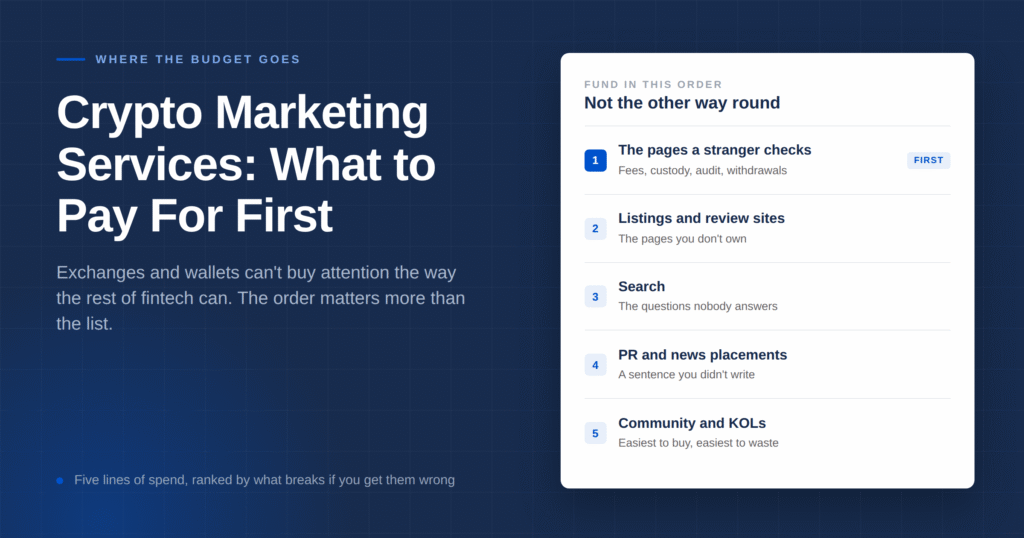
Five things are worth paying for. They are listed here in the order they should be funded:
- The pages a stranger checks before funding an account
- Listings and review sites
- Search
- PR and news placements
- Community and KOLs
Why the order matters more than the list
Item one lies apart from the rest. Every channel below it sends a stranger to the same place through a directory entry, a search result, a journalist’s link, or a creator’s post. If the pages they land on don’t answer the question they arrived with, all four are just buying visits, and the reporting on those four measures traffic that was never going to convert. Item one is the condition the other four get funded against.
The remaining four are ordered by something duller: how expensive the mistake is to undo.
A wrong listing can stay on a third-party site for months. You don’t own the page, you have to ask someone to change it, and until they do, the wrong fee schedule is what a buyer reads. A wrong search strategy costs you the months you spent publishing pages nobody searches for, and you correct it by publishing different ones. A creator deal that lands badly is finished when the post stops circulating.
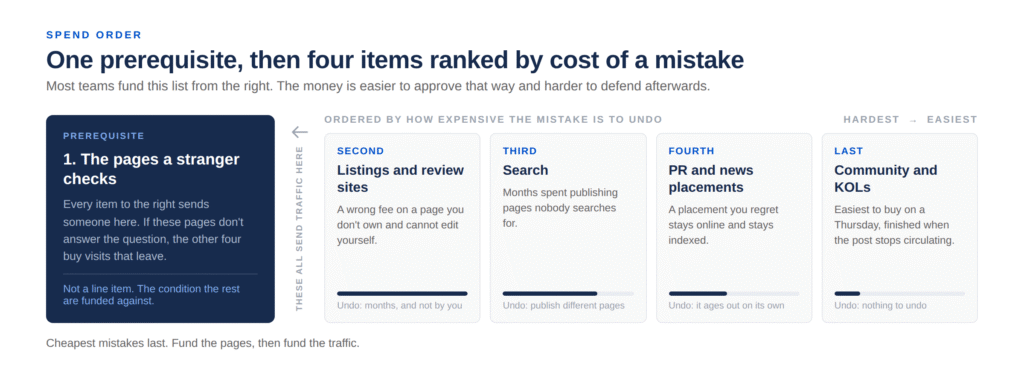
Teams tend to run crypto exchange marketing backwards. The last item is the easiest thing to buy on a Thursday afternoon. The first one requires the marketing team and the product team to agree on what the product does, which takes longer than any campaign.
First: The pages a stranger checks
In crypto, they are nearly always the pages with this information: the full fee schedule including withdrawal and network costs, who holds the assets and under what arrangement, the current audit or proof-of-reserves position including what was covered and when it was last done, which legal entity is licensed and in which jurisdiction, what the withdrawal process looks like including limits and timing, and what happens when something breaks.
Many firms treat audit status as an announcement. It gets a press release on the day it completes and nothing permanent afterwards, so the person who goes looking six months later finds a dated news item and no latest page. This is a standing answer the firm should own, and it costs almost nothing to maintain once it exists.
Even a support page listing hours and an email address answers nothing about what happens to an open position during an outage, how long a stuck withdrawal takes to resolve, or who a customer reaches after the chatbot.
In most categories, a thin product page costs some conversion. In crypto, it costs the customer, because the person reading has usually already lost money somewhere, or knows someone who did, and they are reading to find a reason to stop. Crypto wallet marketing has the same problem in a narrower form: the buyer’s entire question is what happens when the device is lost. Go through the wallet reviews before you read your own pages against it. A reader arriving from that review has already been told the product works. So, your pages have to survive the check that follows.
Budget here is usually writing and decisions. Most of the cost is the hours it takes for legal and product to agree on what can be published about custody, and that sits on nobody’s marketing line, which is why it rarely gets funded.
Second: Listings and Review Sites
Search your own brand name and count how many of the first ten results you control. For most exchanges, the answer is two or three. The rest belong to aggregators, comparison pages and review sites, so the version of your firm that a buyer reads has been assembled by people you have never spoken to.
You can’t remove those pages but you can be correct on them. Supported assets, current fee tiers, the licensed entity, the countries you accept users from: each of those appears on dozens of third-party pages, and each goes stale the moment you change something internally. A fee change that took a day to ship takes a quarter to propagate across the sites that publish it.
Being listed is not a reputation, and a stale listing does more damage than no listing, because a buyer who finds one fee on a directory and a different fee on your site stops trusting both numbers. The exchange reviews here show how much detail these pages now carry: withdrawal limits, order types, regional restrictions.
Getting it right once is a project, but keeping it right is a standing job, and that is the point where most firms stop handling it internally and start paying for crypto marketing services with someone responsible for the whole surface.
Third: Search
These are the searches worth owning in crypto, and may appear uncomfortable to most firms:
- How long a withdrawal takes when the network is congested.
- What proof of reserves actually proves, and what it leaves out.
- Whether a recovery phrase can be restored on a different brand of device.
- What happens to an open order if the exchange halts trading.
These get searched constantly and answered almost nowhere, because answering them means writing down a commitment in public.
Most firms publish the comfortable version: what is a blockchain, how to buy your first coin, why volatility happens. Those pages compete with every other exchange’s identical page and with Investopedia, and they collect readers who are months away from depositing anything.
Crypto SEO gets sold as a keyword list. The version that works is a list of questions the firm has been avoiding. The uncomfortable ones come last in a buyer’s sequence, which is exactly what makes them worth the effort: someone asking what happens to an open order during a halt has already chosen the category, already has money to move, and is looking for the one answer that settles where it goes.
This is a small share of spend in year one and it compounds more slowly than anything else here. It also outlasts everything else here. A page that answers a mechanical question correctly is still answering it in three years.
Fourth: PR and News Placements
Press does one thing paid channels can’t: it puts your name in a sentence you didn’t write. For a category where the ad account may be restricted or closed altogether, that third-party sentence carries weight the ad never had, and it feeds the sources search engines and answer engines pull from when someone asks which exchanges are licensed in a given market.
Crypto PR has a paid tier and everyone in the audience knows it. A placement that reads as bought does the opposite of the job, because a reader who spots the pattern discounts every other mention of you they find afterwards.
On the reversibility scale that orders this list, PR sits second from the bottom. A placement you regret stays online and stays indexed, which makes it stickier than a creator post that stops circulating on its own. It still costs less than the months a wrong search strategy burns, because one bad article ages out of the results without you doing anything.
The test is whether the piece would survive being read by someone who already assumes the worst about the category. That rules out the announcement of a partnership nobody asked about. It leaves what is actually news: a licence granted, an audit published in full and with the standing page to match, a technical failure explained honestly along with what changed afterwards.
The last of those is the hardest to get signed off and the one that keeps paying. A firm that publishes a clear account of its own outage gets cited for years by people writing about outages, and none of those citations cost anything.
Last: Community and KOLs
KOL marketing are at the bottom because it is the most reversible line on the list and the most dependent on everything above it.
A creator with an engaged audience can send several thousand people to your site in an afternoon. But, where those people land is item one’s problem, and if the pages are thin, the money bought a spike in analytics and nothing that appears in deposits a week later. This is the clearest case on the list of spend being blamed for the wrong failure: the creator deal is written off when the destination is what failed.
Practical points on this:
Disclosure rules for paid promotion of financial products differ by country and are enforced unevenly, so the risk isn’t distributed evenly either. A creator who doesn’t disclose stops being only their own problem the moment your name is in the post.
And audience size predicts almost nothing. A trader with eleven thousand followers who answers technical questions in the replies is worth more than an account with three hundred thousand posting price screenshots, because the first one’s audience is already asking the questions your product answers.
This is the whole case for putting it last. Everything above it makes a creator post worth more; nothing a creator does makes a thin fee page worth more.
The Bottom Line
Apart from being an effective way, the order also determines what to stop paying for. A retainer for community management sitting on top of a fee page that hasn’t been updated since the last fee change is money spent sending people somewhere you already know they won’t stay.
Frequently Asked Questions
What do crypto marketing services usually include?
Content and page work on the firm’s own site, listing and review-site management, search, media relations, and paid or organic creator work, with community management often attached. The mix moves with licence status. A firm that can’t buy ads has no paid shortcut to the top of a results page, so the site, the listings and the creator work each carry more than they would in a category where an ad account solves the problem.
Can a crypto exchange run paid ads at all?
Exchanges and software wallets can, in a limited set of countries, with that market’s registration and Google’s certification. Two things founders tend to miss. Approval is handled one country at a time, so clearance in Germany tells you nothing about clearance in Japan, and a campaign built for an approved market can’t simply be pointed at a new one. And the other large platforms run their own rules on their own timetable, which means each platform is a separate application with its own answer.
How much of a crypto marketing budget should go to PR?
There’s no percentage worth quoting, because it depends on whether you have news. A firm with a licence approval, a completed audit or a published incident report has something a journalist can use, and the budget should follow it. A firm with nothing to announce should put that money into the pages in item one and wait.

Our Review Methodology
We evaluate each post based on thorough research, credibility of sources, accuracy of information, and relevance to our readers. Our editorial team follows strict guidelines to ensure all content meets high standards of quality.
Disclaimer
The content in this article is provided for informational purposes only and does not constitute financial, investment, or professional advice. Always do your own research before making any decisions.