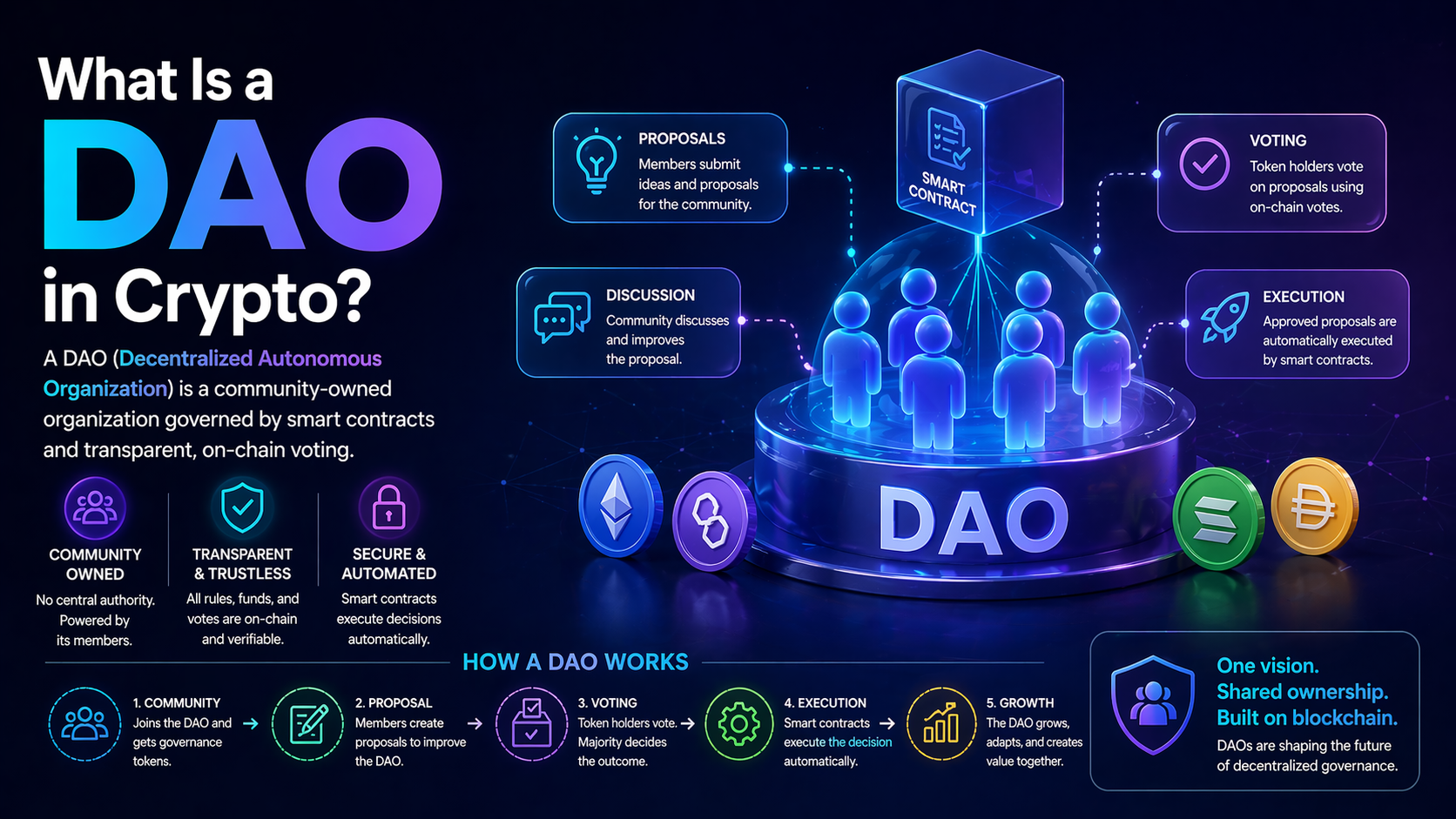
A DAO (Decentralized Autonomous Organization) is a member-governed organization run by smart contracts on a blockchain, no CEO, no board, no central office. Rules are coded in advance and execute automatically when voted through. Over 13,000 DAOs now manage a collective $24.5 billion in on-chain treasuries as of 2025 (CoinLaw, 2025). Members vote using governance tokens, more tokens typically means more voting power.
What Actually Is a DAO in Crypto?
A DAO is an organization where code replaces management, smart contracts on a blockchain handle the rules, and the community votes on every significant decision.
Think of it like this: a company where every shareholder votes on every major decision, the votes happen on-chain, and results execute automatically. Nobody can call a lawyer to reverse a passed vote.
I’ve been watching DAOs evolve since DeFi Summer 2020, when Compound launched its COMP token and essentially invented the governance playbook everyone else copied. Back then, “DAO” often meant a governance experiment with a tiny treasury and almost no participation. What’s changed since is scale, though not necessarily quality.
The fundamental structure has three parts. Smart contracts are the backbone, self-executing code deployed on a blockchain (Ethereum in most cases) that can’t be edited by any single person once live. Governance tokens are the membership card and voting instrument. Hold tokens, cast votes. A treasury holds the DAO’s collective funds, controlled by the smart contracts. Transparent to everyone. Accessible to no one unilaterally, in theory.
We’ll come back to the “in theory” part. It’s important.
How Do DAOs Work? Proposals, Votes, Smart Contracts
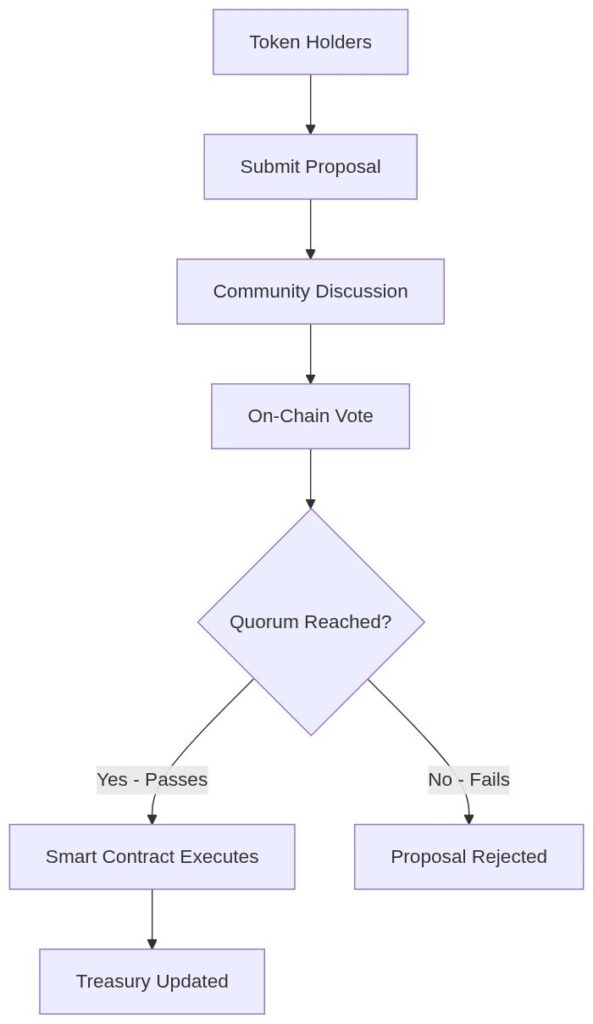
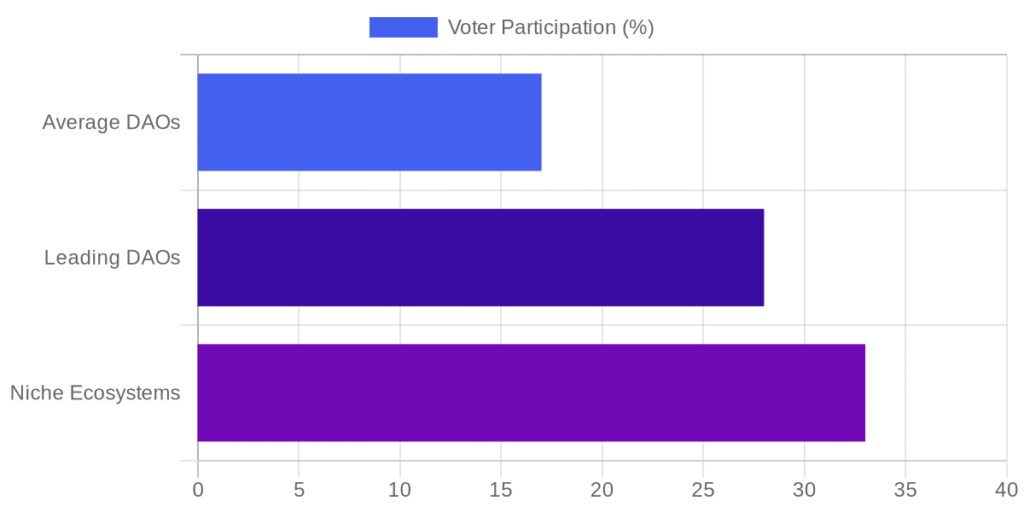
Average voter turnout across all DAOs sits at 17% of token holders (CoinLaw, 2025). That’s the context for everything that follows about governance. Here’s the loop that makes a DAO run: someone submits a proposal, token holders vote, the smart contract executes the result. No lawyers, No signatures and No waiting for a board meeting.
- Submitting a proposal. Most DAOs require a minimum token holding just to propose, this filters out spam. The proposal sits in a discussion forum for a few days, then moves to an on-chain vote. In practice, this period is where the real debate happens.
- Voting with tokens. Each token equals one vote in the most common model. The vote runs for a fixed period, usually three to seven days. The mechanism seems simple, but it concentrates power fast.
- Smart contract execution. If a proposal hits quorum and passes, the smart contract executes it automatically. No human approval needed. A vote to move $10 million from the treasury to a development fund runs itself if it clears the threshold.
What a Real Vote Looks Like
Uniswap DAO voted in 2023 on whether to deploy Uniswap v3 on the BNB Chain. Token holders debated it for weeks on the governance forum, then voted on-chain. It passed. The deployment happened, automatically, via smart contract. No Uniswap Inc. employee approved it. No manual transfer. That’s the model working as designed.
Not every vote runs that smoothly. The governance concentration data tells a more complicated story.
What Is a DAO Governance Token?
Most governance token holders never actually vote with them. Research by Barbereau et al. (2023) found less than 1% of holders voted over a four-year period across nine major Ethereum governance tokens. As of 2025, there are 6.5 million+ governance token holders globally (CoinLaw, 2025), the vast majority hold passively, either unaware their tokens have governance function or simply uninterested in the proposals. That’s a meaningful gap between what token-based governance promises and what it delivers.
Governance tokens aren’t purely for voting, though. In protocols like Uniswap (UNI), Aave (AAVE), MakerDAO (MKR), and Arbitrum (ARB), tokens also carry economic exposure, fee revenue, staking rewards, and treasury distributions. That dual function is why they trade on open markets and fluctuate in price like any other crypto asset.
Worth knowing before you buy a governance token as an investment: voting power is real, but concentrated. CoinLaw (2025) found that the top 5% of token holders control 80%+ of voting power across major DAOs. The math on “community governance” often works out to a small group of early investors and protocol teams running the show.
Token-Weighted Voting: The Core Trade-Off
Token-weighted voting has one obvious flaw. Most tokens go to whoever bought early or funded the protocol. That’s not decentralization, it’s plutocracy with extra steps, and it’s the design most DAOs actually use because it’s simple to deploy.
The alternatives exist but add complexity. Quadratic voting scales power as the square root of tokens held, 100 tokens gives 10 votes, not 100. Reduces whale dominance but requires identity verification to prevent Sybil attacks (one person splitting tokens across many wallets). Conviction voting accumulates votes over time based on sustained commitment. Reputation-based systems weight votes by past contributions, not holdings. Less common because quantifying contribution is hard.
Most DAOs still default to token-weighted. The large holders who set up most protocols prefer the model they already control. That’s not cynicism, it’s just how incentive structures work.
“The dirty secret of on-chain governance is that most DAOs have replicated corporate board dynamics with worse accountability. Token-weighted voting mathematically guarantees plutocracy unless you solve identity first — and solving identity on-chain is a problem nobody has cracked at scale.” — Vitalik Buterin, Co-founder of Ethereum (from his 2021 essay “Moving Beyond Coin Voting Governance”)
Types of DAOs Running in 2026
Not all DAOs are the same category. The type shapes governance structure, token economics, and risk profile. Here’s what’s actually operating at scale in 2026.
- Protocol DAOs are the biggest and most influential. They govern the rules of a DeFi protocol, fee structures, parameter changes, upgrades, treasury allocations. MakerDAO, Aave, Uniswap. DeFi DAOs collectively hold around $7.5 billion across 70 identified organizations (CoinLaw, 2025). When people talk about “DAO governance mattering,” protocol DAOs are what they mean.
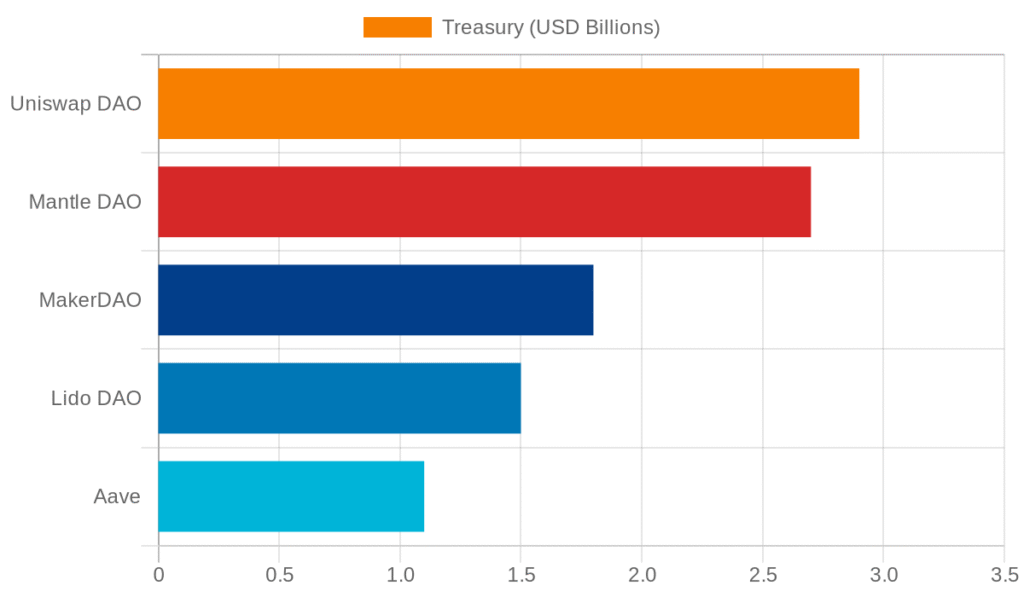
- Investment DAOs pool capital and vote on where to deploy it, decentralized VC funds, essentially. Members contribute funds, receive tokens representing their stake, and vote on investment decisions. The Mantle DAO, with a $2.70 billion treasury as of April 2025, is one of the largest examples.
- Social DAOs organize around a shared interest rather than a protocol. Friends With Benefits (FWB) is the most well-known. Smaller financially. More experimental in governance. Often the most interesting to watch because they’re solving coordination problems that traditional organizations haven’t even named yet.
- Grant DAOs fund ecosystem development. Nouns DAO auctions off one NFT per day, with all proceeds going to a community treasury that votes on grants. Simple model, surprisingly durable.
- Gaming DAOs are the fastest-growing category, up 180% since 2023 (CoinLaw, 2025). Still small in treasury terms compared to DeFi, but growing faster than any other sector.
The Best DAOs in 2026 Worth Knowing
Thirteen thousand-plus DAOs exist. Most are dormant, underfunded, or governance theater. The ones worth knowing have either serious treasury size, active governance participation, or both. Here are five.
- Uniswap DAO holds the largest treasury at $2.9 billion and governs the most widely-used decentralized exchange in crypto (CoinLaw, 2025). UNI holders vote on fee switch activation, v3 deployments to new chains, and protocol upgrades. Participation on major votes runs around 20–25%, above average for the sector. The fee switch debate ran for over a year before any resolution, which tells you something about how slow governance can be even when the stakes are high.
- MakerDAO (now Sky Protocol) is the original DeFi DAO. It governs DAI, rebranded to USDS, one of the oldest decentralized stablecoins. MKR holders vote on collateral types, risk parameters, and stability fees. Maker has maintained more consistent governance cadence than almost anyone else over six years. Not perfect, but more consistent.
- Lido DAO governs the largest liquid staking protocol on Ethereum, and the centralization risk here is a real conversation. LDO token holders control fee structure, validator onboarding, and treasury deployment. The uncomfortable fact: Lido controls 30%+ of staked ETH. That means Lido DAO’s governance decisions are genuinely systemic for Ethereum’s security model. Not just “interesting”, actually consequential.
- Arbitrum DAO handles things differently for a rollup. ARB token holders vote on Arbitrum One and Arbitrum Nova parameters, ecosystem grants, and the security council membership. With 3.5 billion ARB in treasury (CoinLaw, 2025), it’s among the best-funded newer DAOs.
- ConstitutionDAO is the example I give anyone who asks “but what can you actually do with a DAO?” It formed in November 2021, raised $47 million in ETH in a week from strangers on the internet, bid on a physical copy of the US Constitution at Sotheby’s, and lost by a narrow margin to a private bidder. The money was returned. The DAO dissolved. But it proved something nobody had demonstrated before: a DAO can mobilize capital from thousands of anonymous participants faster than any traditional institution, and it can do it to buy a piece of paper.
| DAO | Type | Treasury | Governance Model | Voter Turnout | Token |
|---|---|---|---|---|---|
| Uniswap | Protocol | $2.9B | Token-weighted (1 UNI = 1 vote) | 20–25% | UNI |
| MakerDAOnow Sky Protocol | Protocol | $1.8B | Token-weighted with delegation | ~15–20% | MKR |
| Lido | Protocol | $1.5B | Token-weighted | ~10–15% | LDO |
| Arbitrum | Rollup / Protocol | $3.5B (ARB) | Token-weighted + Security Council | ~12–18% | ARB |
| Mantle | Investment | $2.7B | Token-weighted | ~10–15% | MNT |
| ConstitutionDAOdissolved | Special Purpose | $47M (returned) | Token-weighted, single-vote mandate | ~80% | PEOPLE |
| Nouns | Grant | Ongoing (daily auctions) | 1 NFT = 1 vote | ~40–50% | NOUN |
Sources: CoinLaw (2025), DeFiLlama, CoinDesk — Treasury figures as of April 2025. Turnout estimates based on major proposal averages.
The DAO Hack of 2016, Why It Still Shapes Crypto Security
In May 2016, a project called The DAO had just raised $150 million worth of ETH, the largest crowdfund in history at that point (Gemini, 2023). The concept was elegant: a decentralized venture fund where token holders voted on investment proposals. No managers, no fees, no intermediaries. Within three weeks of launching, a hacker drained approximately $60 million.
The exploit was technically clean. The attacker found a reentrancy vulnerability, a flaw where the withdrawal function could be called repeatedly before the contract updated its internal balance. Loop through enough times, drain enough ETH. The code did exactly what it was written to do. That was precisely the problem.
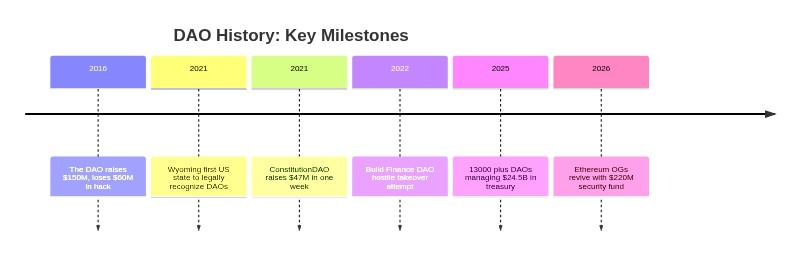
The Ethereum community faced a binary choice. Let the attacker keep $60 million in the name of “code is law”, the principle that blockchain transactions are immutable and irreversible. Or hard fork Ethereum to rewrite the transaction history and recover the funds. Most chose the fork. On July 20, 2016, Ethereum forked at block 192,000. A minority rejected that decision, maintained the original chain, and Ethereum Classic was born.
Students sometimes ask me why a ten-year-old hack still comes up in discussions. Here’s the honest answer: every DAO operating in 2026 has its security architecture shaped by what went wrong in 2016. It’s why professional audits became standard practice. It’s why timelocks exist on major treasury operations. It’s the origin event for a whole field of smart contract security. You can’t understand why DAO developers are paranoid about reentrancy without knowing this story.
The secondary lesson, which gets less attention: “code is law” has limits. The Ethereum community proved that a supermajority can choose to reverse immutable transactions if the stakes are high enough. That’s either reassuring or alarming depending on your view of decentralization. It’s probably both.
What Can Go Wrong? The Risks Nobody Puts in the Headline
The DAO pitch sounds clean: transparent governance, trustless execution, community ownership. Here’s the catch, each of those words has a footnote.
- Governance concentration. Top 5% of token holders control 80%+ of voting power across major DAOs (CoinLaw, 2025). In practice, that concentrates most meaningful governance in early investors and protocol teams. The “community-owned” framing that most DAOs market themselves with often doesn’t survive contact with the token distribution table.
- Smart contract vulnerabilities. Code has bugs. Unlike normal software bugs, a DAO smart contract vulnerability is exploitable by anyone on the blockchain until it’s patched, and patching requires a governance vote that takes days. Time is expensive when someone’s actively draining the treasury. Kelp DAO was exploited for $292 million in April 2026 (CoinDesk, 2026), becoming the largest crypto exploit of the year.
- Voter apathy. Average turnout of 17% (CoinLaw, 2025) means governance is effectively decided by whoever shows up, usually the large holders, since they have the most financial incentive. Less participation means more power concentration. It compounds.
- Hostile takeovers. The 2022 Build Finance DAO attack is the case study. An attacker gradually accumulated enough governance tokens to seize treasury control unilaterally. No smart contract exploit, just governance. The treasury was drained. Legal status and remedies were unclear.
- Legal uncertainty. Over 70% of jurisdictions have unsettled regulatory frameworks for DAOs (CoinLaw, 2025). Wyoming, Vermont, and the US Virgin Islands have formal legal structures. Most places don’t. If your DAO gets sued, the liability question, who’s personally on the hook, if anyone, depends heavily on jurisdiction and is still largely untested in courts.
“DAOs don’t have a governance problem — they have a participation design problem. When voting costs gas, takes research, and offers no direct reward, rational actors free-ride.” — Tarun Chitra, Founder & CEO of Gauntlet (DeFi risk modeling firm)
The Bottom Line on DAOs in Crypto
DAOs are the most interesting governance experiment crypto has produced, and they’re also frequently more centralized than advertised, prone to apathy, and occasionally catastrophically exploited. Both things are true at the same time.
The honest framing: DAOs work best when the community has genuine alignment and the treasury is large enough to fund meaningful work. Uniswap, MakerDAO, Arbitrum, and Lido hit both criteria most of the time. Most of the others don’t. That’s not a criticism of DAOs as a concept, it’s just an accurate description of where the technology actually sits in 2026.
If you’re new to the space, start by reading the future of cryptocurrency and understanding how cryptocurrency works before diving into governance. Understanding centralized vs. decentralized crypto will help frame why DAOs matter. When you’re ready to participate in DAO voting, you’ll need an Ethereum-compatible wallet, MetaMask remains the standard for most Ethereum-based DAOs. Start with reading governance forums before committing capital.
Disclaimer: This article is for informational purposes only and does not constitute financial or investment advice, always do your own research and consult a qualified advisor before committing capital to any DeFi protocol or crypto asset.
Frequently Asked Questions
1. What’s the difference between a DAO and a traditional company?
A traditional company is run by a board and management team who can act without shareholder approval for most decisions. A DAO encodes all major rules in smart contracts, nothing significant executes without a token holder vote clearing a predefined threshold. No CEO can spend from the treasury unilaterally. The flip side: decision-making is slow, voter turnout is often low, and large holders dominate most votes in practice.
2. How do you join a DAO?
Most DAOs require the governance token to vote. Start with an Ethereum-compatible wallet like MetaMask, buy the relevant governance token on a DEX like Uniswap, and you’re technically a member. Some DAOs also offer token delegation, you can assign your voting power to a trusted delegate if you don’t want to track every proposal. A few use NFTs for membership instead of fungible tokens.
3. What happened to The DAO in 2016?
The DAO raised $150 million in ETH in May 2016, was exploited via a reentrancy vulnerability within weeks, and lost roughly $60 million. The Ethereum community responded by hard forking the chain to recover the funds. A minority rejected the fork and maintained the original chain, that’s Ethereum Classic. It’s the founding trauma of smart contract security culture, and it’s why audits and timelocks are now standard.
4. Is Ethereum a DAO?
No. Ethereum is a blockchain protocol with a foundation and a core development team. It uses an informal governance model, the EIP (Ethereum Improvement Proposal) process, with validator consensus determining which software changes get adopted. ETH is a currency and staking asset, not a governance token. Nobody holds ETH to vote on parameter changes; they hold it to use the network or earn staking rewards.
5. Can you make money from a DAO?
Some DAOs distribute protocol fees to token holders, offer staking rewards, or pay contributors for work. Investment DAOs function more like decentralized funds, members pool capital and vote on allocations. But governance tokens are highly volatile and most don’t pay dividends. Sustainable long-term yields typically fall between 3% and 8%, anything above that, ask where the money comes from and whether the source is durable. Read the tokenomics before treating a governance token as a yield vehicle.

Our Review Methodology
We evaluate each post based on thorough research, credibility of sources, accuracy of information, and relevance to our readers. Our editorial team follows strict guidelines to ensure all content meets high standards of quality.
Disclaimer
The content in this article is provided for informational purposes only and does not constitute financial, investment, or professional advice. Always do your own research before making any decisions.