
Gas fees are what you pay to use the Ethereum network. They’re priced in gwei (one billionth of ETH) and calculated as gas units × (base fee + priority tip). Gas Fee Ethereum skyrocket when demand is high — like NFT launches or DeFi frenzy times — and fall during off-peak hours, usually 2–6 AM UTC. For most transactions in 2026, moving to a Layer 2 like Arbitrum or Base cuts costs by 90–99% compared to Ethereum mainnet.
What Is a Gas Fee on Ethereum?
You decide to swap some ETH for USDC on Uniswap. You hit confirm. MetaMask pops up with an estimated fee — maybe $2, maybe $25 depending on the day — and that money leaves your wallet before a single USDC arrives. That’s a gas fee, and it’s probably the most complained-about part of using Ethereum.
Gas fees are the cost of computation on Ethereum. Every operation on the network — sending ETH, executing a smart contract, minting an NFT — requires validators to do real computational work. Gas is how that work gets paid for. Think of it less like a service charge and more like fuel: without it, the transaction simply doesn’t run.
It’s worth noting that gas fees don’t go to Ethereum itself (there’s no company to pay). They compensate the thousands of independent validators running nodes that process and secure the network. The validators get a tip portion of each fee — the rest, called the base fee, is burned (more on that in the EIP-1559 section).
One thing to understand upfront: gas fees are paid in ETH, but priced in a smaller unit called gwei. That distinction matters when you’re reading a wallet confirmation and wondering why the numbers look so strange.
What Is Gwei? Ethereum’s Fee Unit Explained
Gwei is to ETH what cents are to a dollar — except the fraction is about 10 million times smaller. One gwei equals 0.000000001 ETH (one billionth of an ether). The name is short for gigawei, sitting in a hierarchy that runs from wei (the absolute smallest unit) up through gwei to ETH.
Why does this matter? Because “your transaction cost 0.000021 ETH” is awkward to read and harder to compare. “21 gwei” is cleaner. Wallets, block explorers like Etherscan, and gas trackers all display gas prices in gwei for this reason.
| Unit | Value in ETH | Where You See It |
|---|---|---|
| Wei | 0.000000000000000001 ETH | Protocol math, developer tools |
| Gwei | 0.000000001 ETH | Gas price displays in wallets |
| ETH | 1 ETH | Your balance, transfer amounts |
In practice: if MetaMask shows a gas price of 5 gwei and your transaction uses 21,000 gas units, your fee is 5 × 21,000 = 105,000 gwei = 0.000105 ETH. At $3,000 per ETH, that’s about $0.32 for a basic ETH transfer.
Manageable. During the 2021 DeFi frenzy, that same transfer routinely cost $50+ because gas prices spiked above 1,000 gwei. Same computation. Different market conditions.

How Ethereum Gas Fees Are Calculated
Since August 2021 and the London Hard Fork (which introduced EIP-1559), the formula for your total gas fee is:
Total fee = gas units used × (base fee + priority fee)
(You will hardly need a Gas fee Ethereum Calculator for this!)
Three parts. Here’s what each one means:
- Gas units used is a fixed measure of computational work. Sending ETH always costs exactly 21,000 gas units — that’s set at the protocol level and never changes. A Uniswap V3 token swap costs 150,000–300,000 gas units depending on the pool and trade route. Deploying a new smart contract can run 500,000–2,000,000+. The more complex the operation, the more gas it needs.
- Base fee is the minimum price required for a transaction to be included in a block. The network sets this automatically — not you, not the validators. Critically, the base fee is burned, removed from circulation permanently. This is why Ethereum has become disinflationary since 2021: busy periods burn more ETH than validators create through issuance. Since EIP-1559 launched, over 4.5 million ETH has been burned, according to ultrasound.money.
- Priority fee (tip) is optional but practically necessary. It’s the incentive to validators — on top of the base fee — that tells them to include your transaction sooner rather than later. For non-urgent transfers, 0.1–1 gwei is usually fine. If you’re in a race (a hot NFT mint, an arbitrage window), you tip higher.
One thing that trips people up: failed transactions aren’t free. Gas fees pay for computation — and computation happens whether your transaction succeeds or fails. If a transaction runs out of gas mid-execution, you pay for the gas consumed up to that point and get nothing from the transaction itself. Set your gas limit too low and you’ll learn this lesson the hard way.
What Causes Ethereum Gas Fees to Spike?
Block space is finite. Ethereum processes roughly 12–15 transactions per second on mainnet (one block every ~12 seconds, with a 30 million gas limit per block). When demand exceeds supply, the base fee rises automatically — and it can rise fast.
The 2021 NFT boom illustrated this as clearly as anything. During high-demand mints — Bored Apes, CryptoPunks secondary sales, major DeFi protocol launches — thousands of users competed for the same block space simultaneously. Gas prices regularly exceeded 500–1,000 gwei. A Uniswap swap cost $200. A simple ETH transfer cost $50. People were losing more to fees than to slippage.
Factors other than High Demand
The other factor is MEV — Maximal Extractable Value. Bots and sophisticated validators monitor the mempool (the waiting room where unconfirmed transactions sit before inclusion) looking for profitable opportunities: front-running swaps, sandwiching trades, arbitraging price differences. These bots bid aggressively to get their transactions ordered favourably, which drives up priority fees for everyone else even when the base fee is moderate.
Beyond demand spikes and bots, gas prices follow daily patterns that are fairly predictable. US and Asian trading hours see higher network activity. Between 2–6 AM UTC, activity drops across both regions — base fees typically fall substantially. Weekends, especially Saturday and Sunday UTC, tend to be cheaper than weekdays. Blocknative’s 7-day gas heatmap makes this pattern visible.
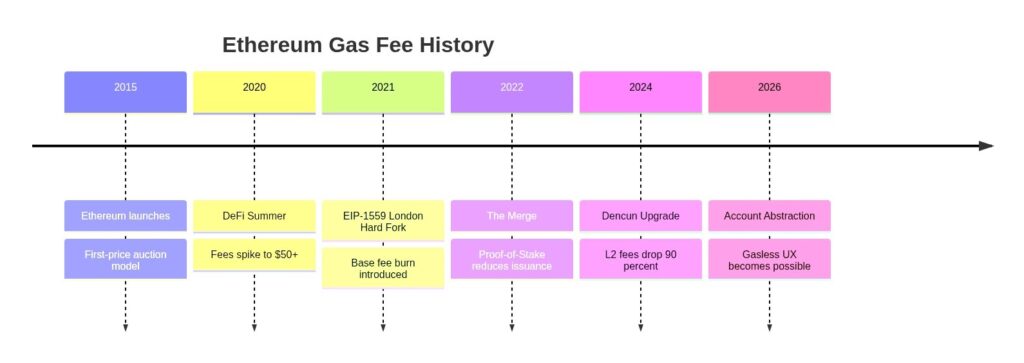
EIP-1559: How Ethereum Overhauled Its Fee Market
Before August 2021, Ethereum used a first-price auction: users bid a gas price, miners picked the highest bids first. The result was constant overbidding and wildly unpredictable fees. You either overpaid to be safe or gambled and waited.
EIP-1559 replaced this with a predictable base fee that:
- Adjusts automatically based on whether the previous block was above or below 50% full
- Rises by up to 12.5% when blocks are full; falls by up to 12.5% when blocks have spare capacity
- Gets burned entirely — it goes to no one, it just disappears from the supply
The practical effects were significant. Fee estimation became more accurate — wallets could suggest reasonable fees without users having to guess. And ETH became deflationary during busy periods. Since the upgrade, over 4.5 million ETH has been burned (source: ultrasound.money), directly reducing total supply and creating deflationary pressure that didn’t exist under the old model.
The priority fee (tip) still exists and still goes to validators. It’s the incentive to get your transaction processed within a specific block rather than the next one. But eliminating the pure auction for the base fee made fees less chaotic, even if not necessarily lower during congestion events.
Having said that, EIP-1559 didn’t solve the underlying problem: limited block space. It just made fees more predictable. During genuine congestion, fees still spike — the mechanism just means they spike and fall more smoothly than the old bidding wars. To add here, I spent almost three months using Uniswap on mainnet in early 2023 before I figured out Arbitrum was a thing. Looking back, I paid probably $400 in gas fees on swaps that would have cost me under $2 on L2. No one explained that to me when I started. I think that’s how experiences are gained, and lessons are learnt in the crypto business.
Gas Fee Ranges: What Different Transactions Actually Cost
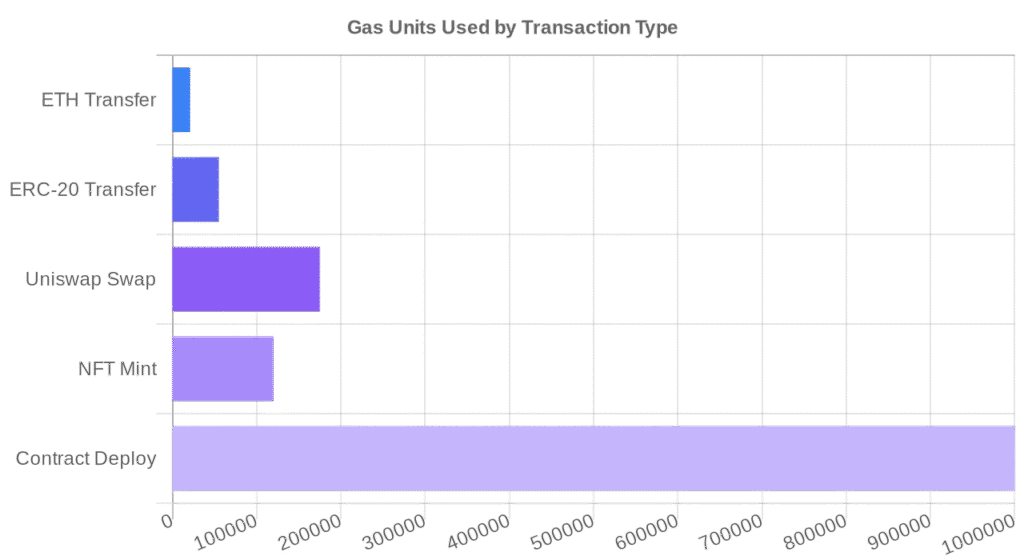
Not all Ethereum transactions are equal. Here’s a realistic breakdown of gas usage and cost at 10 gwei with ETH at $3,000:
| Transaction Type | Gas Units Used | Cost at 10 gwei ($3K ETH) |
|---|---|---|
| ETH transfer (simple) | 21,000 | ~$0.63 |
| ERC-20 token transfer | 45,000–65,000 | ~$1.35–$1.95 |
| Uniswap V3 token swap | 150,000–200,000 | ~$4.50–$6.00 |
| NFT mint (simple ERC-721) | 80,000–150,000 | ~$2.40–$4.50 |
| Smart contract deployment | 500,000–2,000,000 | ~$15–$60+ |
At 1 gwei — which Ethereum mainnet regularly touches during quiet periods in 2026 — those numbers drop by 10x. At the 2021 peak of 100–1,000 gwei, they multiply by 10–100x. The gas units don’t change — only the price per unit changes.
This is also why ETH price matters: a $0.63 transfer at $3,000 ETH becomes $1.26 at $6,000 ETH, even if gwei is identical. Ethereum transaction cost in dollar terms is a product of both network demand (gwei) and ETH market price.
How to Reduce Ethereum Gas Fees
Here’s the honest part: if you’re using Ethereum mainnet for small transactions in 2026, you’re almost certainly overpaying. These five strategies actually work.
1. Use a Layer 2 network
Layer 2 solutions — Arbitrum, Optimism, Base, zkSync Era — process transactions off Ethereum mainnet and post batched proofs back to it. You inherit Ethereum’s security at a fraction of the cost.
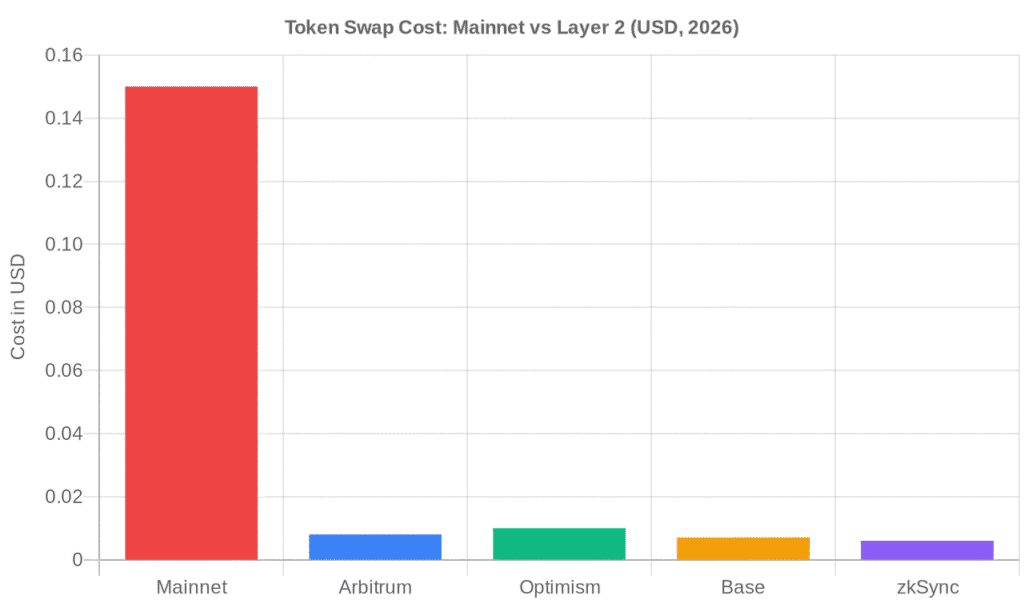
In early 2026, swapping tokens on Ethereum mainnet costs roughly $0.15. The same swap on Arbitrum One costs under $0.01 (source: coinpaprika.com, L2Fees.info). That’s not a modest improvement. For regular DeFi users, this is the single most impactful change available. Most major protocols — Uniswap, Aave, Curve, Compound — are fully deployed on multiple L2s. If you’re paying mainnet fees for routine activity, we’d ask: why?

2. Time your transactions
Gas prices follow demand patterns. UTC 2–6 AM corresponds to overnight hours across the US and after-midnight across Asia — two of the highest-activity regions on Ethereum. When they’re quiet, the base fee drops. For non-urgent transactions, waiting for this window can cut costs by 30–60%.
Blocknative’s Gas Estimator shows a 7-day heatmap of historical gas prices by day and hour. It’s free, it takes 30 seconds to read. For any transaction over $100 in value, checking the timing is worth it.
3. Customize your gas settings
Default gas settings in MetaMask and most wallets are calibrated for speed, not economy. If you’re in no hurry, manually set the priority fee to the minimum — typically 0.1–1 gwei. The base fee is network-set and you can’t change it, but reducing your tip still saves money on every transaction.
Advanced wallet users can also set a max fee cap. If gas spikes above your cap after you submit, the transaction waits in the mempool rather than executing at a higher price.
4. Batch transactions
Instead of making five separate ERC-20 transfers, send all five through a single smart contract call. One transaction instead of five means one base fee instead of five. Wallets with Account Abstraction support — Ambire, Safe, and increasingly consumer wallets in 2025–2026 — handle this natively.
5. Avoid peak windows for NFTs and major events
New collection launches and major DeFi protocol releases cause predictable spikes. If you’re not racing for a limited mint, waiting 30–60 minutes after the initial rush typically cuts gas prices significantly. The demand burst is real, but it normalises quickly once bots and eager buyers have transacted.
Gas Tracking Tools You Should Know
You don’t need to guess at gas prices. These tools provide real data:
- Etherscan Gas Tracker (etherscan.io/gastracker) — The default reference for Ethereum gas fee tracker. Shows current low/average/high gas prices updated every 15 seconds, plus same-day historical trend. If you only bookmark one, make it this one.
- Blocknative Gas Estimator (blocknative.com/gas-estimator) — Includes a 7-day heatmap by hour and day of week. Better for planning recurring transactions than for real-time monitoring.
- L2Fees.info — Compares transaction costs across Ethereum mainnet and major L2s in real time, broken out by transaction type (ETH transfer, ERC-20 transfer, swap, etc.). Directly answers “how much cheaper is Arbitrum for my specific transaction right now?”
- Ultrasound.money — Tracks ETH burn rate and supply impact from EIP-1559. Less useful for timing decisions but gives a clear picture of how much ETH has been removed from supply since August 2021.
What’s Next for Ethereum Gas Fees?
Not much change at the extremes but the middle has already shifted substantially.
According to my understanding, the March 2024 Dencun upgrade introduced proto-danksharding (EIP-4844), adding a new “blob” data type designed specifically for L2 settlement. That is why, L2 fees dropped 90%+ within days. A transaction that cost $0.10 on Arbitrum fell to $0.001. That wasn’t gradual — it happened almost overnight when the upgrade activated.
“Blobs are a game changer. They reduce the cost for rollups to post data to Ethereum by 10–100x.”
— Vitalik Buterin, co-founder of Ethereum, on EIP-4844 (proto-danksharding), technical blog post, March 2024
Ethereum’s longer-term roadmap includes full danksharding (which increases blob capacity further) and continued Account Abstraction rollout. ERC-4337 — the Account Abstraction standard — lets dApps pay gas on behalf of users, or allow payment in stablecoins instead of ETH. Several apps already use this. You complete a transaction and never see a gas fee pop-up.
Conclusion
The net direction: Ethereum mainnet is becoming a settlement and security layer. Most users will interact through L2s where fees are effectively negligible for all but the largest transactions. The “gas fee problem” that defined the 2021–2022 era has been largely addressed through architecture.
Mainnet will still spike during genuine congestion events — major NFT launches, black swan market moments. The base fee mechanism adjusts 12.5% per block, so a sudden 10x demand surge takes time to normalise. That’s not going away. But for routine DeFi and transfers, gas is increasingly a background cost rather than a barrier.
Frequently Asked Questions About Ethereum Gas Fees
1.What are gas fees on Ethereum in simple terms?
Gas fees are payments that compensate Ethereum validators for processing your transaction. Think of gas as the fuel that powers any operation on the network — sending ETH, swapping tokens, minting NFTs. Without it, the transaction doesn’t run. The fee amount depends on how much computation your transaction requires (measured in gas units) and how busy the network is (which sets the price per unit in gwei).
2. What is gwei and how does it relate to ETH?
Gwei is a denomination of ETH — one gwei equals 0.000000001 ETH (one billionth). Gas prices are quoted in gwei because the numbers are more readable that way. When MetaMask shows a gas price of 10 gwei and your transaction uses 21,000 units, your fee is 0.00021 ETH. At $3,000 per ETH, that’s $0.63. The gwei unit is just a convenience — you’re always paying in ETH.
3. Why are my Ethereum gas fees so high?
Usually one of three reasons. First, network congestion: too many transactions competing for limited block space, pushing the base fee up. Second, transaction complexity: smart contract interactions like Uniswap swaps require far more computation than a simple ETH transfer. Third, ETH price: even at identical gwei, a higher ETH price means higher dollar costs. The most reliable fix for regular high fees is using a Layer 2 network where base fees are a fraction of mainnet.
4. Do you pay gas fees for failed Ethereum transactions?
Yes — and this surprises a lot of people. Gas compensates validators for computation, which happens whether the transaction succeeds or fails. If your transaction fails mid-execution (most commonly from insufficient gas limit or a smart contract revert), you pay for all gas consumed up to the failure point. You won’t receive what the transaction was supposed to deliver, but the gas is gone.
5. What’s the cheapest way to use Ethereum in 2026?
Use a Layer 2. Arbitrum, Base, and zkSync Era routinely execute the same transactions that cost $0.15–$5 on Ethereum mainnet for under $0.01. Most major DeFi protocols — Uniswap, Aave, Curve — are fully deployed on these networks. Beyond that: check Blocknative’s gas heatmap for timing, set your priority fee manually to the minimum when you’re not in a rush, and avoid submitting transactions during major NFT launch windows when gas spikes are predictable.

Our Review Methodology
We evaluate each post based on thorough research, credibility of sources, accuracy of information, and relevance to our readers. Our editorial team follows strict guidelines to ensure all content meets high standards of quality.
Disclaimer
The content in this article is provided for informational purposes only and does not constitute financial, investment, or professional advice. Always do your own research before making any decisions.