CoinDCX is legal to use in India and registered with FIU-IND, which settles the question this page was written to answer. The risk lies in custody, not legality. Two wallet losses in 15 months, with the second disclosed late, mean you should not leave large balances on any exchange. Trade with what you need, withdraw the rest, and keep records for the 30% tax.
Quick Verdict
CoinDCX is legal to use in India, and it is registered with the Financial Intelligence Unit (FIU-IND) as a virtual digital asset service provider. Legal, however, does not mean fully protected. India has no crypto licensing law, and CoinDCX has lost money twice from its own wallets: about $44 million in July 2025 and about $16 million, disclosed in October 2026. Customer balances were reported as unaffected both times. Use it for INR trading, and keep only what you plan to trade on the exchange.
Key Takeaways
- CoinDCX is legal to use in India, but no regulator licenses or insures it.
- FIU-IND registration is an anti-money laundering registration, not a safety guarantee.
- Fees start at 0.50% on a spot INR trade and fall only as your 30-day volume rises.
- Two wallet losses in 15 months, both absorbed by the company, are the main risks to weigh.
- Crypto gains are taxed at 30% in India, regardless of which exchange you use.
Pros
- Legal and registered: CoinDCX is on the FIU-IND list of registered virtual digital asset service providers.
- Free INR transfers: Rupee deposits and withdrawals carry no fee.
- Wide coin list: More than 500 assets are listed.
- Large user base: CoinDCX reports over 2 crore (20 million) registered users.
- Round-the-clock support: Live chat runs 24/7.
Cons
- High entry fees: The standard spot fee is 0.50% until your 30-day volume grows.
- Repeated wallet losses: Two losses from company-held wallets in 15 months.
- Slow disclosure: The CEO called the October 2026 reports a false alarm before the company confirmed the loss.
- No investor protection scheme: CoinDCX does not describe any insurance or compensation fund on its security page.
- Heavy tax drag: Indian crypto tax rules apply to every trade.
- Weak user ratings: A 1.4 out of 5 TrustScore on Trustpilot, with complaints about withdrawals, KYC, and support.
CoinDCX Overview
| Parameter | Details |
|---|---|
| Exchange Name | CoinDCX |
| Year Established | 2018 |
| Headquarters Location | Mumbai, Maharashtra, India |
| Regulatory Compliance | Registered with FIU-IND as a virtual digital asset service provider (an anti-money laundering registration, not a licence) |
| Available Cryptocurrencies | 500+ |
| Fiat Currency Support | INR (Indian Rupee) |
| Native Token (if any) | None |
| Maker Fees | 0.50% at the entry tier, falling to 0.03% at the top VIP tier (spot INR) |
| Taker Fees | 0.50% at the entry tier, falling to 0.03% at the top VIP tier (spot INR) |
| KYC Required | Yes |
| Deposit Methods | INR bank deposit (minimum Rs 500, free); crypto deposits to wallet addresses |
| Withdrawal Methods | INR to a bank account (minimum Rs 100, free); crypto to external wallets with a per-coin fee |
| Mobile App Availability | Android, iOS |
| Support Channels | Live chat, help centre, email |
| Support Availability | 24/7 |
Introduction
CoinDCX began in 2018 and is one of India’s largest crypto exchanges. It reports more than 2 crore registered users and lists over 500 assets. Coinbase invested in the company in October 2025 at a valuation of $2.45 billion, according to CEO Sumit Gupta.
This CoinDCX review answers the question most Indian users ask first: is CoinDCX legal? It also covers safety, fees, features, and support, with every figure checked against CoinDCX’s own pages and published reports on 30 October 2026.
Is CoinDCX Safe?
CoinDCX is safe in the sense that customer funds have not been reported lost, but its own wallets have been hit twice. This section covers the legal position first, then the security record.
Regulatory Compliance
CoinDCX operates openly under the name Neblio Technologies Private Limited. It appears on the list of virtual digital asset service providers that are registered with FIU-IND, under the FIU-IND notice on VDA service providers.
Registration means CoinDCX must follow anti-money laundering rules, including KYC and reporting suspicious transactions. It does not mean a regulator has licensed the exchange or backs your funds. India has no dedicated crypto law, so no regulator approves exchanges or insures balances. A parliamentary study on virtual digital assets was still under discussion when we checked, and we found no sign of a passed law.
CoinDCX’s legal status in India also depends on tax. Gains from selling crypto are taxed at a flat 30% (plus cess), losses cannot be set off against other income, and a 1% TDS applies to transfers. These rules carry over to the Income-tax Act, 2025, which replaced the 1961 Act from 1 April 2026. In June 2021, the Enforcement Directorate also sent CoinDCX and CoinSwitch notices seeking information under the foreign exchange law, FEMA.
Security Features
CoinDCX’s security page lists multi-signature cold wallets, two-factor login through email, SMS, or an authenticator app, and ISO/IEC 27001:2022 certification. It also runs a bug bounty programme and shares a proof-of-reserves report every quarter. The CoinDCX security page does not mention any insurance or compensation fund.
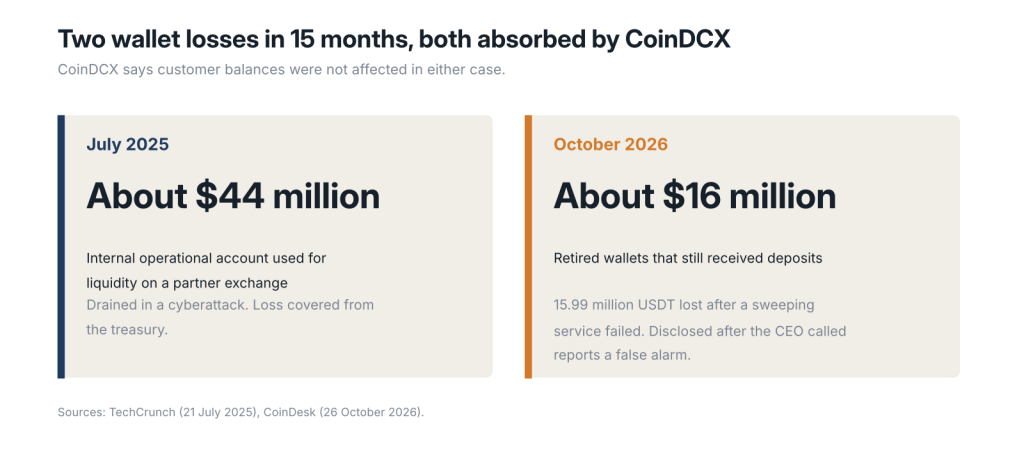
The CoinDCX hack of July 2025 and the October 2026 loss test those claims:
- July 2025: Attackers drained about $44 million from an internal operational account used for liquidity on a partner exchange. Gupta told TechCrunch: “The incident was quickly contained by isolating the affected operational account.” Customer wallets were not touched, and CoinDCX covered the loss from its treasury, as TechCrunch reported.
- October 2026: About 15.99 million USDT left retired wallets after an automated sweeping service failed to move deposits into the main wallet. CoinDCX says the company absorbed the loss and that customer balances and trading were unaffected. CoinDesk reported that Gupta first called the reports a false alarm, and that CoinDCX later said it “could have been more proactive” in disclosing the loss.
Privacy Practices
CoinDCX collects identity documents and bank details during KYC, as Indian rules require. The same rules require it to report suspicious transactions to FIU-IND. Use a separate email address and a unique password, and turn on the authenticator app before you deposit. A banner on the CoinDCX website warns about impersonators and gives an address for reporting fraud.
Reputation and User Feedback
CoinDCX’s reputation now rests mostly on its security record. Press coverage since 2025 has centred on the two wallet losses and on how the second one was communicated.
Trustpilot and Community Reviews
When we checked Trustpilot on 30 October 2026, CoinDCX had a TrustScore of 1.4 out of 5, labeled “Bad”, from 113 reviews, 23 of them in the last 12 months. Of all reviews, 71% gave one star and 23% gave five, and very few fall in between. Trustpilot notes that CoinDCX has no recent history of asking customers for reviews, so the sample may not be representative, and it does not fact-check reviews. CoinDCX replied to 90% of negative reviews, typically within a month. The latest review is dated 13 October 2026, before the October 2026 wallet loss was disclosed, so the score does not yet reflect it.
Common Complaints and Praise
Top Complaints:
- INR withdrawals and deposits delayed or restricted, in some cases for days
- KYC rejected repeatedly with no reason given
- Support replies that are mostly automated, with slow resolution
- App crashes or lag when closing positions in fast markets
- High fees, mainly the 0.50% entry rate with 18% GST on top
- The October 2026 loss and its late disclosure, and the July 2025 hack
Top Praise:
- Fast withdrawals, according to some reviewers
- Free INR deposits and withdrawals
- A coin list of more than 500 assets
Supported Cryptocurrencies
CoinDCX lists more than 500 assets. Pairs are quoted mainly in INR and USDT, and crypto-to-crypto trades have their own fee, covered in the next sections.
Popular Cryptocurrencies
Bitcoin (BTC), Ethereum (ETH), Tether (USDT), USD Coin (USDC), Solana (SOL), BNB, and Dogecoin (DOGE) are all available.
Unique Tokens and Coins
Newer and smaller tokens are listed too, including Polygon Ecosystem Token (POL), which replaced MATIC. Some emerging pairs carry an extra coverage fee, so check the order screen before trading them.
Trading Pairs
INR pairs let you buy directly with rupees. USDT pairs suit crypto-to-crypto trades.
Account Types and Limits
Every user needs full KYC before trading. After that, CoinDCX sorts accounts into Regular 1, Regular 2, and VIP 1 to VIP 7 levels, based on your 30-day trading volume. The level refreshes every Monday. INR deposits start at Rs 500 and INR withdrawals at Rs 100.
CoinDCX Fees
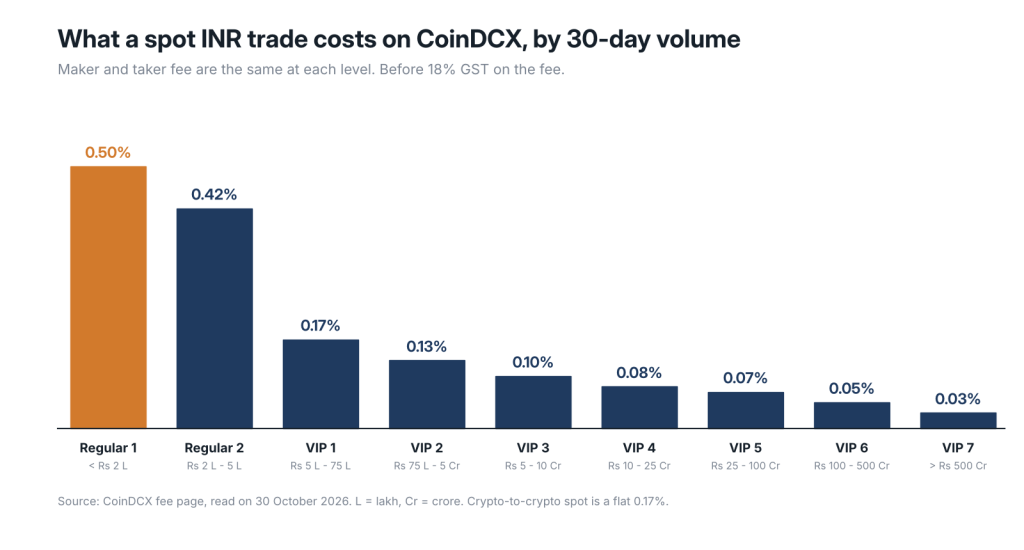
CoinDCX fees depend on your 30-day volume and the market you trade. The CoinDCX fee page lists the following spot INR rates, which are the same for makers and takers.
| Level | 30-day volume | Maker and taker fee |
|---|---|---|
| Regular 1 | Under Rs 2 lakh | 0.50% |
| Regular 2 | Rs 2 lakh to Rs 5 lakh | 0.42% |
| VIP 1 | Rs 5 lakh to Rs 75 lakh | 0.17% |
| VIP 2 | Rs 75 lakh to Rs 5 crore | 0.13% |
| VIP 3 | Rs 5 crore to Rs 10 crore | 0.10% |
| VIP 4 | Rs 10 crore to Rs 25 crore | 0.08% |
| VIP 5 | Rs 25 crore to Rs 100 crore | 0.07% |
| VIP 6 | Rs 100 crore to Rs 500 crore | 0.05% |
| VIP 7 | Over Rs 500 crore | 0.03% |
Other charges to know:
- Crypto-to-crypto spot: 0.17% for makers and takers.
- USDT-M futures: From 0.02% maker and 0.05% taker at the regular level.
- Margin interest: 0.0028% per hour, without interest in the first hour.
- GST: 18% applies on top of trading fees.
- INR deposits and withdrawals: Free.
CoinDCX withdrawal fees for crypto vary by coin and are shown on the withdrawal screen. Examples from the fee page include 1 USDC, 0.006 SOL, 0.002 BNB, and 6 DOGE.
CoinDCX Features and Products
CoinDCX offers spot trading, margin trading, and derivatives. Derivatives cover USDT-margined and INR-margined futures, commodity futures, and options. Leverage differs by token, so confirm the limit on each contract before you open a position. The platform also provides automated tax reports, which help with the 30% tax filing, and a DeFi and Web3 wallet inside the app. Beginners can stay on simple INR spot buying and ignore the rest.
Customer Support
Trustpilot reviewers describe automated replies and slow resolution on withdrawal and KYC tickets, so keep your ticket ID and screenshots. CoinDCX customer care runs 24/7 live chat in the app and on the website, with a help centre for common questions. When we checked on 30 October 2026, the website also carried a warning about fake support accounts.
Reach CoinDCX only through its own app or website, and never share an OTP or your password with anyone claiming to be support.
How to Use CoinDCX: Step-by-Step Guide
- Sign up: Create an account on coindcx.com or the app with your email or phone number.
- Verify KYC: Upload your ID documents.
- Add INR: Deposit rupees from your bank account. The minimum is Rs 500.
- Place a trade: Pick a pair, choose a market or limit order, and confirm.
- Withdraw: Send INR back to your bank, or move crypto to a wallet you control.
Who Is CoinDCX Best For?
CoinDCX suits Indian beginners and regular INR traders who want a large coin list and a simple app.
It is a weaker fit for small traders who care about the lowest fee, and for anyone unwilling to accept the wallet losses on its record.
Final Verdict
Frequently Asked Questions
Is CoinDCX legal in India?
Yes. Crypto is not banned in India, and CoinDCX is registered with FIU-IND as a virtual digital asset service provider. That registration covers anti-money laundering compliance, not a licence, because India has no dedicated crypto licensing law. You must complete KYC, and your gains are taxed at 30% with a 1% TDS on transfers.
Is CoinDCX safe to use?
CoinDCX reports that customer funds are held in cold wallets and were unaffected by its two wallet losses. Its own wallets, however, lost about $44 million in July 2025 and about $16 million in October 2026, and it absorbed both. No insurance fund is described on its security page, so keep large balances in a wallet you control.
Has CoinDCX been hacked?
Yes, in July 2025, about $44 million was taken from an internal operational account. In October 2026, it confirmed a further loss of about 15.99 million USDT from retired wallets after a sweeping service failed. It says it absorbed both losses and that customer balances were not affected. The first was a hack, and CoinDCX has not called the second one that.
What are CoinDCX fees?
Spot INR fees start at 0.50% for traders under Rs 2 lakh in 30-day volume and fall to 0.03% at the top VIP level. Crypto-to-crypto trades cost 0.17%, and 18% GST applies to fees. INR deposits and withdrawals are free. CoinDCX withdrawal fees for crypto depend on the coin and appear on the withdrawal screen.
How do I contact CoinDCX customer care?
Use the 24/7 live chat in the CoinDCX app or on its website, or the help centre for common questions. Avoid support numbers or accounts that message you first, because CoinDCX warns about impersonators. Never share an OTP or password, and report fraud to the address listed on its website.
Do I have to pay tax on CoinDCX profits?
Yes. Indian law taxes gains from crypto at a flat 30% plus cess, without set-off for losses, and a 1% TDS applies when you sell. These rules now sit in the Income-tax Act, 2025. CoinDCX provides automated tax reports to help, but check your own filing with a chartered accountant.

Our Review Methodology
At Tradelize, we follow strict editorial standards to ensure all content is accurate, unbiased, and thoroughly researched. Our reviews, guides, and articles are fact-checked by a team of experienced cryptocurrency and finance professionals, and are not influenced by advertisers or affiliate relationships. Our Trust Score methodology combines direct data scraping from official broker, exchange, and wallet websites with sentiment analysis of up to 1000 verified user reviews. This dual-source approach enables us to objectively evaluate platform features, fees, regulations, security, and customer satisfaction. We then compile comprehensive, specification-based reviews that reflect both technical details and real user experience.
Disclaimer
Trading cryptocurrencies, forex, CFDs, and other derivatives involves significant risk and may not be suitable for all investors. Leverage can amplify both gains and losses. Past performance is not indicative of future results. The content on Tradelize is for informational purposes only and does not constitute financial or investment advice. Always seek professional guidance before making financial decisions. For full risk disclosures, click here.