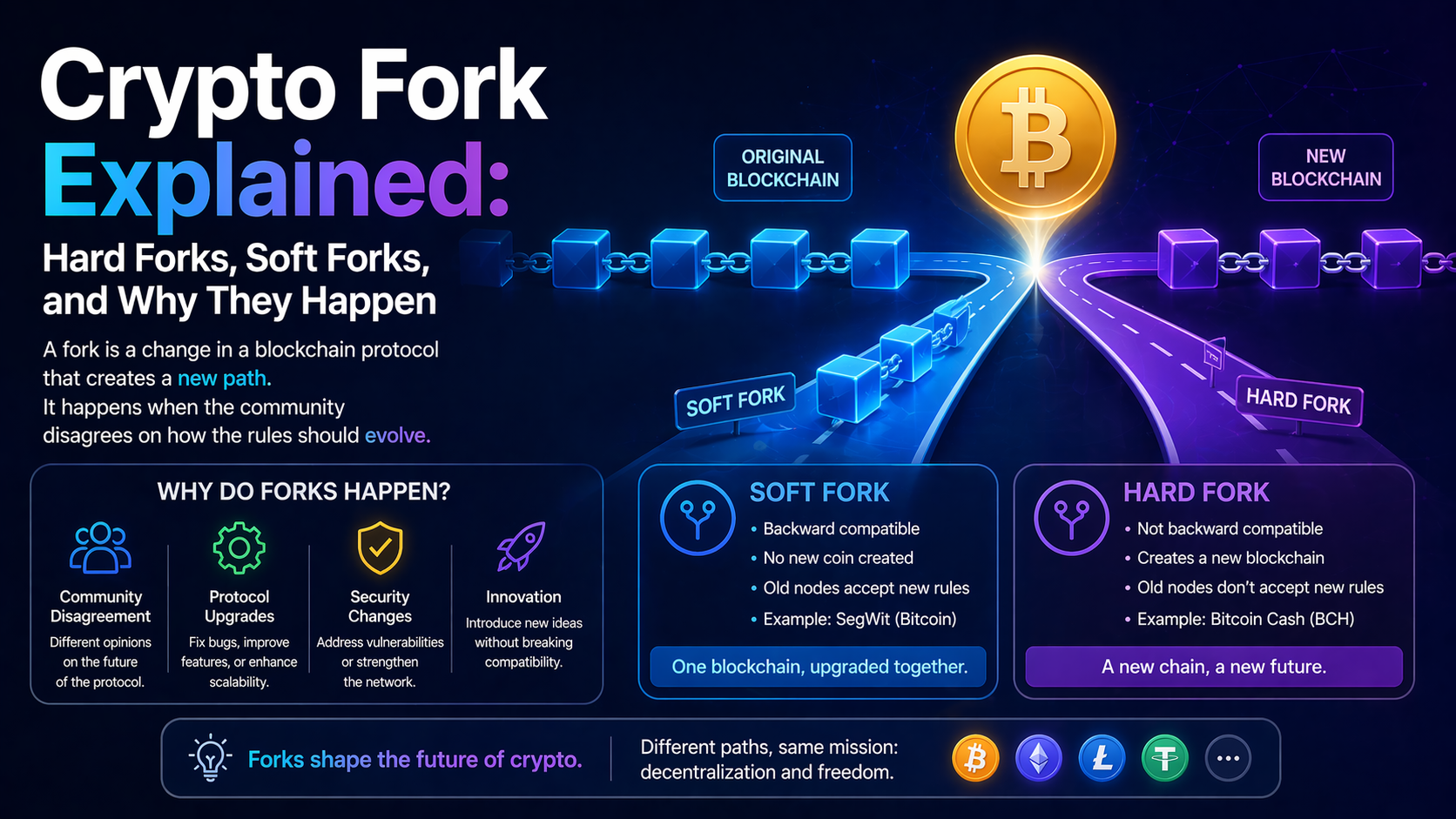
On August 1, 2017, anyone holding Bitcoin woke up to find they also held a brand-new coin they’d never bought. Bitcoin Cash had appeared in their wallets overnight, same balance, different blockchain. No purchase, no transfer. Just a split in the code, and suddenly two separate versions of “Bitcoin” existed at once.
That’s a hard crypto fork. And it’s one of the stranger things that can happen in crypto.
Forks aren’t glitches. They’re deliberate, sometimes contentious, decisions to change how a blockchain operates. Whether you’ve held crypto for years or just started, understanding what a fork actually does (and what it means for your holdings) is useful. The terminology gets thrown around a lot, usually without much explanation.
Here’s the plain version.
The first time I saw a forked coin land in a wallet I controlled, I assumed it was a glitch and nearly ignored it. It wasn’t — and understanding why changed how I read every fork announcement since.
What Is a Crypto Fork?
A crypto fork is a change to a blockchain’s protocol, the rules that govern how the network operates, validates transactions, and adds new blocks. When those rules change, the network either updates smoothly or splits into two competing chains. Which outcome you get depends on the type of fork.
Bitcoin alone has spawned over 100 forks since its launch in 2009, ranging from minor protocol upgrades to entirely new cryptocurrencies. Not all of them mattered. A handful changed the industry permanently.
The underlying logic is straightforward. Blockchains run on software. Software gets updated. When the update is backward-compatible, all nodes continue working on the same chain. When it’s not, nodes that don’t update find themselves on a different chain than the ones that did. Two separate blockchains, two separate transaction histories, running in parallel from the same point.
That split point is the fork.
How Does a Soft Fork Work?
A soft fork tightens the existing rules without breaking backward compatibility. Nodes that haven’t updated can still participate in the network, they just can’t produce blocks under the new rules. They can still validate and receive transactions. The chain stays unified.
Miners who upgrade start producing blocks under the stricter rule set. Old nodes see those blocks as valid because the new rules are a subset of the old ones, nothing new is being claimed as valid that wasn’t valid before. The updated version is just more restrictive.
This sounds technical, but the practical result is important: soft forks don’t split the network. Everyone stays on one chain. That’s why they’re generally less controversial. The community doesn’t have to choose sides.
SegWit: The Soft Fork That Fixed Bitcoin
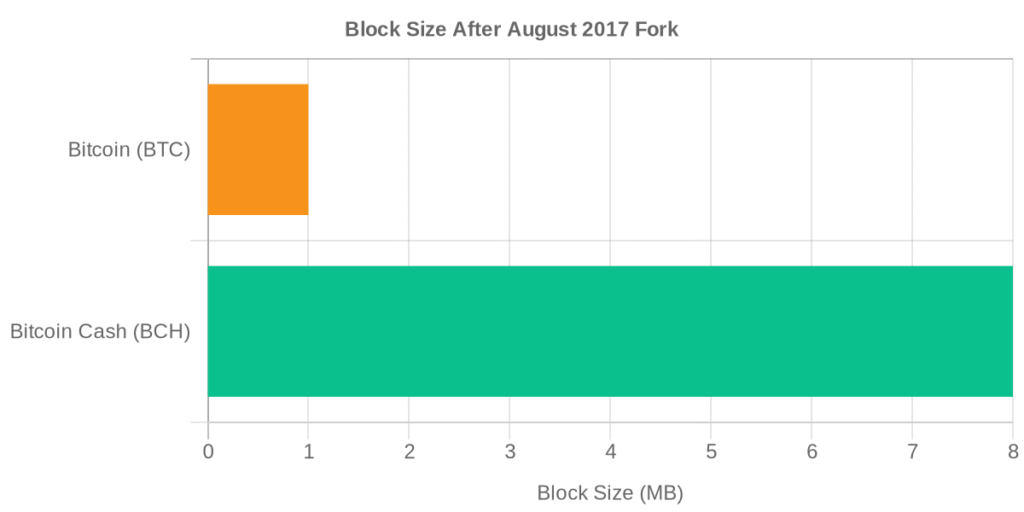
The best example is Bitcoin’s SegWit upgrade. By 2017, Bitcoin’s 1 MB block size was causing serious congestion. Transaction fees were spiking and confirmation times stretched to hours during peak periods.
SegWit’s solution was to separate signature data from transaction data, “segregated witness”, which effectively freed up space inside each block without changing the 1 MB limit. More transactions fit in the same block size.
It also fixed a long-standing vulnerability called transaction malleability, which had caused issues for the Lightning Network’s early development.
SegWit locked in when 100% of miners signaled support between blocks 477,792 and 479,807. It activated on August 24, 2017. (Bitcoin Optech) No new coin was created. No chain split. Bitcoin continued as a single network, upgraded.
How Does a Hard Fork Work?
A hard fork adds new rules that older nodes can’t accept. An unupdated node will reject blocks produced under the new rules as invalid. That’s the breaking point.
If enough miners and nodes split between the old and new rules, you end up with two active blockchains running simultaneously. Both share the same transaction history up to the fork block. After that, they diverge permanently.
Each chain has its own community, its own miners, its own development team, and, if exchanges list it, its own market price. The two versions of the coin are distinct assets. One is not a substitute for the other.
The Chain Split, What Actually Happens
The mechanics look like this: at a pre-announced block height, miners running updated software start building on the new chain. Miners running the old software continue on the original chain. Anyone transacting after the fork needs to be aware of which chain their software is pointing to.
If a hard fork produces a new coin, which it usually does when there’s a genuine community split, holders of the original asset at the fork block receive an equal amount of the new token. You don’t choose; it happens automatically. A holder of 2 BTC at the August 2017 fork block received 2 BCH in addition to their existing 2 BTC. That’s where the “free coins” reputation comes from.

Hard Fork vs. Soft Fork: What’s the Real Difference?
The distinction matters for two reasons: whether your holdings are affected, and whether the network stays unified.
| Feature | Soft Fork | Hard Fork |
|---|---|---|
| Backward compatible | Yes, old nodes still work | No, old nodes rejected |
| New coin created | No | Sometimes (if community splits) |
| Network split | No | Possible |
| Consensus required | Majority of miners | Near-unanimous or chain split |
| Recent example | SegWit (Bitcoin, 2017) | Bitcoin Cash (BCH, 2017) |
| Risk to holders | Minimal | Requires action (wallet, exchange) |
“If a vegetarian restaurant decides to add meat to their menu, that’s a hard fork: a change in the rules that is incompatible with their previous approach. But if they add vegan dishes, that’s a soft fork.” — Andreas M. Antonopoulos, author of Mastering Bitcoin and Mastering Ethereum
Soft forks are closer to software patches. Hard forks are closer to a company spinning off a division, the parent continues, but now there’s a related entity running independently.
Not every hard fork creates a lasting second coin. If the entire community agrees on the upgrade and everyone updates, you just get an upgraded blockchain. The “hard” in hard fork refers to backward incompatibility, not necessarily conflict. Ethereum’s Merge in 2022, switching from proof-of-work to proof-of-stake, was technically a hard fork that the entire community agreed on. No coin split occurred.
Why Do Crypto Forks Happen?
- Forks exist because blockchains need to evolve, and evolution in a decentralized system requires agreement that doesn’t always materialize.
- Scalability disputes. The block size wars that produced Bitcoin Cash are the defining example. One camp wanted to keep blocks small and build layer-2 solutions. The other wanted bigger blocks to handle more transactions on-chain. No consensus was reached, so the minority forked. You can read more about how centralized vs decentralized systems handle these governance conflicts.
- Security emergencies. When a critical vulnerability is discovered, the fastest fix is often a coordinated fork. The network can’t wait for slow consensus mechanisms. Bitcoin’s CVE-2018-17144 fix, a patch for a bug that could have allowed miners to create invalid blocks, was deployed this way.
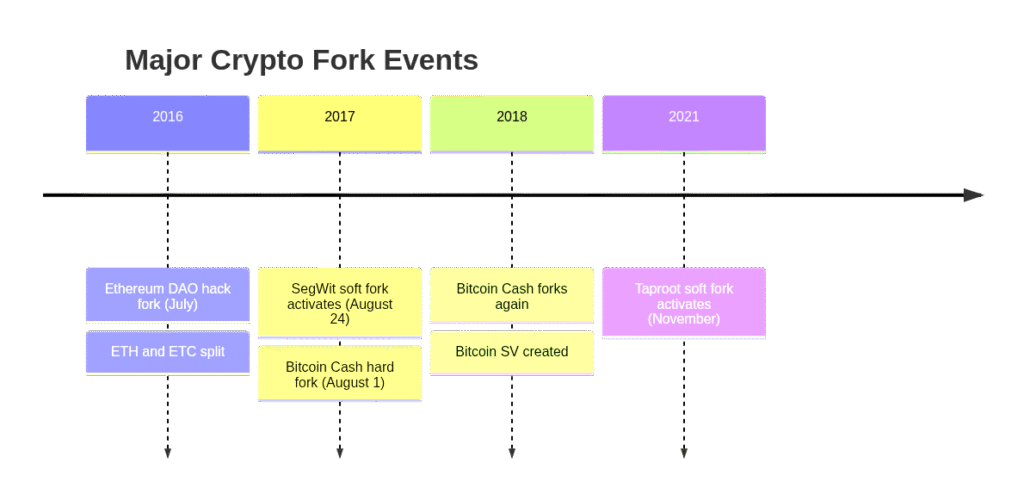
- Post-hack recovery. The DAO hack in 2016 forced Ethereum into an existential question: should an immutable ledger be altered to reverse a theft? Most of the community said yes. Some said no. The “yes” camp forked. The result was Ethereum (with the funds returned) and Ethereum Classic (the original, unaltered chain).
- Feature upgrades. New capabilities, privacy features, smart contract improvements, consensus mechanism changes, sometimes require rule changes that aren’t backward-compatible. Monero, for instance, runs scheduled hard forks every six months to implement ASIC resistance and new privacy features.
Famous Crypto Fork Examples
Bitcoin Cash (BCH), The Block Size Wars
Bitcoin’s scaling debate stretched over years. A core group of developers and miners wanted larger blocks to increase throughput. The incumbent Bitcoin Core developers rejected this, favoring SegWit and the Lightning Network as the scaling path.
When SegWit activated in August 2017, the big-block camp didn’t accept it as sufficient. On August 1, 2017, they hard forked Bitcoin at block 478,558, creating Bitcoin Cash with an 8 MB block size, eight times Bitcoin’s limit. (Coinbase, SFOX)
BCH was immediately listed on major exchanges and traded at a fraction of BTC’s price. By December 2017, it hit $4,355.62, then lost 80% of its value over the following six months as the bear market arrived. As of 2026, BCH maintains its own blockchain and community, though its market cap sits well below Bitcoin’s.
Bitcoin Cash itself later forked in 2018, producing Bitcoin SV (Satoshi Vision), led by Craig Wright’s faction, who wanted even larger 128 MB blocks. So the fork, forked.
Ethereum Classic (ETC), The DAO Hack Fork
In June 2016, an attacker exploited a reentrancy vulnerability in The DAO, a decentralized autonomous organization built on Ethereum. The attacker siphoned 3.6 million ETH, worth around $60 million at the time, into a child DAO with a 28-day lock-up period. (Gemini Cryptopedia, CoinDesk)
The Ethereum community voted to implement a hard fork to reverse the hack and return funds to original investors. The fork executed at block 192,000 on July 20, 2016.
Most of the community followed the new chain, today’s Ethereum (ETH). A minority refused, arguing that “code is law” and that reversing transactions violated blockchain’s immutability principle. They continued on the original chain, which became Ethereum Classic (ETC).
ETC holders still have the hacker’s funds on their chain. That’s a strange inheritance to sit with.
Taproot, A Successful Soft Fork
Not every fork is about conflict. Taproot is worth mentioning because it shows what smooth upgrades look like.
Taproot activated at block 709,632 in November 2021, with approximately 90% miner support. (CoinGecko) It introduced Schnorr signatures, a more efficient signature scheme, and improved Bitcoin’s privacy for complex transactions like multi-signature wallets, making them look identical to regular transactions on-chain. It also laid the groundwork for more sophisticated smart contract capabilities on Bitcoin.
No new coin. No controversy. One unified Bitcoin network, upgraded and improved.
What Happens to Your Crypto During a Hard Fork?
Your existing coins aren’t at risk. The fork doesn’t touch your holdings on the original chain, they continue as normal.
If the hard fork creates a new coin and you held the original asset at the fork block, you’ll receive an equal amount of the new token. Two caveats apply here.
First, your access depends on where you’re holding. Coins on an exchange follow the exchange’s decision, some exchanges credit the new token, some don’t, and some take weeks to evaluate. Coins in a self-custody wallet give you direct access to both chains, but you’ll need compatible wallet software and some caution about replay attacks (where a transaction broadcast on one chain is simultaneously valid on the other).
Second, the new token might be worth very little. Most fork tokens never achieve significant adoption. Bitcoin Cash is the exception, not the rule. Many hard forks produce tokens that trade briefly and then fade.
The practical checklist if a hard fork is announced:
- Check whether your exchange supports the fork and will credit the new token
- If self-custodying, confirm your wallet software is fork-aware
- Wait for replay protection to be implemented before transacting after the fork
- Don’t rush to sell the new token on day one, price is usually volatile
Conclusion: Are Crypto Forks Good or Bad?
Forks are how open-source blockchains resolve disagreements they can’t otherwise solve. In that sense, they’re a feature of decentralization, no central authority can force an upgrade, so communities fork instead of comply.
That’s genuinely useful. It means no single group can control a blockchain’s future. If a development team takes a direction the community rejects, the community can fork. That’s a meaningful safety valve.
The downside is fragmentation. Every fork dilutes community resources, developer attention, and liquidity. Bitcoin Cash, Bitcoin SV, Bitcoin Gold, and a dozen other Bitcoin descendants exist. Most of them accomplish less than the original. The fork option is real, but the subsequent network effects rarely materialize.
For holders, hard forks are mostly neutral-to-positive in the short run, you get new tokens without spending anything. Long-run impact depends entirely on whether the new chain attracts real usage.
Soft forks are almost always positive for existing holders. They upgrade the network without splitting it, which means the value doesn’t fragment.
Worth knowing before you panic: most fork announcements aren’t worth the noise they generate. The ones that mattered, Bitcoin Cash, Ethereum Classic, SegWit, Taproot, were significant for specific reasons. The rest were usually attempts to capitalize on brand recognition.
I’ve stopped reacting to fork headlines on day one. The few that mattered were obvious within weeks for concrete reasons; everything else I’ve watched fade was noise dressed up as opportunity.
Check out more educational guides on the types of cryptocurrency and how different assets work, context makes fork announcements a lot easier to evaluate.
Frequently Asked Questions
1. Does a hard fork give me free coins?
It can. If you hold the original asset in a wallet you control (or on an exchange that supports the fork) at the moment the fork occurs, you’ll typically receive an equal amount of the new token. “Free” is somewhat accurate, the coins appear without any purchase, but the new token often trades at a steep discount to the original. Most fork tokens lose value quickly.
2. What’s the difference between a hard fork and a soft fork?
A soft fork is a backward-compatible upgrade. Old nodes still function on the network; only the rules become slightly stricter. A hard fork is not backward-compatible, nodes that don’t update get left on a different chain. Soft forks keep the network unified. Hard forks can create a permanent split, sometimes generating a second coin.
3. Can a hard fork be reversed?
No. Once two separate chains exist and blocks are being added to both, there’s no rollback mechanism. Each chain’s community decides its future independently. The Ethereum/ETC split from 2016 is still running as two separate networks in 2026. That’s not an anomaly, it’s the nature of decentralized systems. No one can force a merger.
4. How do I know when a fork is happening?
Fork announcements are usually public weeks or months in advance. Watch official developer communications, Bitcoin Optech for Bitcoin-related upgrades, and major crypto news outlets. Your exchange or wallet provider will typically notify users if action is required. If you see fork announcements on social media without official confirmation from core developers, treat them with skepticism, fork scams exist.
5. Does a soft fork affect my existing holdings?
Generally no. Soft forks don’t create new coins and don’t split the network. If you’re holding on an exchange, nothing changes from your perspective. If you’re self-custodying, your wallet will continue to work normally after the upgrade. The main case where you’d need to act is if a soft fork introduces new address formats (as SegWit did), but adoption of those is typically gradual and optional.

Our Review Methodology
We evaluate each post based on thorough research, credibility of sources, accuracy of information, and relevance to our readers. Our editorial team follows strict guidelines to ensure all content meets high standards of quality.
Disclaimer
The content in this article is provided for informational purposes only and does not constitute financial, investment, or professional advice. Always do your own research before making any decisions.