
You bought some ETH six months ago. It’s been sitting in your wallet ever since. Someone tells you that staking it could earn you 3.5% a year, and suddenly you’re wondering why you haven’t been doing this the whole time.
The short answer to ‘What is crypto staking’: staking is how proof-of-stake blockchains pay participants to help run the network. Your tokens act as collateral. Validators confirm transactions. The rewards flow back to you. That part is easy to explain.
What most introductory guides gloss over while answering ‘What is Crypto Staking?’: lock-up periods that trap your funds during a crash, slashing events that can wipe a percentage of your stake, and the gap between nominal yield and what you’re actually earning after inflation. This guide covers all of it, with real APY data from April 2026, not the “up to 20% APY!” marketing copy.
What Is Crypto Staking?
Staking means locking your cryptocurrency in a blockchain network so that network can use your tokens to validate transactions. You earn newly issued tokens as payment, typically a percentage of what you staked, paid out continuously.
The banking analogy gets used a lot: it’s like depositing money in a savings account and earning interest. Not bad as entry points go. Except the “bank” is a decentralized network, your “interest rate” changes based on how many other people are staking, there’s no deposit insurance, and in some setups you can’t withdraw for weeks. So the analogy gets complicated fast.
Crypto Staking only works on blockchains that use proof of stake (PoS) consensus, or a variant of it. Let me tell you, Bitcoin doesn’t support staking; it uses proof of work. Ethereum switched from PoW to PoS in September 2022 during the Merge, reducing energy consumption by 99.95% in the process (per Ethereum Foundation data). Most major smart contract platforms now run on PoS: Solana, Cardano, Polkadot, Avalanche, Cosmos.
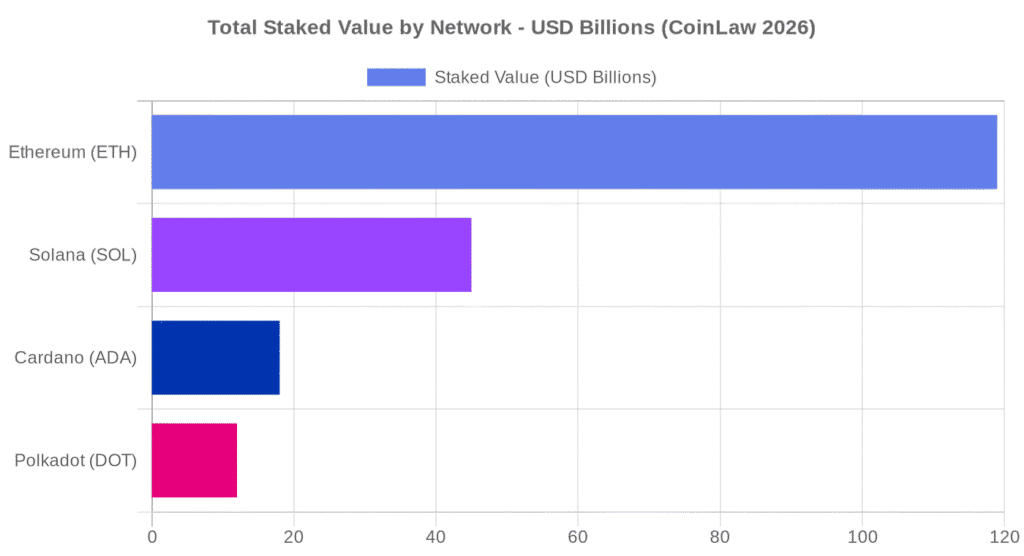
As of April 2026, roughly 45% of crypto holders participate in staking in some form, with over $245 billion staked across all major PoS chains (CoinLaw, March 2026). Ethereum alone accounts for more than $119 billion of that, 31% of all ETH supply locked in validators, per Beaconcha.in data.
How Proof of Stake Actually Works
In proof of work, miners compete to solve cryptographic puzzles. Whoever wins appends the next block and takes the reward. Energy-intensive competition. PoS replaces the hardware race with an economic one, validators are chosen based on how much capital they’ve locked up, not how fast their processors run.
The selection process works like this: a validator deposits a minimum stake (32 ETH on Ethereum, for example), gets added to the validator set, and waits to be selected by the protocol’s randomized algorithm. More stake increases your probability of selection, but it’s not purely proportional, randomization prevents any single validator from dominating block production.
Once selected, a validator proposes the next block. A committee of other validators votes to attest it. If the block checks out, it gets added to the chain and everyone who participated gets a cut.
What keeps validators honest is slashing. Malicious behavior, like trying to sign two conflicting blocks simultaneously, triggers automatic confiscation of a portion of the validator’s staked tokens. On Ethereum, a slashing event can remove anywhere from 1 ETH to the full 32 ETH stake depending on severity. Validators can also get penalized for being offline, though the penalty is much smaller than an actual slash. Since the Merge, there have been 200+ slashing events on Ethereum, most caused by configuration errors rather than intentional fraud.

The Different Ways to Stake
- Solo staking means running your own validator node and meeting the minimum deposit requirement. On Ethereum: 32 ETH (roughly $75,000–$90,000 at current prices), hardware that stays online 24/7, and enough technical knowledge to manage validator software without triggering downtime penalties. Not for most people.
- Delegated staking lets you assign your tokens to an existing validator instead of running your own. Common on Solana, Cardano, and Cosmos, and on Cardano, it’s arguably the default experience. You keep custody of your tokens (they never leave your wallet), the validator earns rewards on your behalf, and they share a cut with you. Validator selection matters: high uptime, commission rates between 5–10%, and a verifiable track record. Picking randomly isn’t free.
- Staking pools aggregate smaller holdings that don’t hit the minimum threshold. Lido and Rocket Pool are the two dominant options on Ethereum. Deposit any amount of ETH, receive a liquid staking token (stETH from Lido, rETH from Rocket Pool) representing your pool share, and keep earning rewards while that token remains tradeable. Liquid staking TVL hit approximately $86.4 billion in mid-2025, per DeFiLlama data.
- Exchange-based staking through OKX, Binance, Kraken, or Coinbase is the simplest path. Lock your tokens through the platform, rewards appear automatically. The trade-off: you’re giving up custody. If the exchange goes under, see FTX, 2022, your staked assets can go with it. The platform also takes a fee, so you’re typically earning less than native staking rates.
“Liquid staking has fundamentally changed the staking participation curve. When we removed the 32 ETH barrier and the lock-up friction simultaneously, we didn’t just attract retail — we unlocked an entirely new category of institutional treasury management. The real systemic question isn’t yield anymore; it’s what happens to Ethereum’s consensus security when 30% of validators are routed through a single protocol.”– Ethereum consensus researcher, Delphi

Which Cryptocurrencies Can You Stake?
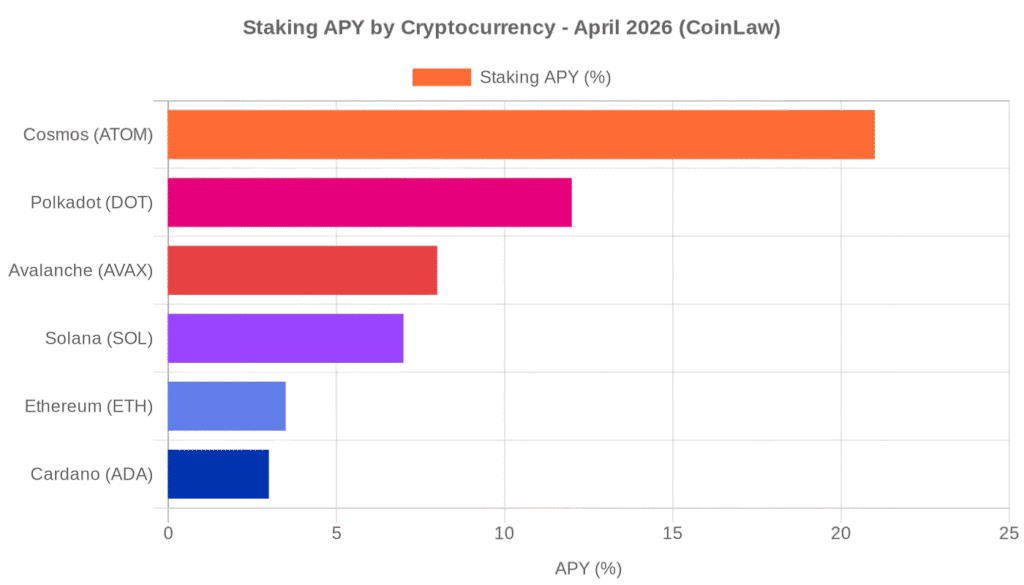
The most widely staked coins and their current APYs as of April 2026. Real yields, after accounting for each network’s token inflation, are lower for most of these.
| Cryptocurrency | APY Range | Minimum Stake | Lock-Up |
|---|---|---|---|
| Ethereum (ETH) | 3–3.5% | 32 ETH solo / any via pool | Days to weeks (queue-dependent) |
| Solana (SOL) | 6–7% | None | ~3-day warm-up/cool-down |
| Cardano (ADA) | 2.4–3% | None | None (no lock-up) |
| Polkadot (DOT) | 11.5–13% | ~250 DOT | 28 days unbonding |
| Cosmos (ATOM) | 18–21% | None | 21 days |
| Avalanche (AVAX) | 7–8% | 25 AVAX | 2-week minimum |
Data: CoinLaw, March 2026. APYs fluctuate based on total staked supply and network conditions.
A word on Cosmos’s 21% APY. ATOM’s annual supply inflation runs 7–10%, which eats a significant portion of the nominal yield. The math on high-APY chains almost always involves this offset, the network is issuing tokens faster, which means each token is worth a little less. Ethereum’s low APY (3–3.5%) reflects a large validator set; Cardano’s lack of lock-up makes it attractive for holders who want flexibility without sacrificing all yield.
For staking-compatible wallets that support multiple PoS assets, including ADA, SOL, and ATOM, Exodus is worth reviewing. Trust Wallet covers more chains and handles delegation natively on most major PoS networks.
What Are Staking Rewards and How Are They Calculated?
Staking rewards are newly issued tokens from the network’s monetary policy, distributed to validators based on participation. They’re not paid from transaction fees alone, most PoS chains still inflate their supply to fund validator incentives.
The reward rate isn’t fixed. On Ethereum, if more people stake, the APY drops. Fewer stakers, higher APY. The protocol adjusts the issuance rate to maintain a rough equilibrium: enough validators for security, not so many that the rewards become economically unsustainable. Ethereum’s current base staking yield of 3–3.5% is the result of 31% of all ETH supply already locked in validators.
Your actual take depends on four variables: the APY at the time you’re staking, the amount you stake, how long you stay in, and what happens to the token price while you’re locked.
That last one is the part worth dwelling on. Say you stake $10,000 of SOL at 7% APY for a year. You earn around $700 in staking rewards. But if SOL’s price drops 40% during that period, you end the year with roughly $6,700 in total value. The rewards didn’t cover the price decline, they just made the loss marginally smaller. Staking doesn’t hedge price risk. It adds yield on top of whatever price risk you’re already holding.
What Are the Risks of Crypto Staking?
- Lock-up periods: Once staked, tokens can’t be moved until the unbonding period ends. Polkadot’s is 28 days. Cosmos is 21 days. Ethereum unstaking involves a withdrawal queue that has stretched to several weeks during high-demand periods. During a sharp price drop, you’re watching the candle and can’t do anything about it.
- Slashing: Validator misbehavior triggers automatic penalties. If you’re delegating to a third-party validator, their mistake partially becomes yours. Research any validator’s incident history before committing. On Ethereum, slashing is relatively rare for established validators, the 200+ events since the Merge have mostly come from small operators with improper dual-signing setups, not from the major staking providers.
- Smart contract risk: Liquid staking protocols involve code holding billions of dollars. That code can have bugs. Lido has never been exploited, but smaller liquid staking protocols have. Before depositing into any liquid staking product, check how many audits the smart contracts have received and whether there’s an active bug bounty program. DeFiLlama shows TVL trends, a sudden TVL drop in a protocol is worth investigating before you add funds.
- Validator concentration: Lido controls roughly 30% of staked ETH. That’s a systemic risk point, a regulatory action, a major exploit, or governance failure at Lido would affect a material portion of Ethereum’s security layer. This isn’t a reason to avoid liquid staking entirely, but it’s a reason to consider spreading across Lido and Rocket Pool rather than concentrating in one.
- Taxes: Staking rewards are taxable as ordinary income in most jurisdictions at the time you receive them, not when you sell. That means even if the token drops 50% after rewards are distributed, you owe tax on the dollar value of the rewards at receipt. Keep records of reward amounts and token prices as they arrive. Koinly and CoinTracker both handle staking reward tracking if you need a dedicated tool.
Here’s the honest part: for most people staking ETH or SOL through reputable platforms, the day-to-day risk is lower than this section makes it sound. But knowing what can go wrong is table stakes (pun intended) before you commit capital.
How to Start Staking Crypto
The simplest path doesn’t require 32 ETH or running node software.
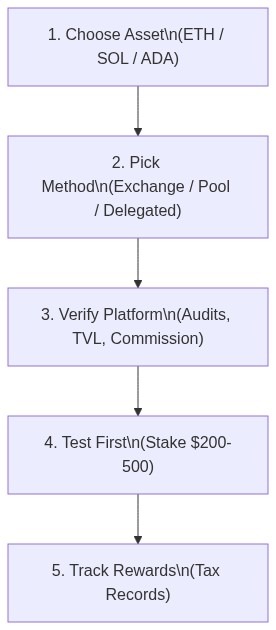
1. Pick your asset.
Ethereum and Solana are the clearest starting points for most people, established validator ecosystems, deep liquidity, and liquid staking options if you don’t want lock-up exposure. Cardano is worth considering if you want zero lock-up with modest yield and non-custodial staking.
2. Choose your method.
Exchange staking is easiest but custodial. Liquid staking via Lido or Rocket Pool is non-custodial with no minimum. Delegated staking through a wallet like Coinbase Wallet or Trust Wallet is the most direct path for SOL and ADA.
3. Verify the platform.
Before depositing, check: how many audits the smart contracts have, TVL stability over the past six months, commission rates, and any past security incidents. Staking Rewards and DeFiLlama are the most reliable sources for live APY data and TVL verification.
4. Start with a small test.
Run $200–$500 through the full cycle first, stake, wait for rewards, then unstake and verify the withdrawal process actually works as described. More than a few people have discovered withdrawal queue surprises after committing a larger position.
5. Track your tax exposure.
Staking income is taxable as ordinary income in most jurisdictions. Record the fair market value of each reward at receipt, not when you eventually sell. This gets complicated fast if you’re staking across multiple protocols, a crypto tax tool is worth the subscription fee.
Conclusion
Crypto staking offers a genuine way to earn yield on proof-of-stake assets you’re already holding, but it’s not passive income without trade-offs. As of 2026, Ethereum and Solana represent the most mature staking ecosystems for most investors: established validator sets, liquid staking alternatives, and sufficient track records to evaluate risk. So I will suggest, start small. Verify the withdrawal process before committing a full position. And treat staking rewards as a supplement to your thesis on the underlying asset
Frequently Asked Questions
1. What is crypto staking in simple terms?
Staking means locking your cryptocurrency on a proof-of-stake blockchain so the network can use your tokens as collateral for transaction validation. In return, the network pays you a percentage of new tokens it issues, typically 2–21% APY depending on the asset. It’s how PoS chains pay the participants who keep them running.
2. How much can you realistically earn from staking crypto?
As of April 2026: roughly 3–3.5% APY for Ethereum, 6–7% for Solana, and 2.4–3% for Cardano, per CoinLaw data (March 2026). Higher nominal yields, like Cosmos at 18–21%, are partially offset by token inflation, which erodes real returns. Stablecoins yield 2–6% with less price volatility risk, but introduce smart contract and protocol risk instead.
3. Can you lose money staking crypto?
Yes, through three main routes: slashing penalties if your validator behaves incorrectly, token price declines while your funds are locked in an unbonding period, or smart contract exploits in liquid staking protocols. For most users delegating to established validators on Ethereum or Solana, slashing risk is low. Price risk is always present and staking rewards alone won’t cover a major drawdown.
4. What’s the difference between staking and mining?
Mining uses computational power to solve cryptographic puzzles, it’s how Bitcoin creates new blocks. Staking uses locked capital as collateral instead of hardware. Ethereum’s switch from mining to staking reduced its energy consumption by 99.95%, per Ethereum Foundation data. Mining requires expensive, depreciating equipment. Staking requires tokens you already own.
5. What’s the minimum amount needed to start staking?
Solo Ethereum validation requires 32 ETH. But Cardano and Solana have no minimum for delegated staking, you can delegate any amount through a compatible wallet. Liquid staking pools like Lido accept any ETH amount. Most exchange staking platforms have minimums around $50–$100.
6. What is liquid staking?
Liquid staking lets you stake tokens through a protocol (like Lido for ETH) and receive a liquid token (stETH or rETH) in return. That token represents your staked position and keeps earning rewards, but you can trade or use it in DeFi without waiting out an unbonding period. The trade-off: smart contract risk on the protocol layer, and for Ethereum specifically, concentration risk.

Our Review Methodology
We evaluate each post based on thorough research, credibility of sources, accuracy of information, and relevance to our readers. Our editorial team follows strict guidelines to ensure all content meets high standards of quality.
Disclaimer
The content in this article is provided for informational purposes only and does not constitute financial, investment, or professional advice. Always do your own research before making any decisions.


