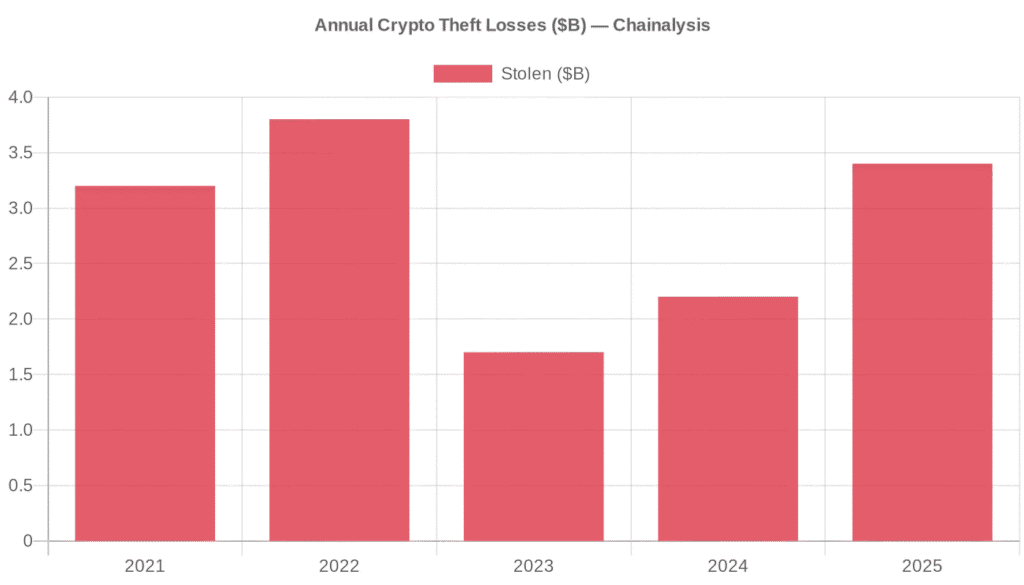
Most people pick an exchange once, fund it, and never look back. Which is fine — until it isn’t. In 2025 alone, $3.4 billion in cryptocurrency was stolen from exchanges and related platforms (Chainalysis, 2026), the highest annual figure since 2022. The question isn’t whether exchanges get compromised. It’s whether yours has the controls to survive it — and whether your account does too.
This guide walks through every meaningful security signal you should be checking, what a breach actually looks like from the user side, and which exchanges earn their “safe” reputation in 2026.
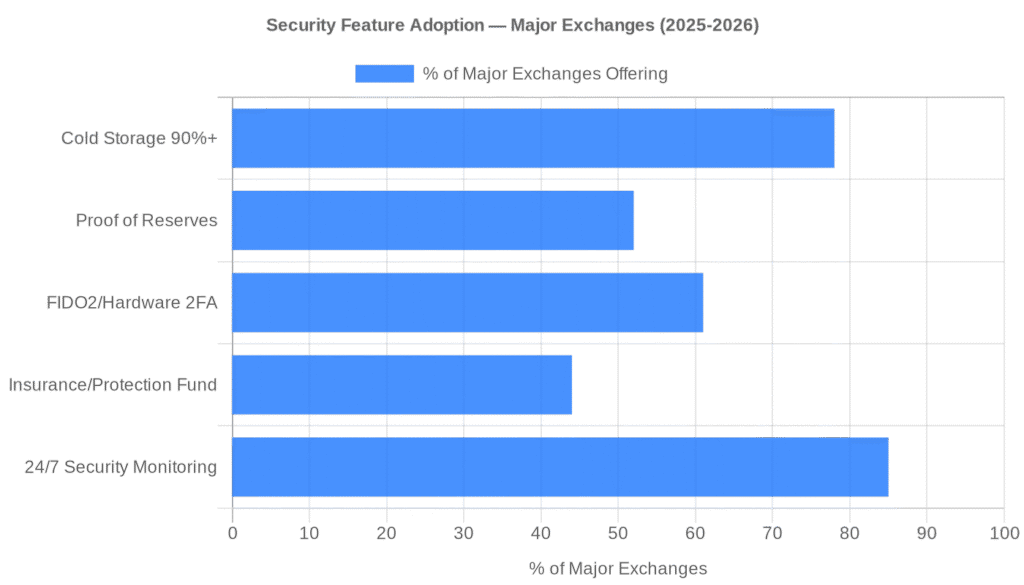
TL;DR: A safe exchange stores 90%+ of assets in cold storage, publishes independently verified proof of reserves, holds regulatory licenses in your jurisdiction, offers FIDO2/hardware-key 2FA (not just SMS), and maintains an insurance or protection fund. Enable every security feature your exchange offers, use a hardware key for 2FA, and don’t leave long-term holdings on any custodial platform. No exchange is hack-proof — what matters is whether they can cover losses if something goes wrong.
What Does “Safe Exchange” Actually Mean?
A safe crypto exchange is one that can absorb a worst-case scenario — a hack, an insolvency, a regulatory freeze — without wiping out user funds. That’s a different bar than “no one’s attacked it yet.” Several high-profile exchanges looked safe right up until they weren’t.
Security broadly comes down to five things: where funds are held, how accounts are protected, whether reserves are independently verified, whether the platform is licensed where you live, and what financial backstop exists if something fails.
Cold Storage: Where the Money Actually Sits
Cold storage means funds kept on hardware that’s physically disconnected from the internet — think air-gapped servers in secured vaults, not a laptop in someone’s office. When an exchange is hacked, it’s almost always hot wallet funds (internet-connected) that get drained. Cold storage is the primary reason major exchanges survive breaches while smaller ones don’t.
Leading platforms store 90–98% of user assets in cold storage. Coinbase stores 98%+ of customer assets offline and maintains insurance through Lloyd’s of London covering up to $255 million in hot wallet holdings. Kraken physically stores its cold storage reserves in facilities guarded 24/7 by armed security and video surveillance. That’s not marketing copy — those are disclosed operational practices you can look up.
What you should look for: any exchange claiming high security should publish their cold storage ratio. If they don’t, assume the number isn’t impressive.
Two-Factor Authentication — Not All 2FA Is Equal
Here’s the bit most guides skip. Not all two-factor authentication carries the same protection. SMS-based 2FA — where a code is texted to your phone — is vulnerable to SIM-swap attacks, where a criminal convinces your carrier to transfer your number to a new device. It happens more than you’d think, and once it does, every SMS code goes to the attacker.
NIST (the US National Institute of Standards and Technology) and CISA both explicitly recommend against SMS-based 2FA for sensitive accounts. The standard worth using is FIDO2/WebAuthn, implemented via hardware security keys like YubiKey or via passkeys. These are phishing-resistant — a fake login page can’t intercept them.
The practical check: does your exchange offer hardware key support? Binance, Coinbase, Kraken, and Gemini all do. If your exchange only offers SMS or app-based TOTP, that’s a real gap.
Proof of Reserves: Independently Verified vs. Pinky Promises
Post-FTX, “we have your funds” became a phrase that needed evidence behind it. Proof of Reserves (PoR) is the mechanism exchanges use to prove they actually hold the assets they claim — typically via a Merkle tree audit where users can verify their own balance is included in the total.
The important word is independently. Self-published reserve snapshots are better than nothing. Third-party audits from firms like Hacken or Mazars are significantly more meaningful. Binance publishes monthly PoR reports — 40 consecutive as of early 2025. Kraken pioneered the practice back in 2014 and still does it. Coinbase, notably, doesn’t publish PoR audits, relying instead on its status as a publicly listed company (subject to SEC scrutiny) as a proxy for transparency.
Since around 2025, the industry has started moving from point-in-time annual audits toward real-time reserve dashboards. That’s the direction things are heading — anything less is increasingly a red flag.
Regulatory Licensing: Why Jurisdiction Matters
An exchange regulated in your country is meaningfully safer than one offshore. Regulation means the exchange meets minimum capital adequacy requirements, follows anti-money-laundering rules, and — critically — gives you legal recourse if something goes wrong.
Unregulated offshore exchanges might offer higher leverage or more exotic assets, but the trade-off is real: if they disappear with your funds, legal recovery is extremely difficult. The CFTC and SEC have both warned consumers that exchanges incorporated outside the US make legal action “very difficult.”
Regulated exchanges to note in 2026: Kraken and Coinbase (US), Gemini (US, NYDFS licensed), Bitstamp (Luxembourg), Crypto.com (multiple jurisdictions).
Protection Funds and Insurance: The Last Line of Defence
The most mature safety mechanism is a dedicated fund to compensate users if a breach happens. These work like exchange-level insurance.
Binance’s SAFU (Secure Asset Fund for Users) holds over $1 billion in reserves. Bitget’s Protection Fund started at $300 million in 2022 and had grown to over $600 million — backed by 6,500 BTC — as of early 2026. Crypto.com carries private crime and custody insurance totaling more than $750 million, with an additional institutional cold-storage layer of around $120 million.
These funds don’t cover everything. They have limits, conditions, and exclusions. But they’re meaningfully better than nothing — which is what most smaller exchanges offer.
Why Should You Even Worry? The Hack Numbers Don’t Lie
The answer to “is this actually a real risk?” is: yes, demonstrably. Crypto theft in 2025 wasn’t a freak event. It was a pattern.
The Bybit Moment That Changed the Conversation
In February 2025, Bybit — one of the world’s largest derivatives exchanges by volume — was hit for $1.4 billion in cryptocurrency. It remains the largest centralized exchange hack ever recorded. The attackers didn’t brute-force their way in; they exploited a vulnerability in the exchange’s multi-signature wallet infrastructure through a sophisticated supply-chain-style attack.
Bybit survived. They had sufficient reserves to cover the loss and continued operations. But the incident exposed how even well-resourced, security-conscious platforms can be targeted — and how much depends on what happens after an attack, not just before it.
“In the short time since the hack,” industry analysts noted, “the $1.4 billion theft has reshaped expectations for what a ‘well-capitalized’ exchange needs to hold in reserve.”
A Short History of Exchange Failures
The Bybit hack wasn’t a one-off. Exchange hacks and collapses have been a recurring theme since Bitcoin became tradeable:
- Mt. Gox (2014) — then the world’s largest Bitcoin exchange, lost roughly $660 million in BTC. It took users nearly a decade to recover partial funds through bankruptcy proceedings.
- Bitfinex (2016) — $72 million in BTC stolen via compromised multisig wallets. Bitfinex survived by issuing recovery tokens to users and gradually buying them back.
- FTX (2022) — not a hack, but a collapse driven by misuse of user funds. $8 billion in customer money gone. No insurance fund. No reserve backing. Users are still waiting for distributions.
- Bybit (2025) — $1.4 billion, as above. Exchange survived and compensated users.
- Phemex (2025) — $73 million stolen in a hot wallet compromise.
The pattern: exchanges that survive are ones with cold storage, reserve buffers, and real insurance. Ones that don’t have those things don’t make it through a serious breach.
North Korean state-backed hacker groups were responsible for $2.02 billion of all crypto stolen in 2025, according to Chainalysis — an increase of $681 million over 2024. These aren’t opportunistic script kiddies. They’re sophisticated, well-funded operations targeting specific exchange infrastructure.
How Do You Actually Check If Your Exchange Is Safe?
Here’s the practical side. Theoretical safety features don’t help if you can’t verify them for your specific platform.
1. Check the exchange’s regulatory status. Visit their “About” or “Legal” page. They should name at least one regulator and provide a license number. In the US, look for FinCEN MSB registration (minimum) or NYDFS BitLicense (stronger). In Europe, look for MiCA compliance or national crypto asset service provider registration.
2. Find their cold storage disclosure. Most reputable exchanges publish this in their security or transparency sections. “Majority in cold storage” isn’t enough — look for a percentage. Anything under 90% is below the industry standard set by the largest platforms.
3. Look up their PoR status. Check milkroad.com/exchanges/proof-of-reserves/ for a running list of exchanges that publish PoR audits with third-party verification. If your exchange isn’t on any list and doesn’t mention PoR anywhere, that’s a real gap.
4. Verify their insurance or protection fund. A protection fund with a published balance and verifiable reserves is meaningful. “We take security seriously” is not.
5. Test your own account security. Log in, go to security settings, and check: Can you enable a hardware key or passkey? Do they offer withdrawal whitelisting (approving only specific wallet addresses)? Do they send notifications on new device logins? These features should all be there.
Red Flags That Should Make You Move
Some signals are harder to ignore:
- No regulatory license, no jurisdiction disclosure
- Promises of guaranteed returns or “risk-free” yields — the CFTC has flagged this exact language as classic fraud scripting
- Exchange asks you to move funds to an “external wallet” they provide — that’s a scam pattern, not a legitimate security measure
- Withdrawal requests take more than 1–3 business days without explanation
- No published security documentation, no named security team, minimal social media presence
- Customer service complaints about funds being held or frozen without cause
Thirty percent of crypto owners have reported a breach (Beyond Identity, 2024). That’s not a niche risk. If any of the above apply to your exchange, move first, ask questions later.
What Happens If Your Exchange Gets Hacked?
Short answer: it depends entirely on which exchange and what kind of insurance they carry.
What Exchanges Are Supposed to Do
If a licensed, well-capitalised exchange is breached, the playbook typically goes:
- Halt withdrawals and deposits immediately to contain the damage
- Assess the scope — which wallets, which assets, estimated total
- Notify users and regulators (regulatory requirement in most licensed jurisdictions)
- Deploy reserve fund or insurance to cover affected user balances
- Restore operations once the vulnerability is patched and audited
The key variable: whether the exchange has sufficient reserves and a real compensation fund. Bybit had both, and covered the $1.4 billion breach without user losses. FTX had neither — and collapsed.
What You Should Do Immediately
If your exchange announces a hack, or if you notice unauthorised activity:
I’ve been in this situation — or close enough to it. When one exchange I used paused withdrawals “for scheduled maintenance” during a period when the broader market was down 20% in 48 hours, the temptation was to do nothing and wait. Don’t. Within 20 minutes I had two-factor codes reset, all my other exchange accounts reviewed for shared passwords, and my hardware wallet addresses double-checked. It turned out to be genuinely routine maintenance. But those 20 minutes of triage cost nothing and would have been valuable if it wasn’t.
The practical steps: change your exchange password immediately, revoke any API keys connected to the account, check your email for any unauthorized login notifications, and confirm your withdrawal destination addresses. If funds are locked, file a formal support ticket — a written record matters for any eventual claim process.
How to Protect Yourself Beyond the Exchange
Here’s the part most people skip until after something goes wrong: your own account security.
The Hardware Wallet Question
The safest place for any crypto you don’t actively trade is not on an exchange. It’s in a self-custody wallet, ideally a hardware wallet (Ledger, Trezor, Coldcard). Hardware wallets store your private key on a physical device that never exposes it to the internet — meaning a compromised exchange, a phished website, or an infected computer can’t touch it.
The trade-off is responsibility: if you lose the device and the seed phrase, there’s no recovery. No customer support, no fund insurance. That’s a real cost worth understanding before you move everything off-exchange.
Practical split: for most people, keeping active trading funds on a reputable exchange and moving long-term holdings to a hardware wallet is the sensible middle ground. An exchange that stores 95% in cold storage is protecting their infrastructure — it doesn’t protect your specific account if your login is compromised.
Security Habits That Actually Matter
A few things that genuinely reduce risk and take under 10 minutes:
Upgrade your 2FA. Delete SMS 2FA. Replace it with an authenticator app at minimum (Google Authenticator, Authy). Better: use a hardware key. Kraken, Coinbase, and Binance all support FIDO2. It’s not optional if you’re holding significant value.
Enable withdrawal whitelisting. Most major exchanges let you restrict withdrawals to pre-approved wallet addresses. Even if someone gets into your account, they can’t move funds anywhere new without your approval.
Use a dedicated email. Your crypto accounts should not use the same email address as your Reddit, Amazon, or social media. A breach on one platform becomes a vector for all of them otherwise.
Set login alerts. Turn on notifications for every new device or IP address login. These are the fastest early warning system you have.
The Safest Crypto Exchanges in 2026: Quick Reference
For people comparing centralized exchanges on security specifically, here’s a summary of the leading platforms and their key safety credentials in 2026:
| Exchange | Cold Storage | PoR Published | Insurance / Fund | Regulation |
|---|---|---|---|---|
| Kraken | “Vast majority” | Yes (since 2014) | Partial hot wallet | US (FinCEN), EU (multiple) |
| Coinbase | 98%+ | No formal PoR | $255M Lloyd’s (hot wallet) | US (publicly listed, SEC) |
| Gemini | 95%+ | Yes | SOC 2 compliant, limited insurance | US (NYDFS BitLicense) |
| Bitget | 95%+ | Yes | $600M Protection Fund | Multiple jurisdictions |
| Binance | 92%+ | Yes (monthly) | $1B+ SAFU fund | Multiple jurisdictions |
| Crypto.com | 93%+ | Yes | $750M private insurance | Multiple jurisdictions |
No exchange on this list has never been hacked. Several have had incidents of varying severity. What separates these platforms is what happened after — which is exactly the question to ask before you choose one.
For a deeper look at how these platforms compare on fees, liquidity, and asset selection, see the full best crypto exchanges guide.
The Bottom Line: Is Your Crypto Exchange Safe?
The honest answer is: probably — if you’re on one of the major licensed platforms and you’ve enabled the security features they offer. The $3.4 billion stolen in 2025 didn’t come primarily from users on well-secured, well-capitalised exchanges. It came from protocol exploits, smaller platform breaches, and individual account compromises where basic security hygiene was missing.
Your exchange’s cold storage ratio and protection fund are things they control. Your 2FA setup, password hygiene, and whether you’re holding long-term savings on a custodial platform — those are things you control. Both matter. Don’t outsource all of it to the exchange.
If you’re unsure about your specific platform, run through the five-point checklist above. And if the exchange fails more than two of those checks, it’s worth considering a move to one that doesn’t.
Frequently Asked Questions
Are crypto exchanges insured like bank accounts?
No — and this is an important distinction. Bank deposits are typically insured by government schemes (FDIC in the US, FSCS in the UK) up to fixed limits. Crypto exchanges have no equivalent government guarantee. The best platforms carry private insurance or maintain internal protection funds (Coinbase’s Lloyd’s policy, Bitget’s $600M fund), but coverage is limited, conditional, and varies widely by exchange. Never assume your crypto is insured unless you’ve read what the exchange actually covers.
Is it safe to leave crypto on an exchange long-term?
For actively traded funds, a reputable licensed exchange is a reasonable custodian — provided you’ve enabled all security features on your account. For long-term holdings you don’t intend to trade, a hardware wallet gives you full custody and removes exchange-counterparty risk entirely. The rule most security professionals follow: don’t keep more on exchange than you’d be comfortable losing in a worst-case breach.
Is any crypto exchange 100% secure?
No. The $1.4 billion Bybit hack in 2025 demonstrated that even well-resourced, security-focused exchanges operating for years can be successfully targeted. “Secure” in this context means “has the controls and reserves to absorb a breach without user losses” — not “has never been attacked.”
What is proof of reserves and why does it matter?
Proof of Reserves is a cryptographic audit where an exchange proves it actually holds the assets it claims on behalf of users. Using a Merkle tree, individual users can verify their balance is included in the published total. It matters because it makes fabricated reserve claims nearly impossible — and it’s the main mechanism the industry developed after the FTX collapse, where user funds had been quietly misappropriated for months.
What should I do if my exchange gets hacked?
Change your password immediately. Revoke any active API keys. Enable any withdrawal locks or freeze features the exchange offers. File a formal support ticket with a written record of your balance at the time. Monitor your email for unauthorized access notifications. If the exchange is licensed, a regulatory body (FinCEN, FCA, or your local equivalent) can be contacted. Don’t assume the exchange will proactively update you — the most important thing in the first hours is securing your account from further compromise.
Always verify exchange security disclosures directly on the platform before making custody decisions. Crypto is not government-insured. This guide is for informational purposes — not financial advice.

Our Review Methodology
We evaluate each post based on thorough research, credibility of sources, accuracy of information, and relevance to our readers. Our editorial team follows strict guidelines to ensure all content meets high standards of quality.
Disclaimer
The content in this article is provided for informational purposes only and does not constitute financial, investment, or professional advice. Always do your own research before making any decisions.