A private key is a randomly generated 256-bit number that proves ownership of your cryptocurrency. It generates your public key, signs every transaction you send, and cannot be recovered if lost. Roughly 3.7 million Bitcoin — worth hundreds of billions at peak prices — is permanently locked because owners lost their private keys (Chainalysis, 2020). Keep it offline. Share it with no one.
What Is a Private Key in Crypto?
A private key is a randomly generated string of characters that gives you — and only you — the ability to authorize transactions from your crypto wallet. Think of it as a master password that can never be reset. If you hold the private key to a wallet address, you own whatever crypto sits there. If someone else gets it, so do they.
Bitcoin private keys are 256-bit numbers: any value between 1 and 2^256. That range is so large — roughly 10^77 possible values — it exceeds the estimated number of atoms in the observable universe. No computer can guess your private key through brute force. Per NIST guidelines on cryptographic key management, 256-bit keys provide sufficient security against all known classical computing attacks. The security isn’t in obscuring the algorithm; it’s in the sheer scale of the number space.
The stakes are real. According to blockchain analytics firm Chainalysis, approximately 3.7 million Bitcoin is estimated to be permanently inaccessible because owners lost their private keys. That figure doesn’t shrink. There’s no “forgot my password” for Bitcoin — once the key is gone, the funds are gone with it.
How Do Public and Private Keys Work Together?
Most explanations get abstract here. Let’s be concrete instead.
Your public key is mathematically derived from your private key using elliptic curve cryptography (ECC) — a type of asymmetric encryption standardized in NIST FIPS 186-5. The math works in one direction: given a private key, you can always calculate the public key. Given only the public key, reversing that calculation is computationally infeasible. Cryptographers call this a “trapdoor function.” Easy one way, essentially impossible the other.
Your public key then gets run through a hashing algorithm to produce your wallet address — the alphanumeric string you share with people to receive crypto. So the generation chain is:
Private key → (ECC) → Public key → (Hash) → Wallet address
You share the wallet address freely. The public key is sometimes visible when you sign a transaction. The private key never leaves your control — or shouldn’t.

This structure lets the entire blockchain network verify your transactions without ever knowing your private key. Everyone can confirm that a valid signature came from the holder of a given address. Nobody can work backwards to identify who that holder is unless you tell them.
What Does a Private Key Actually Look Like?
A raw Bitcoin private key is a 256-bit binary number, but nobody works with those directly. You’ll encounter private keys in a few practical formats:
Hexadecimal (64 characters) The standard raw format. Letters A-F and digits 0-9. Example: E9873D79C6D87DC0FB6A5778633389F4453213303DA61F20BD67FC233AA33262
WIF — Wallet Import Format A compressed base58 encoding that starts with “5”, “K”, or “L”. Shorter and easier to copy without errors. Looks like: 5HueCGU8rMjxECyDialwujzZuZMFnhWYVeqJHLZb1sTZJBJk
Seed phrase (mnemonic) Not technically the private key itself — it’s the master seed that generates it, plus every other key in a hierarchical wallet. Twelve or 24 plain English words: something like “correct horse battery staple zebra ocean table lamp river valley forest dream.” This is what hardware wallets show you during setup, and the format most people should be backing up.
Worth understanding: seed phrases and private keys aren’t the same thing. Lose a single private key and you lose access to one address. Lose the seed phrase and you lose access to every address the wallet ever generated. Back up the seed phrase. For more on the fundamentals of how cryptocurrency works, that guide covers the basics.
How Does a Private Key Sign a Transaction?
When you send crypto, your wallet doesn’t broadcast your private key to the network. That would defeat the entire point. Instead, it uses the private key to produce a digital signature — a piece of cryptographic math that proves you authorized this specific transaction, without revealing the key itself.
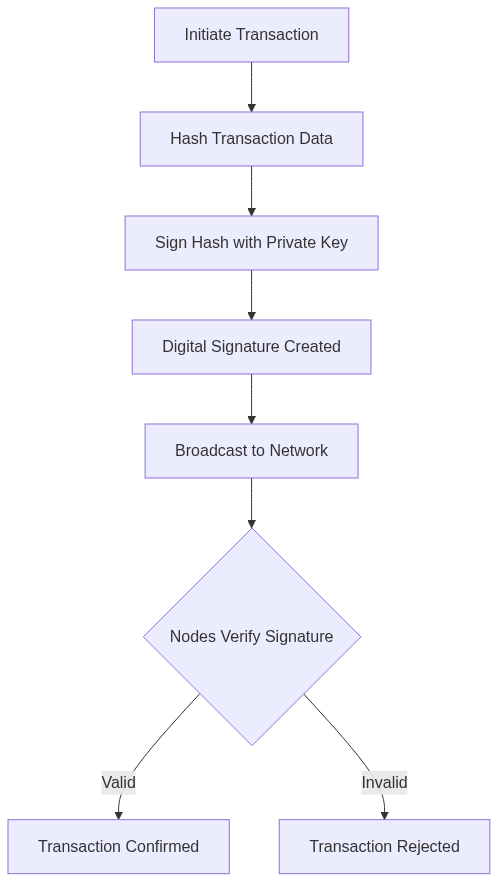
The signing process step by step:
- You initiate a transaction (send 0.1 ETH to address X)
- Your wallet creates a cryptographic hash of the transaction data
- The private key is used to sign that hash, producing a unique signature
- The signature and transaction data are broadcast to the network
- Network nodes verify: does this signature match the public key for this address? If yes — valid. If no — rejected.
The signature is unique to that transaction. Capture a signature from a previous transaction and it can’t be reused. Run the math backwards on a signature and you still can’t extract the private key. The math is one-way in every direction that matters for an attacker.
This is why blockchain self-custody works at scale. Millions of transactions process daily without a central authority checking identity. The cryptography itself is the identity verification.
Where Is Your Private Key Stored?
Wherever your wallet is — but the “wherever” matters enormously.
Custodial wallets (exchanges: Coinbase, Binance, Kraken) The exchange holds your private keys. You’re trusting their security team, not running your own. Convenient for active trading. Not self-custody. If the exchange is hacked, goes bankrupt, or freezes withdrawals — your access goes with it.
Software wallets (MetaMask, Trust Wallet, Phantom) Keys are encrypted and stored on your device — phone or laptop. More control than an exchange. Still connected to the internet (“hot”), which means malware or a compromised device is a real attack vector.
Hardware wallets (Ledger, Trezor) The private key is generated and stored on a dedicated secure chip that never connects to the internet. To sign a transaction, you physically confirm it on the device. The private key can’t be extracted even if your computer is fully compromised. This is “cold storage.”
Paper wallets The private key (or seed phrase) is written on paper and stored physically. Air-gapped from every network. Main risks: fire, flood, physical theft, someone finding it in a drawer. Popular in early Bitcoin days. Hardware wallets have largely replaced this approach for most users.
| Storage Method | Security | Convenience | You Hold Keys? |
|---|---|---|---|
| Exchange (custodial) | Medium | High | No |
| Software wallet | Medium | High | Yes |
| Hardware wallet | High | Medium | Yes |
| Paper wallet | High (if secured) | Low | Yes |
The old crypto maxim captures it precisely: “Not your keys, not your coins.” If you don’t control the private key, you hold an IOU from whoever does. Check our crypto wallet reviews for comparisons of specific wallets across these categories.
How Do You Keep Your Private Key Safe?
A few principles that actually matter — not a 30-point checklist:
Never share it. Period. There is no legitimate scenario where a support agent, exchange employee, Ledger representative on Discord, or “recovery specialist” needs your private key. None. The moment someone asks for it, that’s the scam. Real support can help you without your private key because they don’t need it to help you — and the blockchain doesn’t either.
Back up your seed phrase physically, not digitally. Don’t screenshot it. Don’t type it into a notes app. Don’t email it to yourself. Don’t store it in a cloud password manager. Write it on paper. Better: engrave it on metal if the holdings justify the effort. Store it somewhere physically secure.
Use a hardware wallet for significant holdings. Set your own threshold — maybe $500, maybe $5,000, whatever you’d be genuinely upset to lose. Below that, a software wallet is fine for convenience. Above it, the $80-200 for a hardware wallet is real insurance. Not optional insurance. Real insurance.
Keep backups in separate physical locations. The biggest real-world risk for most people isn’t sophisticated hacking — it’s fire, flood, or moving house and losing track of where the backup is. One copy at home, one copy somewhere else (safe deposit box, trusted family member’s location). Separate the failure modes.
The model is simple: private key offline, backups physically separated, anyone who asks for it gets nothing. That’s it.
What Happens If You Lose Your Private Key?
You lose permanent access to the crypto in that wallet. Full stop.
No blockchain helpdesk. No recovery form. No Bitcoin Foundation customer service. The network has no concept of identity — it only processes valid or invalid signatures. Without the private key, no valid signature can be produced, and the funds are frozen in that address forever.
I’ve watched people go through this in crypto communities — genuinely convinced that if they explained their situation clearly enough, to enough people, someone would find a way through. They tried contacting Coinbase support (for a self-custody wallet Coinbase has nothing to do with), the Bitcoin Foundation, paid recovery specialists. None of it worked. It never does. The math doesn’t have an exception clause for honest mistakes or compelling circumstances.
That Chainalysis figure bears repeating: approximately 3.7 million Bitcoin is considered permanently lost — locked in addresses visible on the blockchain, balances sitting there, unmovable. Every satoshi trackable. None of it accessible.
One partial lifeline exists: if you’ve lost your seed phrase backup but still have the device with the wallet app installed and you remember the wallet PIN/password, the app may still be able to display or export your key while it remains accessible on the device. Act immediately if that’s your situation — don’t uninstall the app, don’t factory reset the phone.
If both the device and the backup are gone? There’s no path forward. This is why backup discipline isn’t a “nice to have.” It’s the single most consequential security decision in self-custody crypto. See our cryptography and network security guide for the broader context on how these systems are built.
The Bottom Line on Crypto Private Keys
Your private key is the cryptographic proof of ownership at the core of every blockchain. It generates your wallet address, signs every transaction you authorize, and — if lost — cannot be recovered by anyone, anywhere, under any circumstances. That combination of power and irreversibility is what makes self-custody both the most secure form of crypto ownership and the one that demands the most responsibility.
Practically: software wallet for small amounts you’re actively using, hardware wallet for anything significant, seed phrase backed up in two physical locations, and a standing policy of never sharing your key with anyone who asks. That’s the whole framework.
For a deeper look at how cryptography underpins blockchain security at the protocol level, see our guide to cryptography and network security.
Frequently Asked Questions
What is the difference between a private key and a seed phrase?
A seed phrase (mnemonic phrase) is 12-24 words that generate a master private key. From that master key, your wallet derives individual private keys for each crypto address it creates. Lose the seed phrase and you lose access to every address that wallet ever generated — which is why it’s more important to back up than any single private key.
Can you recover a lost private key?
No. There is no recovery mechanism for a lost private key in a self-custody wallet. Blockchain networks have no user accounts, no identity records, and no authority that can grant access without a valid signature. Your only recovery option is a backup you made before losing access — a seed phrase written down, an encrypted wallet backup file, or the original private key recorded somewhere. If no backup exists, access is permanently gone.
What is the difference between a private key and a public key?
A private key is kept secret and used to sign transactions — proving you authorized them. A public key is derived from the private key and shared openly — it’s used to verify those signatures and is the basis of your wallet address. The math is one-way: private → public is straightforward. Public → private is computationally infeasible with current technology.
What does a private key look like?
In raw hexadecimal format, a Bitcoin private key is 64 characters of letters (A-F) and numbers (0-9). Example: E9873D79C6D87DC0FB6A5778633389F4453213303DA61F20BD67FC233AA33262. Most users interact with private keys through a 12 or 24-word seed phrase instead, which is far easier to write down and back up accurately.
Is my private key stored on the blockchain?
No. Your private key is never broadcast to or recorded on the blockchain. Only your public wallet address and transaction signatures appear on-chain. The private key exists only where you store it — in your wallet application, hardware device, or physical backup. The network verifies that a transaction was signed with the correct key without ever seeing the key itself.

Our Review Methodology
We evaluate each post based on thorough research, credibility of sources, accuracy of information, and relevance to our readers. Our editorial team follows strict guidelines to ensure all content meets high standards of quality.
Disclaimer
The content in this article is provided for informational purposes only and does not constitute financial, investment, or professional advice. Always do your own research before making any decisions.

